
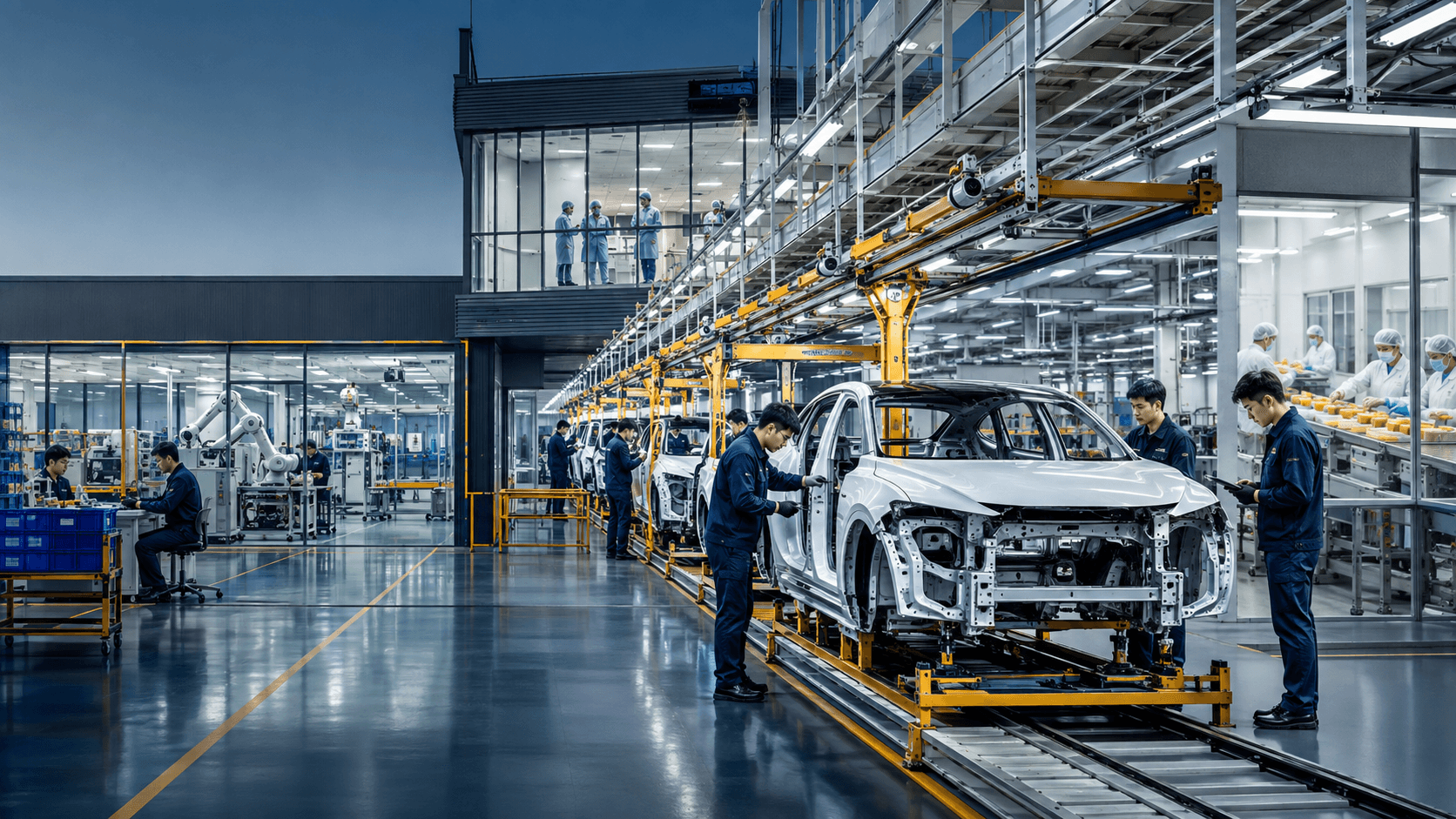
Conceptual editorial image — not a photograph of the specific event described.
Thailand's National EV Policy Committee Approves Principle of Tying EV Excise Tax to Local Production
At its meeting on 10 September 2026 the National Electric Vehicle Policy Committee approved, in principle, restructuring electric-vehicle excise tax so that rates reflect investment, production and local content inside Thailand. No rate schedule has been issued. The committee also recorded that BEV, HEV and PHEV vehicles made up 55 percent of new car registrations in the first seven months of 2026.
source verified
Thailand's National Electric Vehicle Policy Committee has approved, in principle, a restructuring of electric-vehicle excise tax designed so that rates reflect the benefit a manufacturer generates inside Thailand. According to a press release from the Thailand Board of Investment dated 10 September 2026, Narit Therdsteerasukdi — BOI Secretary General and committee member and secretary — said the committee met that day under the chairmanship of Deputy Prime Minister and Finance Minister Ekniti Nitithanprapas and agreed the principle as a mechanism to move Thailand's vehicle and parts industry toward being a global production base across all technologies.
The release sets out five principles behind the proposed structure: investment-driven import, tying import conditions to real production investment in Thailand; building Thailand as a regional and global export hub for electric vehicles; raising the use of high value-added local parts and raw materials, alongside employment and skills development; a level playing field between locally made and imported vehicles; and development of local parts suppliers. Under the proposal, rates would step down across four situations — vehicles imported by a party with no manufacturing plant in Thailand would face the highest rate; manufacturers that already have a Thai plant but need to import certain models to test the market would face import volume limits set against the economic value they generate in Thailand; locally made vehicles with medium local content that cannot yet use key locally made electronic parts, particularly low-volume premium models, would sit lower; and locally made vehicles using a high level of local content, especially key electronic parts, would sit lowest. The BOI describes this as a principle agreed by the committee; no rate schedule has been published.
The committee also approved two subcommittees. One, on promoting modern vehicle and parts manufacturing, is chaired by the Minister of Industry and covers the production chain across the vehicle life cycle, including systematic management of used electric-vehicle batteries and end-of-life vehicle disposal. The other, on charging infrastructure, is chaired by the Minister of Energy and covers building out charging capacity and updating the related regulations. The Permanent Secretary of the Ministry of Finance was asked to study measures to encourage greater use and production of commercial electric vehicles and electric motorcycles.
On the numbers, the release records that in the first seven months of 2026 battery electric vehicle registrations reached 126,950 units, up 88 percent on the same period a year earlier, and that BEV, HEV and PHEV vehicles together accounted for 55 percent of all new car registrations. As at 31 August 2026 the BOI had promoted 189 electric-vehicle and related projects worth 151,372 million baht, with battery manufacturing the largest category at 87,073 million baht, followed by BEV manufacturing at 38,563 million baht and key parts manufacturing at 12,558 million baht. Promoted charging station projects plan 23,135 charging points in total, of which 10,249 are quick-charge points. The release adds that Mitsubishi, Honda, Mazda and Isuzu, all with existing plants in Thailand, plan more than 50,000 million baht of further investment in new models, automation and robotics, and HEV, MHEV and other electrified technologies.
This article is general orientation only and is not tax or legal advice. The committee has approved a principle, not final rates, and excise policy is subject to change. Readers with a commercial interest should confirm the current position with the responsible Thai authorities before acting.
Sources and Verification
Thailand Board of Investment (BOI), secretariat to the National Electric Vehicle Policy Committee
Thailand's National EV Policy Committee Approves Principle of Tying EV Excise Tax to Local Production
- Publication date:
- Last checked:
Author / publisher: T3 — The True Thailand
Related T3 Pages
T3 provides this independently prepared summary for general information. Facts and figures are attributed to the sources listed below and should be confirmed with the responsible organization before being relied upon. Requirements, policies, schedules and market conditions can change. Confirm the latest position with the responsible official source.