
T3 CONSTRUCTION & BUILT ENVIRONMENT
Building Thailand's Next Generation of Cities and Infrastructure
From mixed-use towers, hospitality and Grade-A offices to transport infrastructure and industrial estates — Thailand's construction economy spans modern building techniques, a deep materials and machinery supply chain, and an ambitious public infrastructure programme.
Executive Overview & Verified Facts
Thailand's construction sector spans buildings and infrastructure — related but distinct markets with different clients, financing and regulatory paths. The facts below are each shown with their reporting period, unit and source; private market-research estimates are labelled separately from official government statistics.
Official sector growth (9M 2025)
+5.6% year-on-year
Thailand's construction sector expanded 5.6% in the first nine months of 2025, driven by public construction (+10.2%, with government construction +17.0% offsetting a state-enterprise-construction decline of -1.4%) while private construction contracted -2.0%. The sector then contracted -4.0% in Q3 2025 alone.
Source: NESDC, Thai Economic Performance in Q3 2025 and the Outlook for 2025-2026 (opens in a new tab) · Accessed 22 August 2026
GDP contribution
~8% of GDP (2023)
Construction-sector investment contributed close to 8% of Thailand's GDP in 2023 — the most recent specific percentage this research pass could verify; confirm the current-year figure directly with NESDC before citing it as current.
Source: NESDC-sourced reporting (2023 figure) (opens in a new tab) · Accessed 22 August 2026
Construction market size (private research estimate)
US$29.9-31.6 billion (2025-2026)
A private market-research estimate puts Thailand's construction market at roughly US$29.91 billion in 2025, rising to US$31.55 billion in 2026 (about THB 466.0-489.6 billion) — a research-firm estimate, not an official government statistic.
Source: Mordor Intelligence, Thailand Construction Market (opens in a new tab) · Accessed 22 August 2026
Listed-contractor concentration
3 firms hold 56% of listed-contractor revenue
Thailand's three largest SET-listed contractors — Italian-Thai Development, CH. Karnchang and STECON Group (Sino-Thai Engineering and Construction) — together account for 56% of total revenue among listed construction companies.
Source: Krungsri Research, Industry Outlook: Construction Contractor 2025-2027 (opens in a new tab) · Accessed 22 August 2026
Construction Industry Structure
Thailand's construction economy is organised around four related segments — each with distinct clients, financing models and regulatory touchpoints. Expand each card for a fuller picture of activities, participants and current dynamics.
Activities
- • Condominium and housing development
- • Hotel and resort development
- • Grade-A office development
- • Shopping centre and mixed-use development
- • Renovation and retrofit of existing buildings
Participants
- • Listed and private property developers
- • General contractors
- • Architecture and design firms
- • Project management consultancies
Current dynamics
Private construction contracted -2.0% in the first nine months of 2025 per NESDC, while public construction expanded strongly — a divergence buyers and investors should factor into segment-specific due diligence rather than treating "construction" as one uniform market.
Activities
- • Road and expressway construction
- • Rail and mass-transit construction
- • Bridges and marine/port infrastructure
- • Airport expansion
- • Water, power and utility infrastructure
Participants
- • State agencies (SRT, DOH, EXAT, AOT and others)
- • Major listed contractors (ITD, CH. Karnchang, STECON)
- • International engineering/EPC contractors on larger schemes
Current dynamics
Government construction grew 17.0% in the first nine months of 2025, and a pipeline of transport megaprojects (high-speed rail, port and airport expansion) is driving this segment — though not every announced megaproject proceeds as originally scoped; see the Land Bridge case in Clusters & Opportunities.
Activities
- • Cement and ready-mixed concrete production
- • Steel and structural-component manufacturing
- • Glass and facade-system manufacturing
- • Prefabricated/precast component manufacturing
- • Distribution and building-materials retail
Participants
- • SCG (Siam Cement Group) — Thailand's largest and oldest cement/building-materials group, founded 1913
- • Steel and glass manufacturers
- • Precast and modular-component producers
Current dynamics
A private industry databook estimates Thailand's prefabricated-construction market at roughly THB 24.66 billion in 2025 (+6.5% y/y), with modular buildings holding a 48.6% product-type share and concrete 51.7% of the materials mix — again, a market-research estimate rather than an official statistic.
Activities
- • Heavy-equipment sales, rental and leasing
- • Piling and foundation-specialist services
- • Crane and access-equipment provision
- • Equipment maintenance and parts distribution
- • MEP (mechanical/electrical/plumbing) and specialist subcontracting
Participants
- • Local equipment distributors for global OEM brands
- • Rental/leasing companies
- • Specialist subcontractors (piling, MEP, facade installation)
Current dynamics
Equipment sourcing is discussed in the dedicated Machinery & Equipment section below, including import classification and duty-lookup guidance rather than asserted tariff rates.
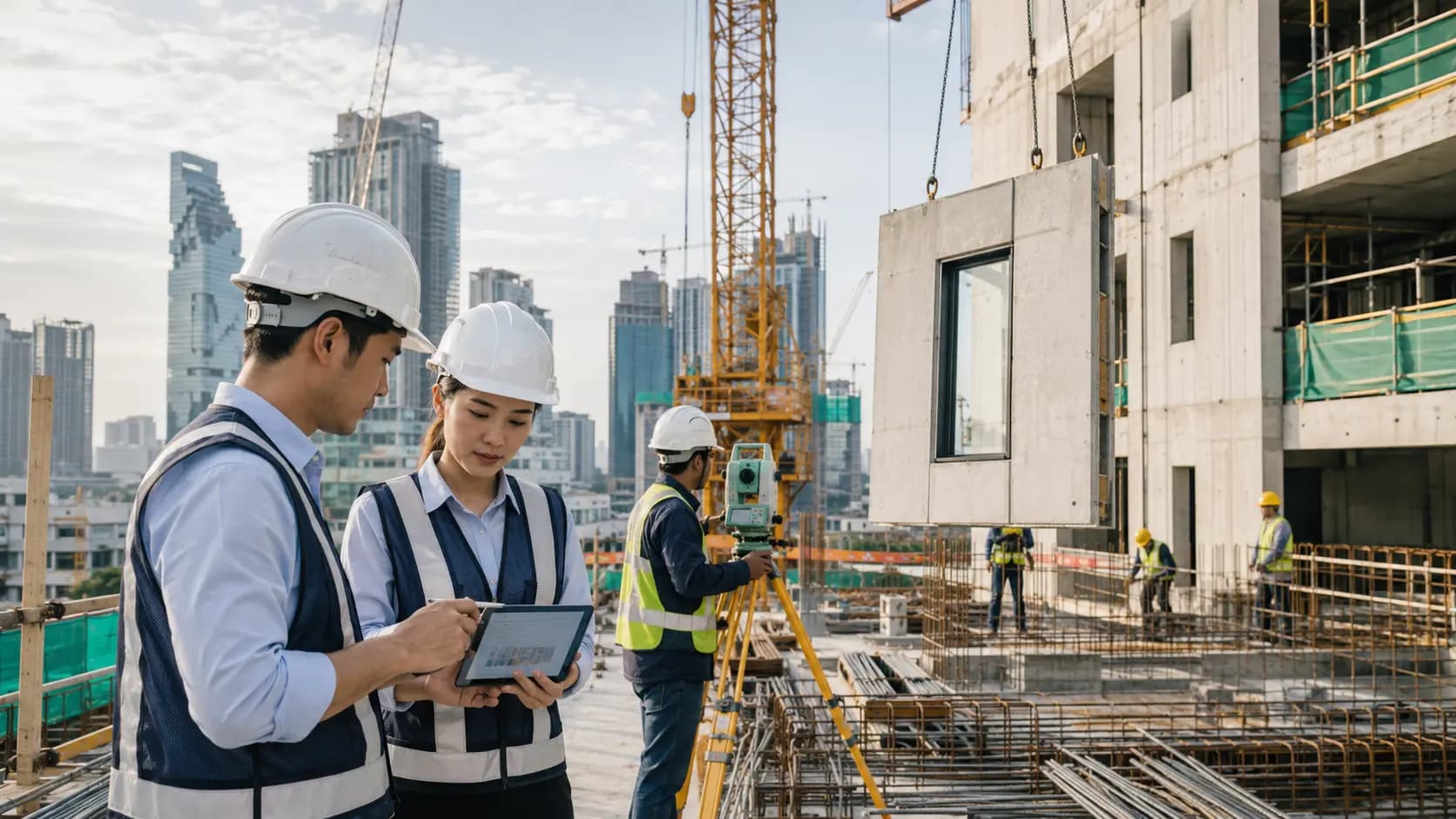
Modern Construction Techniques
Thailand's construction industry is adopting Building Information Modelling (BIM), modular and precast construction, and digital project-control tools — but adoption is concentrated in large-scale and public projects rather than industry-wide. This page distinguishes demonstrated project-level adoption from a claim of universal industry practice.
Building Information Modelling (BIM)
Government infrastructure tenders increasingly specify BIM coordination, and one industry commentary source reports BIM use rising roughly 40% since 2020 with over half of large-scale projects now using it for design and planning. This is industry commentary rather than an official adoption census — treat the percentage as indicative, not a verified national statistic.
Digital twins
Digital twin implementation has been documented in specific Bangkok building-operations case studies published in peer-reviewed research, building on Thailand's growing BIM maturity — a demonstrated capability on named projects, not yet standard industry-wide practice.
Modular & precast construction
Modular building systems held an estimated 48.6% product-type share of Thailand's prefabricated-construction market in 2025 per private industry research, with residential applications the largest end use (47.2% revenue share) — concentrated in specific residential and government housing programmes such as "Homes for Thais" rather than universal across all building types.
Government-led modular housing
The Thai government's "Homes for Thais" programme, launched January 2025, targets an initial 5,000 housing units along railway corridors in its 2025-2026 phase, with a long-term ambition of scaling to 300,000 units — a concrete, dated example of modern-methods-of-construction adoption at the public-housing scale.
Project controls & surveying
Larger contractors and infrastructure projects increasingly use drone/laser surveying, digital project-controls software and site-safety monitoring technology — demonstrated on major infrastructure and mixed-use schemes, with adoption depth varying significantly by contractor size and project value.
Adoption Scope Note
Adoption of BIM, digital twins and advanced project controls in Thailand is real but uneven — concentrated among large listed contractors, major mixed-use developments and government-mandated infrastructure tenders. Smaller residential and renovation projects still predominantly use conventional methods. Treat any single adoption percentage cited above as indicative industry commentary rather than a verified national census.
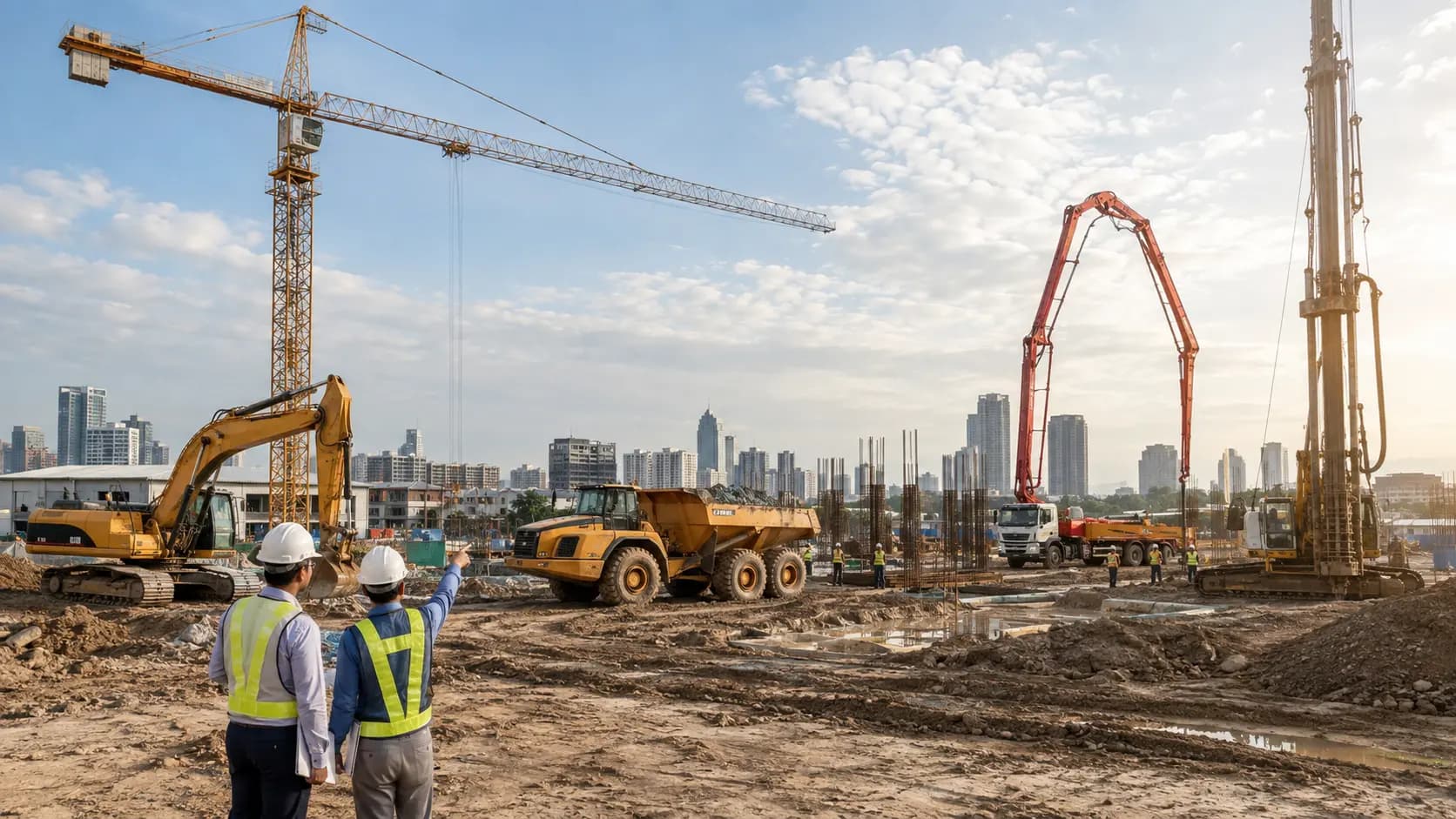
Machinery & Equipment
Thailand's construction equipment market spans cranes, earthmoving machinery, piling rigs, concrete plant and access systems — sourced through a mix of local distribution of global OEM brands, equipment rental/leasing, and imports. Equipment-specific import classification and duty treatment should always be confirmed through an official tariff lookup rather than assumed from a general category.
Cranes & access equipment
Tower cranes, mobile cranes and access platforms for high-rise and infrastructure work, supplied through authorised local distributors of major global OEM brands and increasingly available via rental/leasing rather than outright purchase.
Earthmoving & piling
Excavators, bulldozers and piling rigs for site preparation, foundations and infrastructure earthworks — a mix of imported and locally assembled equipment depending on class and specification.
Concrete equipment
Batching plants, pumps and placement equipment supporting Thailand's large ready-mixed-concrete industry, closely tied to the materials sector covered in Section 2.
Rental & leasing
A growing equipment rental/leasing market lets contractors access specialised machinery for project-specific needs without full capital outlay — particularly relevant for smaller and mid-sized contractors.
Maintenance & local distribution
Authorised dealer networks provide parts, servicing and technical support for imported machinery — an important due-diligence point for equipment buyers evaluating total cost of ownership, not just purchase price.
Import Classification Note
Construction machinery imports are classified under HS Chapter 84 (mechanical appliances) headings — the applicable heading and duty rate depend on the specific machine type and specification. This page does not state a blanket tariff rate for construction machinery; use Thailand's National Trade Repository or consult Thai Customs directly for a current, product-specific classification and duty lookup before importing.
Thailand National Trade Repository — tariff lookupMajor Project Segments
Hotels & Resorts
Hospitality development remains a significant construction segment, tied closely to Thailand's tourism recovery — spanning international-branded resorts, boutique hotels and mixed hotel-residential schemes in Bangkok and leading resort provinces (Phuket, Chonburi/Pattaya, Krabi, Chiang Mai). Specific project values and openings should be verified against the individual developer's or hotel operator's own announcements rather than assumed from general tourism-recovery commentary.
Grade-A Offices, Smart Buildings & Data-Enabled Facilities
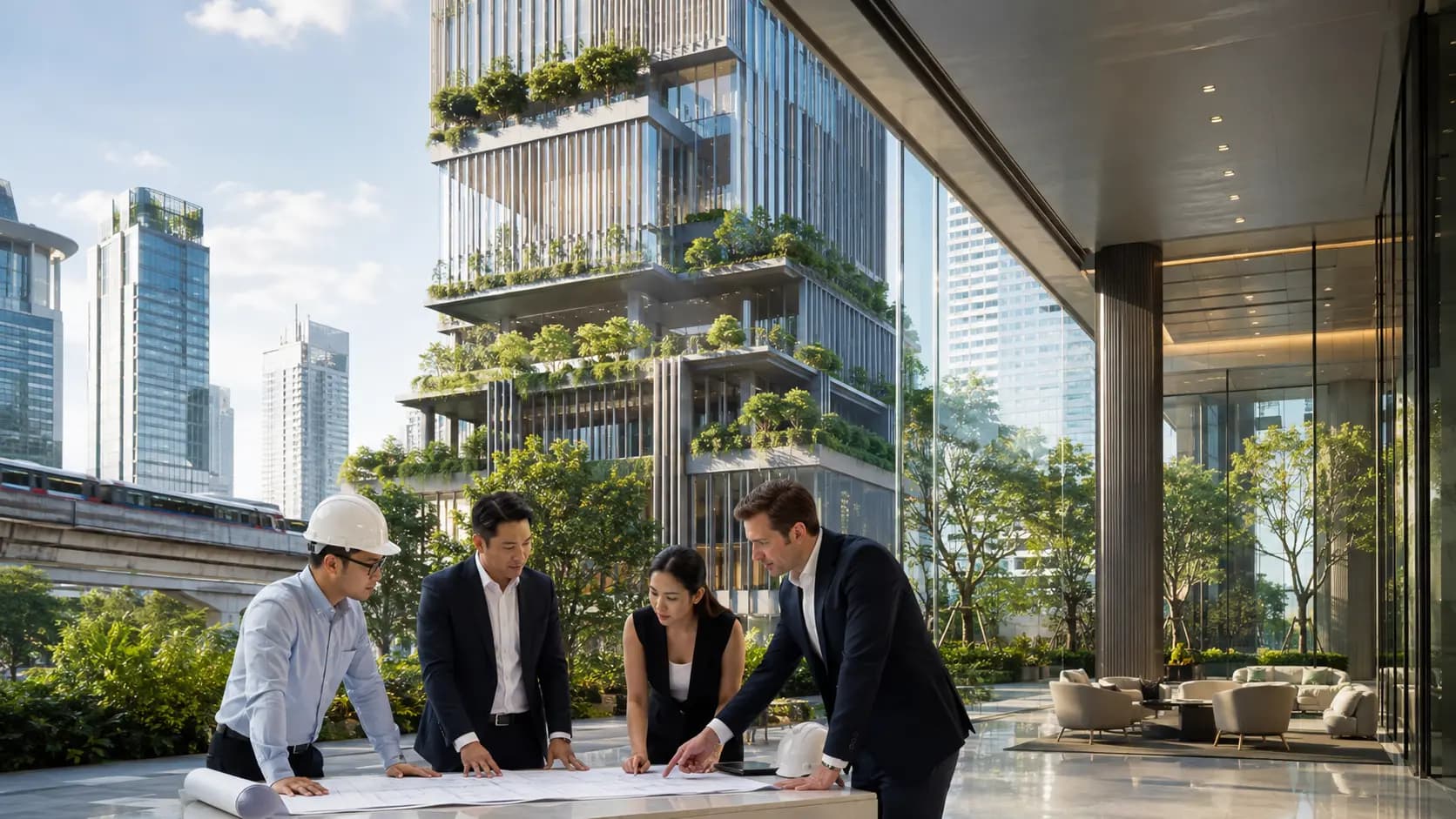
Bangkok's Grade-A office market has been reshaped by large mixed-use schemes such as One Bangkok, whose initial phase — the Parade and The Storeys retail precincts plus office Towers 3 and 4 — opened on 25 October 2024, with the 92-storey, 437-metre Signature Tower still under construction as of this research pass. Demand for data-centre and other data-enabled facilities is also a named BOI investment-promotion priority, discussed further in the BOI section.
Shopping Centres, Mixed-Use Plazas & Public Realm
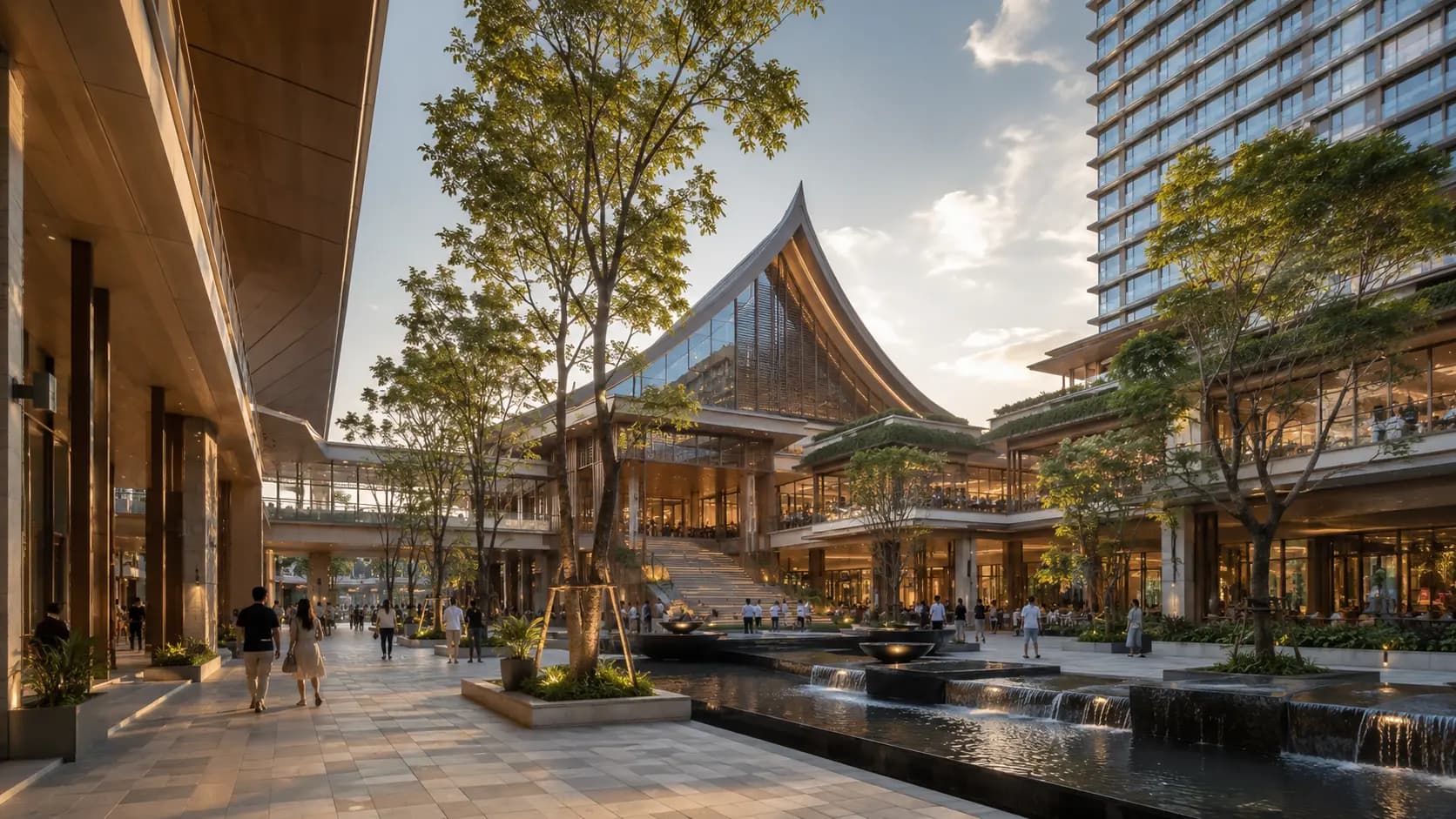
Central Pattana (CPN) — Thailand's largest listed retail-property developer, SET-listed since 1995 — anchors a retail-led mixed-use development model that increasingly combines shopping centres with residential, office and hotel components. ICONSIAM, jointly developed by Siam Piwat, Magnolia Quality Development Corporation and Charoen Pokphand Group and opened 9 November 2018 on the Chao Phraya riverfront, is a landmark example of this mixed-use model rather than a retail-only scheme.
Roads, Bridges, Rail Interfaces & Public Infrastructure
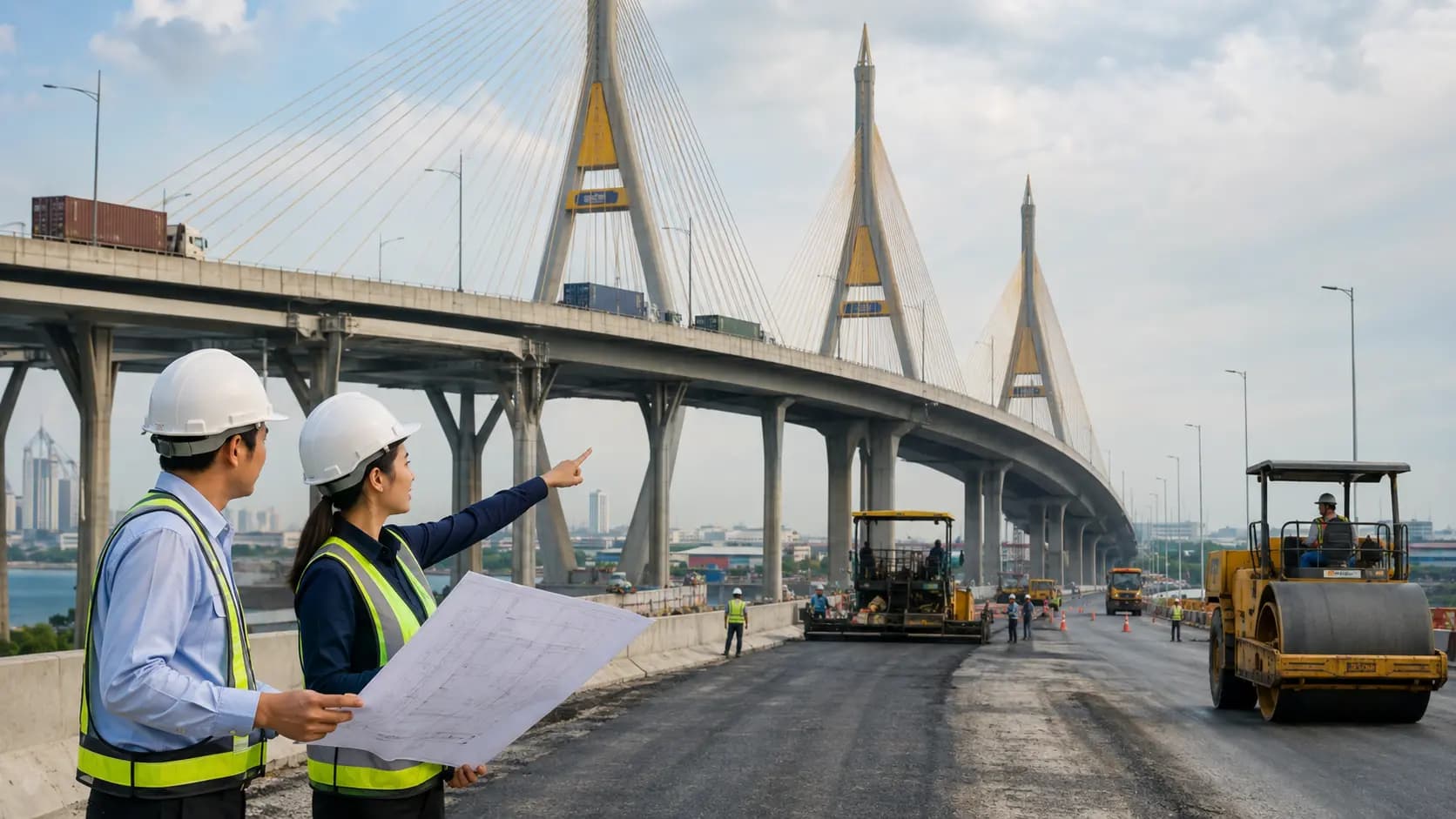
Public infrastructure construction grew strongly in 2025 (government construction +17.0% for the first nine months, per NESDC) and includes an active pipeline of expressway, rail and airport projects. Not every announced megaproject proceeds as originally scoped — the Land Bridge project's July-August 2026 review is a current, concrete example discussed in the Clusters & Opportunities section — so project-status verification against a current official source is essential before treating any single announced infrastructure scheme as committed.
Industrial estates & factories
Industrial estate development, coordinated by IEAT and private estate developers (e.g. WHA Group, Amata Corporation), remains a major construction driver — particularly in EEC provinces — supporting manufacturing tenants across multiple sectors.
Warehouses & logistics facilities
E-commerce and regional-distribution growth continues to drive warehouse and logistics-facility construction, often developed speculatively by industrial-estate developers or built-to-suit for specific tenants.
Hospitals & healthcare facilities
Both public hospital expansion and Thailand's private medical-tourism hospital sector generate specialised construction demand, with distinct regulatory and technical requirements from general commercial building.
Housing
Residential construction spans government-supported affordable-housing programmes (e.g. "Homes for Thais") and private condominium/landed-housing development from major listed developers — two distinct markets with different financing, land and demand drivers.
Renovation & retrofit
Renovation and retrofit of existing buildings — including energy-efficiency upgrades relevant to the Building Energy Code discussed in the Materials & Sustainability section — is a growing segment as Bangkok's existing building stock ages.
Landmark Developments & Comparative Standing
The directory below lists notable completed Thai developments with verified type, location, completion year and, where confirmed, developer and architect/contractor. Media descriptions such as "tallest" or "largest" are shown as attributed claims with their own source — this page does not convert them into an independently verified global or regional numerical ranking unless a named methodology, publisher and year were found.
Mixed-use tower (office, hotel, residential, observation deck)
King Power Mahanakhon
- Location:
- Bangkok
- Completion:
- 2016
- Developer:
- PACE Development
- Architect: Ole Scheeren / OMA
314 metres tall — described as Thailand's tallest building at completion; this page attributes that description to its sources rather than asserting an independently verified current regional/global rank.
Source: The B1M / Comansa industry coverage · Accessed 22 August 2026
Mixed-use riverside development (retail, residential, hotel)
ICONSIAM
- Location:
- Bangkok (Chao Phraya riverfront)
- Completion:
- 2018 (opened 9 November 2018)
- Developer:
- Siam Piwat, Magnolia Quality Development Corporation (MQDC) and Charoen Pokphand Group (joint development)
A THB 60 billion, 55-rai mixed-use development with over 750,000 sqm of retail, lifestyle and residential space; its Magnolias Waterfront Residences component (70 floors) is described by sources as Thailand's tallest residential building — an attributed description, not an independently re-verified current ranking.
Source: PR Newswire; Siam Piwat official site · Accessed 22 August 2026
Mixed-use development (retail, offices, residences, hotels)
One Bangkok
- Location:
- Bangkok
- Completion:
- Phase 1 opened 25 October 2024; Signature Tower under construction
- Developer:
- TCC Assets (Thailand) and Frasers Property Holdings (Thailand) — joint venture
Phase 1 (Parade and The Storeys retail precincts, office Towers 3 and 4) is operational. The planned Signature Tower (92 storeys, 437 metres) remains under construction as of this research pass — shown here as an in-progress component, not a completed landmark.
Source: Frasers Property; onebangkok.com official press materials · Accessed 22 August 2026
Shopping centre / mixed-use plaza
CentralWorld
- Location:
- Bangkok
- Completion:
- Originally opened 1990, substantially expanded/rebranded 2006
- Developer:
- Central Pattana (CPN)
One of Bangkok's largest and longest-established shopping-centre developments, operated by Thailand's largest listed retail-property developer.
Source: Central Pattana official site · Accessed 22 August 2026
Ranking Caution
No numerical global or regional ranking (e.g. "5th tallest in Asia") is asserted for any building in this directory unless this research pass found a named ranking methodology, publisher and year to cite. Where a source describes a project as "tallest," "largest" or similar, that description is shown as the source's own claim, not as an independently verified current ranking.

Materials, Sustainability & Quality
Thailand's construction-materials industry — cement, ready-mixed concrete, steel, glass and facade systems — is anchored by large integrated producers, chiefly SCG (Siam Cement Group), founded 1913 and Thailand's oldest and largest cement/building-materials group. Mandatory Thai product standards are distinct from voluntary green-building certification, and this page keeps the two clearly separated.
Mandatory Thai requirements
- • TISI product certification — the Thai Industrial Standards Institute sets and certifies mandatory standards for specific listed construction-material product categories (structural steel, certain cement grades, and other mandatory-listed items); confirm the current mandatory list for your specific product with TISI directly.
- • Building Energy Code (BEC) — sets minimum energy-efficiency standards for new and renovated buildings; one source describes it as currently applicable to nine categories of new/renovated government buildings under the Ministry of Energy — confirm current scope (including any extension to private buildings) directly with the Ministry of Energy before relying on this description.
Voluntary green-building certification
- • TREES (Thai's Rating of Energy and Environmental Sustainability) — a voluntary green-building rating system developed by the Thai Green Building Institute (TGBI), established 2012 and adapted from LEED for Thailand's climate and context; growth from roughly 55 to 240 certified/registered buildings was reported between 2012 and 2017 in industry coverage — confirm current certified-building counts directly with TGBI.
- • LEED and other international green-building certifications — used alongside or instead of TREES by some Thai developers, particularly for internationally marketed office and hospitality projects; certification status applies only to the specific certified building, not to the industry as a whole.
- • Recycled inputs, engineered timber and energy-efficiency measures — increasingly specified by developers targeting green certification or corporate ESG commitments, but adoption varies significantly by project and developer rather than being a uniform industry practice.
Data Scope
This page distinguishes legally mandatory Thai product/energy standards (TISI certification, Building Energy Code) from voluntary green-building certification (TREES, LEED). A project holding a voluntary green certification is not automatically representative of the wider industry, and TISI's mandatory-list scope should always be confirmed directly for the specific product before assuming certification is required or not required.
Regulation, Approvals & Responsible Bodies
Responsibility for construction regulation in Thailand is distributed across multiple national and local bodies rather than concentrated in one universal "SOP body." The directory below sets out each body's confirmed current role; the approval-journey steps that follow are a practical orientation, not legal advice — confirm the exact procedure with the competent authority for your project's specific location and type.
Department of Public Works and Town & Country Planning (DPT)
A Ministry of Interior department responsible for town and country planning at every level, public works, and building design/construction control — may delegate authority to local administrations under Thailand's decentralisation framework.
Visit official websiteBangkok Metropolitan Administration (BMA)
Handles building-permit issuance and enforcement within Bangkok's jurisdiction through its Building Control Division — the relevant local authority outside Bangkok is the equivalent provincial or municipal administration for that project's location.
Visit official websiteCouncil of Engineers Thailand (COE)
The statutory regulatory body for the engineering profession under the Engineer Act B.E. 2542 (1999) — licenses and disciplines professional engineers whose sign-off is required for regulated engineering work.
Visit official websiteArchitect Council of Thailand (ACT)
The statutory regulatory body for the architecture profession under the Architect Profession Act — licenses, regulates and disciplines architects practising in Thailand.
Visit official websiteThai Industrial Standards Institute (TISI)
Sets and certifies mandatory and voluntary product standards for relevant construction materials and components, under the Ministry of Industry.
Visit official websiteDepartment of Business Development (DBD)
Handles company registration and corporate filings for construction, engineering and development companies operating in Thailand.
Visit official websiteDepartment of Labour Protection and Welfare (DLPW)
Under the Ministry of Labour — establishes and enforces labour standards, worker protection and occupational safety and health requirements on construction sites.
Visit official websiteState agencies for individual public projects
Public infrastructure projects are typically overseen by the specific responsible state agency (e.g. the State Railway of Thailand for rail, the Department of Highways or the Expressway Authority of Thailand for roads, Airports of Thailand for airport projects) rather than a single central construction authority.
Visit official websiteApproval journey
Confirm land title, zoning classification and any use restrictions for the specific site — zoning and land-use rules are set at the town/country-planning level and vary by location.
Projects meeting EIA/EHIA thresholds (size, type or location-sensitivity criteria) require environmental review before proceeding — confirm whether your specific project triggers this requirement.
Structural and architectural designs for regulated building types require sign-off by professionals licensed through the Council of Engineers Thailand and/or Architect Council of Thailand, as applicable to the scope of work.
Apply for building permission from the relevant local authority (BMA within Bangkok, or the equivalent provincial/municipal authority elsewhere) — requirements and processing times vary by jurisdiction and project scale.
Construction proceeds under the licensed professionals' supervision, subject to periodic inspections by the permitting authority and compliance with labour/safety requirements enforced by DLPW.
Completed buildings require occupancy or use authorization from the permitting authority before legal occupation — confirm the specific certificate/authorization required for your building type and jurisdiction.
Not Legal Advice
This approval journey is a practical, high-level orientation, not legal advice. Exact procedures, required documents and timelines vary by project type, scale and jurisdiction — confirm the precise process with the competent local authority and qualified Thai legal/professional advisers before relying on this summary for a real project.
BOI Investment Promotion
BOI promotion generally targets specific eligible activities that support the built environment — it does not automatically apply to ordinary construction contracting or speculative property development. The categories below reflect activity types discussed in current BOI-related commentary; exact eligible-activity codes, incentive groups and benefits must be verified directly against the latest BOI Investment Promotion Guide before relying on any of them for an investment decision.
Industrial estate/zone development
Industrial estate and smart-industrial-estate development is a recognised BOI-promoted activity category — e.g. a Smart Industrial Estate expansion project reported an approved investment of approximately US$108 million.
Incentive group, CIT treatment and non-tax privileges depend on the specific estate's classification and location (including EEC-zone eligibility) — verify directly with BOI.
BOI — current promoted activitiesSmart / sustainable infrastructure and digital parks
Digital parks and smart-city infrastructure are named among BOI's promoted high-tech and green-infrastructure categories, tied to Thailand's digital and green-innovation investment priorities.
Not independently confirmed for the current guide edition in this research pass — verify directly.
BOI — current promoted activitiesEngineering design & R&D services
Engineering-design and R&D activities supporting manufacturing and infrastructure sectors are a recognised BOI category, distinct from general construction contracting.
R&D-linked activities can carry merit-based additional incentives under BOI's general framework — verify current conditions directly.
BOI — current promoted activitiesAdvanced materials & machinery manufacture
Manufacturing of advanced construction materials or construction-machinery components (as opposed to on-site contracting) can fall within BOI's broader manufacturing-promotion categories.
Standard manufacturing-tier incentives may apply depending on technology content — verify current tier directly.
BOI Investment Promotion GuideEnergy efficiency & renewable infrastructure
Energy-efficiency retrofit and renewable-energy infrastructure projects are part of BOI's BCG (bio-circular-green economy) promotion priority — a named 2025-2026 strategic focus area.
Not independently confirmed for the current guide edition in this research pass — verify directly.
BOI — current promoted activitiesQualifying large infrastructure in the EEC
The Eastern Economic Corridor offers additional tax benefits and infrastructure support for businesses in designated target sectors — construction directly serving these zones may access location-based incentives distinct from general nationwide promotion.
EEC-specific incentive scope should be verified with the EEC Office (EECO) alongside BOI.
EEC OfficeProfessional Advice
BOI promotion is activity-specific, not sector-wide: ordinary construction contracting and speculative property/residential development are not automatically BOI-eligible. Do not assume a tax holiday, land-ownership benefit or foreign-ownership relaxation applies to your project without confirming the specific eligible activity, incentive group and conditions directly with BOI or a qualified investment-promotion adviser.
Foreign Ownership, Contracting & Joint Ventures
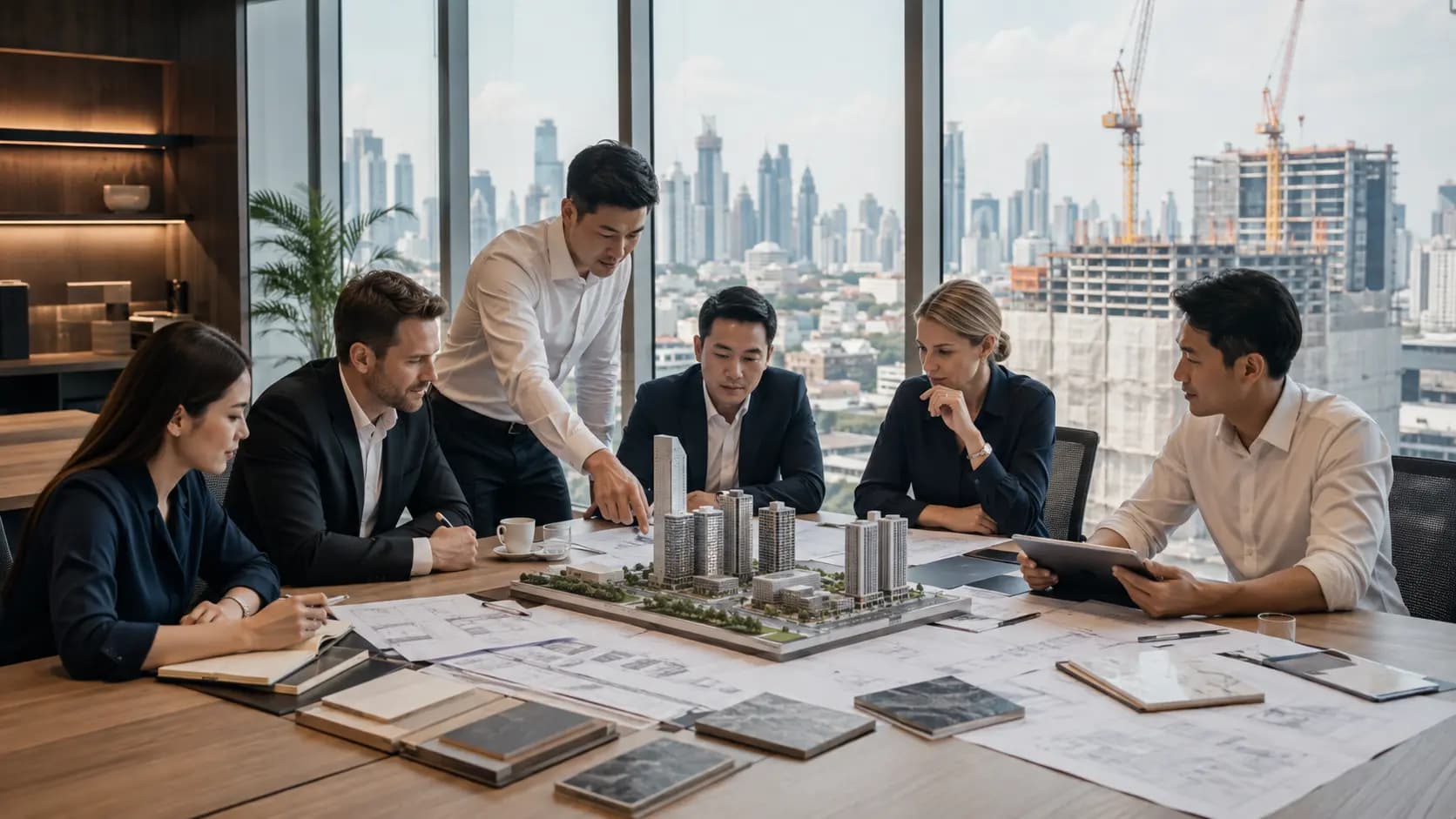
Foreign participation in Thai construction is shaped chiefly by the Foreign Business Act (FBA). Under the FBA's List 2/List 3 framework, general construction is a restricted activity: a foreign-majority company generally needs a Foreign Business License from the Department of Business Development to undertake construction, though an exception exists for infrastructure construction using special apparatus/technology with minimum capital of THB 500 million or more from foreign investors, subject to specific conditions.
Thai company (majority Thai-owned)
A Thai limited company with at least 50%+ Thai ownership can undertake construction without the FBA restriction applying — the most common structure for standard domestic contracting.
Project company / SPV
A special-purpose vehicle set up for a specific development or infrastructure project, often used to ring-fence project risk, financing and, where applicable, concession rights.
Consortium
Multiple contractors/investors bidding and delivering jointly on large infrastructure tenders — common on major transport and utility megaprojects requiring combined technical and financial capacity.
Subcontracting
Foreign specialist firms (e.g. specialised MEP, facade or equipment-installation contractors) commonly participate as subcontractors to a Thai-licensed main contractor rather than holding the head contract directly.
PPP / concession
Public-private partnership structures under the PPP Act B.E. 2562 (2019), used for qualifying infrastructure projects — see the Public Procurement & PPP section for detail.
Property/development joint venture
Thai and foreign partners co-investing in a specific development, typically structured to respect land-ownership and FBA constraints while combining local market access with foreign capital or expertise.
Orientation points
- Foreign Business Act (FBA) — general construction sits in the FBA's restricted-activity framework (List 2/3); confirm current classification and licensing requirements with the Department of Business Development for your specific scope of work.
- Land ownership — foreign individuals and majority-foreign companies face constraints on direct land ownership in Thailand; structuring around this (leasehold, Thai-majority landholding entities, condominium foreign-quota rules) requires qualified legal advice specific to your project.
- Licensing of regulated professional work — engineering and architecture sign-off must come from professionals licensed by the Council of Engineers Thailand and Architect Council of Thailand respectively, regardless of the underlying company's ownership structure.
- Tax — corporate income tax, VAT and (where applicable) BOI tax privileges depend on your entity structure and eligible-activity status; confirm current treatment with the Revenue Department and, if BOI-promoted, with BOI directly.
- Procurement — public-sector work follows Thailand's public procurement rules (see Section 11); private development follows standard commercial contracting practice.
- Due diligence & beneficial ownership — verify counterparties' corporate registration, beneficial ownership and standing through the Department of Business Development's official company records before entering a JV or major contract.
- Anti-corruption controls — Thailand's anti-corruption framework applies to construction and public-procurement dealings; qualified legal advice on compliance obligations is essential for foreign investors and contractors alike.
- Dispute clauses — construction and JV contracts should specify governing law, dispute-resolution mechanism (arbitration vs. Thai courts) and jurisdiction clearly, ideally with qualified Thai legal counsel involved in drafting.
Obtain Thai Legal & Tax Advice
This section is an orientation-level overview only, not legal or tax advice. Foreign ownership, licensing and contracting structures in Thai construction carry real legal complexity — obtain qualified Thai legal and tax advice before structuring any investment, joint venture or contract. This page does not suggest or endorse nominee shareholder arrangements, which carry significant legal risk under Thai law.
Public Procurement & PPP
Public construction and infrastructure work in Thailand follows government procurement rules distinct from private commercial contracting. Larger, longer-term infrastructure schemes may instead use the Public-Private Partnership (PPP) framework under the Public-Private Partnership Act B.E. 2562 (2019).
- Procurement portals & prequalification — Thai government agencies run tenders through official e-procurement channels, typically requiring contractor prequalification (financial standing, technical capacity, track record) before bid submission.
- Bid security & performance guarantees — public tenders typically require bid bonds/security at submission and performance guarantees (often bank guarantees) upon contract award, sized as a percentage of contract value per the specific agency's rules.
- Agency-specific rules — individual state agencies (SRT, DOH, EXAT, AOT and others) may apply their own procurement procedures within the overarching public procurement law framework — confirm the specific agency's current rules for any given tender.
- PPP structures — the Public-Private Partnership Act B.E. 2562 (2019) governs PPP/concession structures for qualifying infrastructure and public-service projects, with the State Enterprise Policy Office (SEPO) serving as the central PPP coordinating body; the PPP Committee has responsibility for setting procedures for projects below a THB 5 billion threshold, with different procedures applying above it.
- Private developments follow standard commercial contracting practice and are not subject to public procurement rules — this page keeps public-works procurement and private-development contracting clearly separate.
Verification Note
Public procurement thresholds, PPP Act provisions and agency-specific rules are subject to change and amendment. Verify the current PPP Act text, threshold values and the responsible body's current procedures directly with the State Enterprise Policy Office (SEPO) or a qualified public-procurement adviser before relying on this summary for a live tender or PPP proposal.
Trade, Imports, FTAs & Customs
Thailand's construction sector relies on a mix of domestically produced and imported machinery, electrical/mechanical systems, steel, glass and fixtures. This page explains the classification and duty framework at an orientation level — it does not claim any FTA eliminates duty for every construction product, and points readers to official tariff and origin tools for product-specific answers.
- HS classification — construction machinery generally falls under HS Chapter 84, electrical/mechanical systems and fixtures under HS Chapter 85, and steel/glass/building materials under their respective HS chapters — the exact heading determines the applicable duty rate and any FTA preference.
- Customs valuation — import duty is assessed on the customs value (typically transaction value plus qualifying costs) per Thai Customs' valuation rules.
- VAT — standard 7% VAT applies to most imports in addition to any customs duty, confirmed with the Revenue Department.
- Product standards & permits — TISI mandatory certification applies to specific listed construction-material and equipment categories; confirm whether your specific product requires it before import.
- FTA/rules-of-origin — ATIGA (ASEAN), RCEP and Thailand's bilateral FTAs can offer preferential rates for qualifying construction products meeting the relevant rules-of-origin test (Regional Value Content or Change in Tariff Classification, depending on the product) — eligibility is product- and origin-specific, never a blanket exemption across all construction materials or machinery.
- Certificates of origin — administered by the Department of Foreign Trade (DFT); required to claim any FTA preferential rate.
Showing 15 of 15 entries
ASEAN & Regional
ASEAN Trade in Goods Agreement
ATIGA
In effectThe foundational ASEAN free-trade framework — preferential or zero tariffs on most goods traded within the ten-member ASEAN Economic Community.
ASEAN & Regional
Regional Comprehensive Economic Partnership
RCEP
In effect (Thailand, since 1 Jan 2022)The largest regional trade pact by GDP, linking ASEAN with China, Japan, South Korea, Australia and New Zealand under common rules of origin.
East Asia
ASEAN–China Free Trade Area
ACFTA / ACFTA 3.0
In effect; 3.0 Upgrade Protocol signed, not yet in forcePreferential tariff access into China, Thailand's largest single food and one of its largest overall export markets. A 3.0 Upgrade Protocol adding digital economy, green economy and supply-chain chapters was signed by ASEAN and China on 28 October 2025.
East Asia
ASEAN–Japan Comprehensive Economic Partnership
AJCEP
In effectRegional preferential access into Japan, alongside Thailand's bilateral JTEPA below.
East Asia
Japan–Thailand Economic Partnership Agreement
JTEPA
In effectBilateral preferential tariffs and streamlined rules of origin between Thailand and Japan, one of Thailand's established premium export markets.
East Asia
ASEAN–Korea Free Trade Area
AKFTA
In effectPreferential tariff access into South Korea for qualifying Thai goods.
East Asia
ASEAN–Hong Kong, China Free Trade Agreement
AHKFTA
In effect since 12 Feb 2021Preferential access into Hong Kong; a 2024 protocol expanded product-specific origin rules from around 200 to almost 600 tariff lines.
South Asia
ASEAN–India Trade in Goods Agreement
AITIGA
In effect (since 2010); under review and upgrade negotiationThe regional ASEAN–India goods agreement is in force but is currently being reviewed and upgraded — the 12th Joint Committee meeting was held in March 2026, targeting substantial conclusion of the upgrade during 2026.
South Asia
Thailand–India Early Harvest Scheme
Bilateral EHS, not a full FTA
In effect since 2006 — limited scopeA limited preferential arrangement covering 82 product categories (including fruit, processed food, gems and jewellery, iron and steel, auto parts and electronics). A comprehensive bilateral FTA/CECA covering services and investment remains under negotiation.
Oceania
Thailand–Australia Free Trade Agreement
TAFTA
In effectBilateral tariff preferences into Australia, complementing the regional AANZFTA below.
Oceania
ASEAN–Australia–New Zealand Free Trade Area
AANZFTA
In effectRegional preferential access into both Australia and New Zealand, alongside Thailand's bilateral agreements with each.
Oceania
Thailand–New Zealand Closer Economic Partnership
TNZCEP
In effectBilateral tariff preferences into New Zealand for qualifying Thai goods.
Americas
Thailand–Chile Free Trade Agreement
In effect since 5 Nov 2015
In effectTariffs eliminated on 90% of goods traded at entry into force, with the remaining 10% phased out between 2020 and 2023 — a rare Latin American market-access route for Thai exporters.
Americas
Thailand–Peru Early Harvest Scheme
Bilateral EHS, not a full FTA
In effect since 2011 — partial scopePreferential tariffs on approximately 70% of goods traded under the Early Harvest Scheme; the full bilateral FTA has not been concluded, so coverage is partial rather than comprehensive.
Under Negotiation
Thailand–European Union Free Trade Agreement
Under negotiation — not yet signed or in force
Under negotiationAround two-thirds of the agreement (15 of 24 chapters) was reported concluded as of July 2026, with both sides targeting conclusion in 2026. A further negotiating round was scheduled for late September 2026 in Thailand. This is not a signed or in-force agreement.
Clusters & Opportunities
Thailand's construction activity concentrates in a small number of metropolitan and industrial corridors, plus a national infrastructure programme whose individual projects sit at very different stages — from operational, through under-construction and tendered, to announced-but-unconfirmed or under review. Status badges below reflect this research pass's findings and should be re-verified against current official sources before any investment decision.
Bangkok Metropolitan Area
Thailand's core market for Grade-A offices, hospitality, retail/mixed-use and high-rise residential — home to landmark developments including One Bangkok, ICONSIAM and King Power Mahanakhon, and to the country's largest concentration of listed developers, contractors and design firms.
Eastern Economic Corridor (EEC)
Covering Chachoengsao, Chonburi and Rayong, the EEC drives industrial estate, logistics and infrastructure construction tied to BOI's target-industry promotion, coordinated by the EEC Office (EECO).
Industrial estate corridors
IEAT-managed estates and private industrial-estate developers (WHA Group, Amata Corporation and others) anchor factory, warehouse and logistics construction across multiple provinces beyond the EEC as well.
Tourism-led provinces
Phuket, Chonburi/Pattaya, Krabi and Chiang Mai see concentrated hospitality and resort-residential construction tied to Thailand's tourism sector, distinct in financing and demand drivers from Bangkok's office/mixed-use market.
Named infrastructure projects — current status
Bangkok-Nakhon Ratchasima High-Speed Rail (Phase 1)
The 253km first phase, begun in 2017, had reached 52.4% completion as of March 2026; two contract sections remain stalled — one pending revised Three-Airports-Link agreements, one delayed by Ayutthaya UNESCO heritage concerns and under redesign.
Source: Wikipedia (Bangkok-Nong Khai high-speed railway), citing SRT progress reporting · Accessed 22 August 2026
Bangkok-Nong Khai High-Speed Rail (Phase 2)
Auctions for Phase 2 were expected to begin around February 2026, with SRT anticipating roughly four years of construction and a targeted 2031 opening.
Source: Wikipedia (Bangkok-Nong Khai high-speed railway) · Accessed 22 August 2026
Land Bridge (Chumphon-Ranong Sea-Land-Sea corridor)
A Finance-Minister-chaired review committee found on 24 July 2026 that the project's updated net present value had turned negative (-THB 10,287 million, from a prior positive estimate of over THB 600 billion); Cabinet accepted the finding on 5 August 2026 and directed withdrawal of the project's environmental assessments. Government public statements describe this as a "pause," not a formal cancellation, while a smaller "Missing Link" railway (Chumphon-Ranong Port, ~THB 27 billion, 2018 cost base) is now the more concrete near-term project.
Source: Maverick Consulting Group, "Thailand Land Bridge: The Trillion-Baht Corridor Stopped Post-Review" (citing Cabinet resolution, 5 August 2026 and committee report, 24 July 2026) · Accessed 22 August 2026
One Bangkok — Signature Tower
The planned 92-storey, 437-metre tower remains under construction; the development's initial retail and office phases (Parade, The Storeys, Towers 3 & 4) opened 25 October 2024 and are operational.
Source: Frasers Property / onebangkok.com · Accessed 22 August 2026
Key Players Directory
Showing 9 of 9 entries
Developers
Central Pattana
Central Pattana Public Company Limited
SET: CPN · Listed 1995Thailand's largest listed retail-property development and investment company, developing shopping centres and complementary mixed-use projects including residences, offices and hotels.
Developers
Sansiri
Sansiri Public Company Limited
SET: SIRIA major Thai residential property developer active across condominium and landed-housing segments.
Developers
AP (Thailand)
AP (Thailand) Public Company Limited
SET: APA major Thai residential property developer with a broad condominium and housing portfolio.
Listed Contractors
Italian-Thai Development
Italian-Thai Development Public Company Limited
SET: ITD · Founded 1958One of Thailand's largest construction firms and one of two contractors most commonly engaged for large-scale government infrastructure projects.
Listed Contractors
CH. Karnchang
CH. Karnchang Public Company Limited
SET: CK · Founded 1972Thailand's second-largest listed construction firm, active in infrastructure (including mass-transit) and building construction in Thailand and Laos.
Listed Contractors
STECON Group
Sino-Thai Engineering and Construction
SET: STECON · Founded 1962A leading Thai construction company delivering infrastructure, commercial and industrial projects, including mass-transit rail work.
Materials Manufacturers
SCG (Siam Cement Group)
The Siam Cement Public Company Limited
SET: SCC · Founded 1913Thailand's largest and oldest cement and building-materials group, producing cement, ready-mixed concrete, roof tiles, ceramic tiles and sanitary ware, with operations across ASEAN.
Industrial Estate Developers
WHA Group
WHA Corporation Public Company Limited
SET: WHAA major Thai industrial estate, logistics-facility and utilities developer active across multiple industrial corridors including the EEC.
Industrial Estate Developers
Amata Corporation
Amata Corporation Public Company Limited
SET: AMATAA long-established Thai industrial estate developer with major estates in Chonburi and Rayong provinces, within and adjacent to the EEC.
Directory Disclosure
This directory lists companies with verified SET-listed status, official company sites or well-documented public-company identity. It is not exhaustive, and inclusion does not represent an endorsement, certification or representation by T3 of any listed company. Market-leadership claims are not inferred from company marketing copy — descriptions here reflect verifiable facts (listing status, founding year, publicly described core business) rather than each company's own promotional characterisation of its market position.
Associations & Trade Bodies
Verified associations, chambers, federations, business councils and government bodies connected to Construction in Thailand.
- Industry Association
Thai Contractors Association under H.M. the King's Patronage
TCA
Represents Thailand's contractors and construction industry.
- Industry Association
Thai Real Estate Association
สมาคมอสังหาริมทรัพย์ไทย
Represents Thailand's real estate development industry across residential and mixed-use development, engaging with government on sector policy and market conditions.
Trade Shows & Professional Events
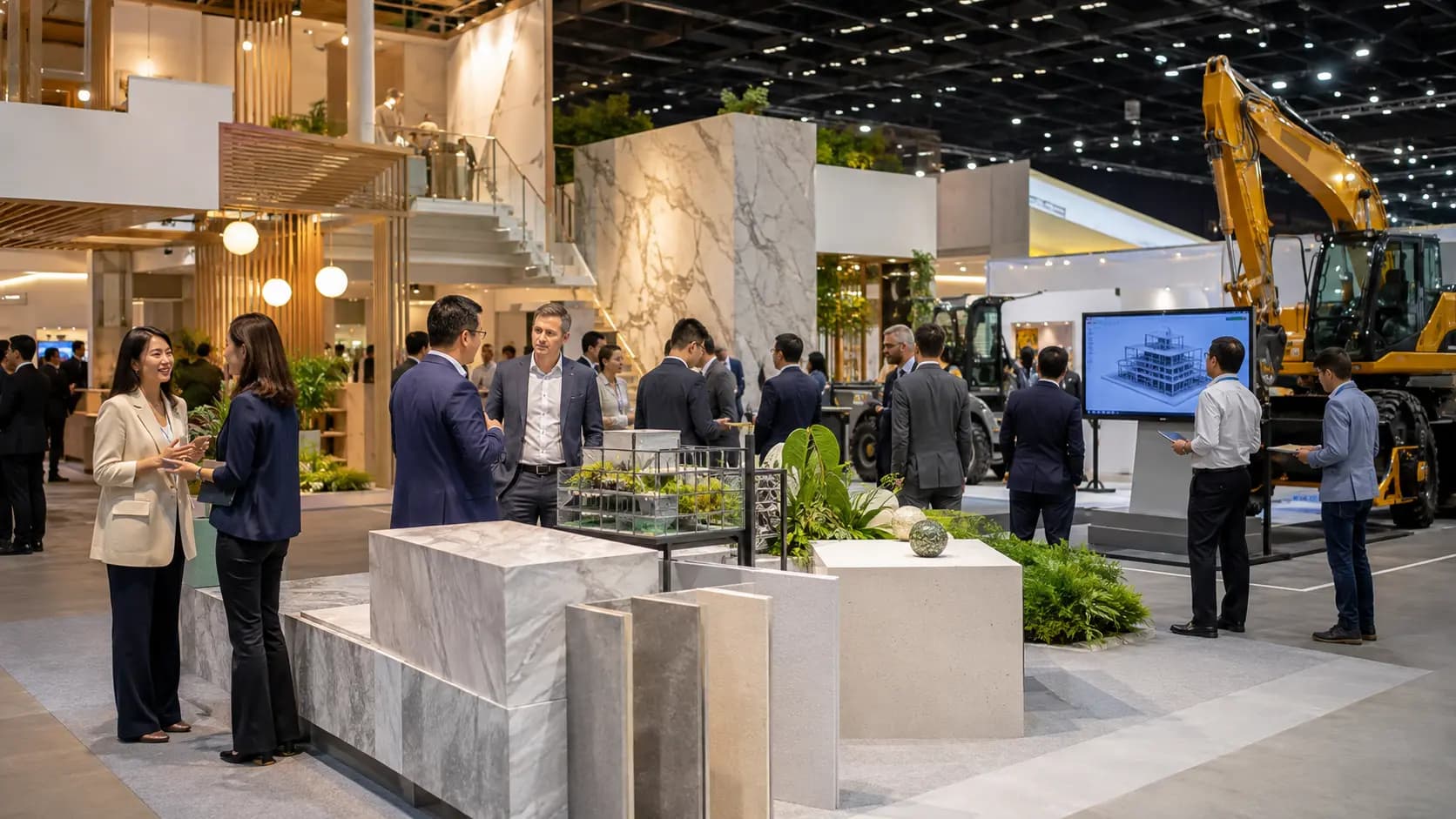
Thailand hosts several established construction, architecture and building-technology events, chiefly at IMPACT Muang Thong Thani. Each event below was checked against an official or organiser-confirmed listing before inclusion; dates are shown exactly as published, and no future date has been guessed.
BCT Expo 2026 (Building Construction Technology Expo)
Southeast Asia's exhibition and conference for the building, construction and mining industries — its 6th edition, themed "Empowering Net Zero in Construction & Mining."
- Venue:
- Hall 7, IMPACT Exhibition and Convention Center, Bangkok
- Organiser:
- Informa Markets
- Focus:
- Building and construction technology, net-zero transition, mining
Accessed 22 August 2026
Architect Expo 2026
ASEAN's largest building-technology exposition, covering building materials, construction, architecture, design and technology — reported to draw over 1,000 exhibitors and roughly 375,000 trade and public visitors annually.
- Venue:
- Challenger Halls 1-3, IMPACT Exhibition and Convention Center, Bangkok
- Organiser:
- Association of Siamese Architects under Royal Patronage
- Focus:
- Architecture, building materials, design technology
Accessed 22 August 2026
Event Date Status
Additional recurring events relevant to construction machinery, materials and building-energy topics (e.g. ASEAN Sustainable Energy Week and machinery/materials-focused exhibitions) exist but were not independently confirmed against a current official date during this research pass — check each organiser's own site directly before relying on a specific future date.
Market-Entry Action Plan
Identify the specific segment (buildings vs. infrastructure; public vs. private) and confirm current demand signals against official/primary sources rather than general market-research summaries alone.
Engage Thai-licensed engineers (Council of Engineers Thailand) and/or architects (Architect Council of Thailand) as required for your project's regulated design work.
Verify land title, zoning classification and use restrictions for the specific site with the relevant local planning authority.
Determine whether your project triggers environmental (or environmental-and-health) impact assessment thresholds, and plan the review timeline accordingly.
Apply for building permission from the relevant local authority (BMA or provincial/municipal equivalent) and any other project-specific permits required.
If your activity may qualify for BOI promotion (see Section 9), engage BOI or a qualified adviser early to confirm eligible-activity classification before finalising your investment structure.
Decide on entity structure (Thai company, project company/SPV, consortium, JV) with qualified legal advice, accounting for FBA constraints and land-ownership rules.
For public-sector work, register for and follow the relevant agency's procurement process (prequalification, bid security); for private work, follow standard commercial tendering practice.
Draft construction and JV contracts with qualified Thai legal counsel, specifying governing law, dispute-resolution mechanism and clear scope/variation provisions.
Arrange contractor's all-risk, professional-indemnity and other project-appropriate insurance cover before construction begins.
Establish site-safety compliance with DLPW requirements and quality-control processes aligned with any mandatory TISI standards and, where targeted, voluntary certification (TREES/LEED) requirements.
Plan customs clearance for imported machinery/materials (see Section 12) and define a clear handover, commissioning and occupancy-authorization process ahead of project completion.
Sources & Methodology
Every statistic, regulatory description, FTA/tariff statement, event date and company fact on this page is cited to a specific source with an access date. Sources are grouped below by type; each row states what it supports and any limitation readers should know about.
| Source | Supports | Limitation |
|---|---|---|
| NESDC — Thai Economic Performance in Q3 2025 and the Outlook for 2025-2026 | Official construction-sector growth figures (9M 2025, Q3 2025) | PDF content summarised via search-result excerpts in this pass; direct PDF fetch returned no extractable text — figures cross-checked across multiple search results citing the same release. |
| Department of Public Works and Town & Country Planning (DPT) | DPT's role in town/country planning and building control | General departmental site — confirm project-specific procedure directly. |
| Council of Engineers Thailand (COE) | COE's statutory role under the Engineer Act B.E. 2542 (1999) | Opened directly during this research pass. |
| Architect Council of Thailand (ACT) | ACT's statutory role under the Architect Profession Act | Identity and role cross-verified via multiple sources; official site referenced but not independently opened in this pass. |
| Source | Supports | Limitation |
|---|---|---|
| Thailand Board of Investment (BOI) — official site | General BOI promotion framework | Confirm specific activity eligibility directly — not independently re-verified for every activity cited on this page. |
| BOI Investment Promotion Guide 2025 (PDF) | Incentive-tier structure referenced for construction-adjacent activities | Referenced via search results, not independently opened in this research pass. |
| Source | Supports | Limitation |
|---|---|---|
| Maverick Consulting Group — "Thailand Land Bridge: The Trillion-Baht Corridor Stopped Post-Review" | Land Bridge project status, July-August 2026 review findings | A consultancy's analysis piece (updated 18 August 2026), citing primary Cabinet/committee documents — treat the underlying primary documents (Cabinet resolution, committee report) as the ultimate source where available. |
| Wikipedia — Bangkok-Nong Khai high-speed railway | High-speed rail Phase 1/Phase 2 status and completion percentage | Tertiary source aggregating SRT/press reporting — confirm current status directly with SRT for transaction-critical decisions. |
| onebangkok.com / Frasers Property press materials | One Bangkok phase-opening dates and status | Developer's own press materials. |
| Source | Supports | Limitation |
|---|---|---|
| Thai Customs Department | Tariff classification, valuation and clearance procedures | General departmental site — confirm current HS classification and duty rate directly for your product. |
| Thailand National Trade Repository — tariff lookup | Product-specific tariff and FTA-rate lookup | Referenced as the appropriate lookup tool; not independently queried for every HS code discussed on this page. |
| Department of Foreign Trade (DFT) | Rules of origin, certificates of origin | General departmental site — confirm product-specific origin rules directly. |
| Source | Supports | Limitation |
|---|---|---|
| Thai Industrial Standards Institute (TISI) | Mandatory/voluntary product standards for construction materials | Confirm which specific product categories are currently mandatory-listed directly with TISI. |
| Thai Green Building Institute (TGBI) — TREES rating documentation | TREES green-building rating system background | Referenced via search results; confirm current certified-building counts and standard version directly with TGBI. |
| Public-Private Partnership Act B.E. 2562 (2019) — full text | PPP legal framework, PPP Committee threshold reference | Hosted by UNESCAP as a reference copy — confirm current amended text with SEPO directly. |
| Source | Supports | Limitation |
|---|---|---|
| Central Pattana — official site | CPN company identity, listing status, core business | Company's own site. |
| Krungsri Research — Industry Outlook: Construction Contractor 2025-2027 | Listed-contractor market-share concentration figure | Bank research report, not an official government statistic. |
| Source | Supports | Limitation |
|---|---|---|
| BCT Expo 2026 — PR Newswire organiser announcement | BCT Expo 2026 dates, theme, venue | Organiser press release distributed via PR Newswire. |
| Architect Expo — Thailand NOW event listing | Architect Expo 2026 dates and description | Third-party event-listing site; cross-check against the Association of Siamese Architects' own site for future editions. |
Sources last reviewed: 22 August 2026
Explore Thailand's Construction & Built-Environment Opportunity
From landmark mixed-use developments to a substantial public infrastructure programme, Thailand's construction economy offers real opportunity alongside real complexity — regulatory, ownership and project-status due diligence matter as much as market size.
T3 connects developers, contractors, equipment suppliers, consultants and investors to verified government, professional and industry resources across Thailand's construction and built-environment sector.