

T3 INDUSTRY GATEWAY
Healthcare Thailand
Thailand's health system as national infrastructure — public and private hospitals, coverage schemes, regulation, technology, workforce and investment — explained for patients seeking orientation, founders, investors, hospital partners, insurers and policy stakeholders.
Not Medical Advice
This page provides information and navigation only. It is not medical advice, a diagnosis, a treatment recommendation, or an emergency service. T3 is not a doctor, hospital, insurer or broker.
Healthcare at a Glance
Universal Coverage Scheme enrolment
~47 million people
The Universal Coverage Scheme (UCS), Thailand's largest public health financing scheme, covers Thai nationals not already covered by the Civil Servant Medical Benefit Scheme or Social Security Scheme — commonly cited at roughly 47 million people, alongside the Social Security Scheme and Civil Servant Medical Benefit Scheme covering most of the remainder. T3's editorial team should confirm the current NHSO-published enrolment figure and year before publishing a precise number.
Source: National Health Security Office (NHSO) (opens in a new tab) · Last reviewed 6 September 2026
"30-Baht Treatment Anywhere" nationwide rollout
Nationwide since January 2025
NHSO's digital-ID-based "30-Baht Treatment Anywhere" initiative — allowing eligible UCS beneficiaries to access participating primary care units, pharmacies, clinics, laboratories and hospitals beyond their originally registered facility using a Thai national ID card — expanded to nationwide coverage from January 2025, following province-by-province pilots. It applies to eligible UCS beneficiaries using a Thai national ID card, not to every visitor, resident, service or hospital.
Source: National Health Security Office (NHSO), English news portal (opens in a new tab) · Last reviewed 6 September 2026
Public financing schemes
3 principal schemes
Thailand's public health financing runs through three principal schemes with different eligible populations and rules: the Universal Coverage Scheme (NHSO), the Social Security Scheme (Social Security Office, for private-sector employees), and the Civil Servant Medical Benefit Scheme (for civil servants and their dependants). Eligibility, registered provider and referral rules differ between them and must be verified with the responsible agency, not assumed.
Source: National Health Security Office (NHSO) / Social Security Office (SSO) (opens in a new tab) · Last reviewed 6 September 2026
JCI-accredited private hospitals
Multiple, led by early ASEAN adopters
Thailand was an early adopter of Joint Commission International (JCI) accreditation in Southeast Asia — Bumrungrad International Hospital was the first hospital in Asia to receive JCI accreditation and has since received repeat re-accreditation. Several other private hospital groups hold current JCI accreditation. T3's editorial team should verify each hospital's current accreditation status directly against JCI's own accredited-organization search before publishing a count, since accreditation is time-bound and subject to renewal.
Source: Joint Commission International (JCI); hospital-published accreditation pages (opens in a new tab) · Last reviewed 6 September 2026
How Thailand's Healthcare System Works
Thailand's health system runs on two parallel tracks that intersect at many points: a public provider network (government hospitals, university/teaching hospitals, other government hospitals, local-authority health centres and primary care units) financed mainly through the three schemes below, and a large private sector (private hospitals, clinics, pharmacies, laboratories) that serves self-paying patients, privately insured patients, and — for specific services — public-scheme patients referred or contracted in.
University / Teaching Hospitals
Large tertiary referral and teaching hospitals attached to medical faculties (e.g. Siriraj, King Chulalongkorn Memorial, Ramathibodi) — combine patient care, medical education and clinical research, and typically handle the most complex referred cases.
Other Government Hospitals
Regional, provincial, district and community hospitals operated by the Ministry of Public Health, plus hospitals run by other government bodies (e.g. police, military, Bangkok Metropolitan Administration) — the backbone of the public referral network outside the university hospitals.
Local-Authority Health Centres & Primary Care Units
Sub-district health-promoting hospitals and primary care units providing first-contact, preventive and basic curative care, and acting as the registered entry point for most UCS beneficiaries' referral pathway.
Private Hospitals & Clinics
Range from small outpatient clinics to large private hospital groups with international-patient departments — serve self-paying patients, privately insured patients, and in some cases patients referred under public-scheme contracts.
Pharmacies & Independent Laboratories
Licensed community pharmacies and independent diagnostic laboratories operate alongside hospital pharmacy and in-house labs, and are part of the "30-Baht Treatment Anywhere" participating-facility network for eligible UCS services.
Public Financing Schemes
Universal Coverage Scheme (UCS)
Administered by: National Health Security Office (NHSO)
Thai nationals not already covered by the Social Security Scheme or Civil Servant Medical Benefit Scheme, registered to a designated primary care unit.
Registration, referral rules, the "30-Baht Treatment Anywhere" participating-facility list, and covered services all change over time — verify current rules directly with NHSO rather than assuming universal eligibility for every visitor or resident.
Social Security Scheme (SSS)
Administered by: Social Security Office (SSO)
Private-sector employees (and, under separate voluntary sections, some self-employed individuals) who contribute to the Social Security Fund, registered to a contracted hospital.
Coverage, contracted-hospital choice, and claim procedures are set by SSO and the employee's registered hospital — verify directly with SSO or the employer's HR/payroll function.
Civil Servant Medical Benefit Scheme (CSMBS)
Administered by: Comptroller General's Department, Ministry of Finance
Civil servants, state employees and their eligible dependants (parents, spouse, children under specified conditions).
Reimbursement rules, direct-billing hospital lists and dependant eligibility are set by the Comptroller General's Department — verify current rules directly rather than assuming they mirror UCS or SSS.
Verify Eligibility Directly
None of the three schemes above provides automatic coverage for every visitor, every resident, every service or every hospital. Eligibility, the registered provider, referral requirements, exclusions and payment arrangements must always be verified with the responsible agency (NHSO, SSO or the Comptroller General's Department) before assuming a service is covered.
Benefits of a Strong Health Industry
A strong healthcare sector creates value well beyond hospital walls — for individuals, the workforce, regional equity, the economy, innovation and Thailand's international standing.
Health & Quality of Life
Prevention, earlier diagnosis, safer care, continuity of treatment, rehabilitation and healthy ageing all depend on a functioning, adequately resourced health system.
National Productivity
A healthier workforce, effective occupational health programs, faster return to work after illness or injury, and reduced catastrophic household health spending all support broader economic productivity.
Regional Equality
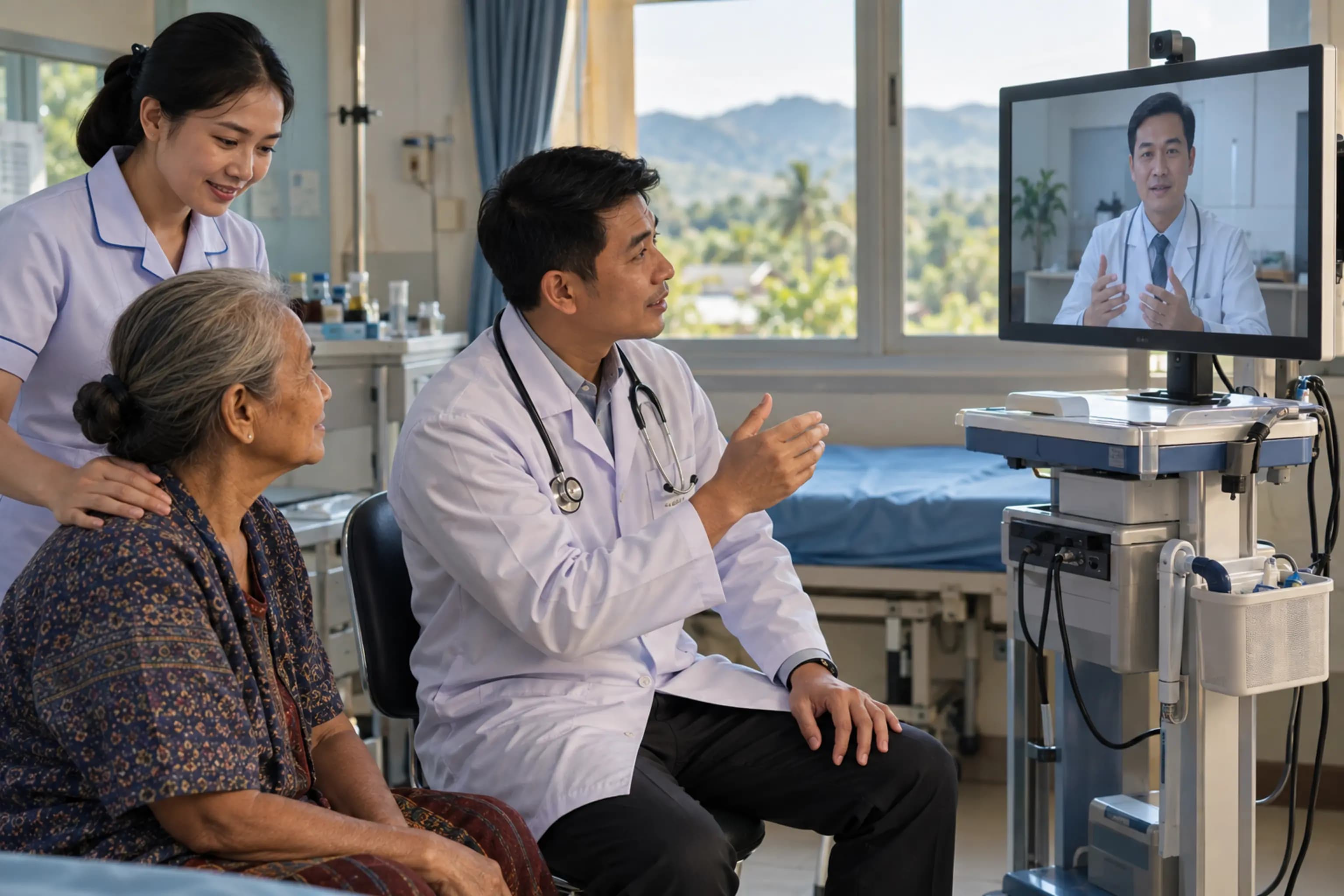
District and provincial hospital networks, referral pathways, telehealth and mobile services, and workforce distribution policy all affect whether healthcare access outside Bangkok keeps pace with access within it.
Economic Capability
Hospitals, medical devices, pharmaceuticals, diagnostic laboratories, healthcare logistics, digital health and clinical research together represent a significant skilled-employment and export-capable sector, not only a cost centre.
Investment & Innovation
Hospital modernization, biomedical engineering, health-data infrastructure, university-hospital research partnerships and responsibly deployed clinical technology expand what the system can do over time.
International Confidence
Transparent quality reporting, multilingual coordination for international patients, continuity of care, clear insurer processes and robust patient-safety systems build the trust that supports Thailand's role as a regional healthcare hub.
Growth Does Not Automatically Mean Equity
Growth in the healthcare sector does not automatically improve equity or affordability — real trade-offs exist alongside the benefits above, including health-workforce shortages and maldistribution between Bangkok and other provinces, out-of-pocket household costs even under public schemes, health-data privacy and cybersecurity risk as digitization expands, rising demand from an ageing population, antimicrobial resistance, and, in some areas, an uneven or still-developing evidence base for newer technologies. This page does not present growth as a substitute for addressing these trade-offs.

Healthcare Modernization
Thailand's healthcare modernization spans hospital infrastructure renewal, service redesign, digital health records, interoperability, telehealth, analytics, cybersecurity, clinical engineering, smart logistics, energy efficiency and expanding access for an ageing and regionally dispersed population. These sit at different stages of maturity — an announced policy, an active pilot, a procurement in progress and a completed nationwide rollout are not the same thing, and this page does not present one as another.
Digital ID & "Treatment Anywhere"
National-ID-based patient identification enabling UCS beneficiaries to access participating facilities outside their registered unit, part of NHSO's digital-transformation push.
Active, nationwide since January 2025 for participating facility types under UCS — confirm current participating-facility categories with NHSO.
Electronic Health Records & Interoperability
Hospital-level electronic medical record systems and government-led interoperability initiatives intended to let patient records move between providers more safely and efficiently.
Adoption varies significantly by hospital and network — a hospital-level EMR is not the same as system-wide interoperability; verify a specific hospital's or network's current status directly.
Telehealth & Remote Consultation
Both public pilots and private-hospital telehealth services allowing remote consultation, follow-up and, in some programs, medicine delivery.
Ranges from established private-hospital services to smaller public pilots — do not assume any specific telehealth service is nationwide or reimbursed by a public scheme without checking.
Cybersecurity & Health Data Governance
Hospitals and health-data systems fall under Thailand's Personal Data Protection Act (PDPA) and sector-specific data-governance requirements, alongside hospital-level cybersecurity investment.
Requirements are set by law and regulation, not by any single hospital's marketing claims — verify current PDPA obligations with the Personal Data Protection Committee's official guidance.

SEED TRACKER — NON-EXHAUSTIVE
Government Initiatives Tracker
Prevention, universal coverage, primary care, digital health, ageing, noncommunicable disease, mental health, medical industry, workforce and emergency-preparedness initiatives, each shown with its own status and last-checked date.
"Healthy Thailand" Is a Reader-Friendly Umbrella
This is a small, independently verified seed list — not a comprehensive tracker of every Thai government health initiative. "Healthy Thailand" is used here only as a reader-friendly umbrella term for prevention, health-promotion, access and healthy-ageing initiatives; T3 has not found an official source confirming it as one single legally defined program with that exact name, and does not present it as one. Each verified initiative is listed individually below with its own official name, agency and status.
"30-Baht Treatment Anywhere" (Digital ID Card Healthcare)
activeNational Health Security Office (NHSO)
Allow eligible UCS beneficiaries to access participating primary care units, pharmacies, clinics, laboratories and hospitals beyond their originally registered facility, using a Thai national ID card for identification.
- Target group:
- Universal Coverage Scheme (UCS) beneficiaries
- Scope:
- Nationwide (following province-by-province pilot rollout)
- Implementation:
- Nationwide from January 2025 (piloted in earlier phases across multiple provinces from 2024)
NHSO reports expanding participating-facility numbers and usage through its own English news portal; T3 has not independently verified a specific usage or outcome figure and does not publish one here without a dated NHSO source.
Official source · Last checked 6 September 2026

Government & Public Hospitals
A non-ranked, non-exhaustive seed directory of public and university/teaching hospitals — see the disclosure below before treating this as complete.
Showing 2 of 2 entries
University / Teaching Hospital
Siriraj Hospital
Faculty of Medicine Siriraj Hospital, Mahidol University
Thailand's oldest and one of its largest teaching hospitals, affiliated with Mahidol University's Faculty of Medicine — a tertiary referral centre and major site of medical education and clinical research.
University / Teaching Hospital
King Chulalongkorn Memorial Hospital
Faculty of Medicine, Chulalongkorn University / Thai Red Cross Society
A major teaching and tertiary referral hospital operated jointly with the Thai Red Cross Society and Chulalongkorn University's Faculty of Medicine.
Directory Disclosure
This is a small, independently verified seed list, not a comprehensive directory of Thailand's public hospitals — order carries no significance, and inclusion is not a ranking or endorsement. No bed numbers, specialties, waiting times or outcome claims are stated unless sourced from the hospital's or a regulator's own published materials. T3's editorial team should expand this directory with further verified entries before it is treated as complete.

Private & International Hospitals
A hospital is not called "international" here solely because its name includes that word — see the disclosure below for what is and isn't verified for each entry.
Showing 3 of 3 entries
Private International Hospital
Bumrungrad International Hospital
A large private hospital in Bangkok with a long-established international-patient department, multilingual coordination services, and repeat Joint Commission International (JCI) re-accreditation — among the first hospitals in Asia to hold JCI accreditation.
JCI accreditation is time-bound and subject to periodic re-accreditation — verify current status on the hospital's own accreditation page before relying on it.
Private International Hospital
Bangkok Hospital
Bangkok Hospital Group / Bangkok Dusit Medical Services (BDMS)
A large private hospital network with JCI accreditation and JCI Clinical Care Program Certifications in specific specialties, operated by Bangkok Dusit Medical Services (BDMS).
Specialty-specific certifications and accreditation scope vary by BDMS network hospital — verify the specific hospital location's current certifications directly.
Private International Hospital
Samitivej Hospital
Samitivej Sukhumvit / Samitivej Hospital Group
A private hospital group JCI-accredited since 2007, recognised by WHO/UNICEF as a Mother and Baby Friendly Hospital, with dedicated international-patient services and multilingual staff.
Directory Disclosure
A hospital is not described as "international" here solely because its name includes that word — each entry's international-patient services are stated only where the hospital's own materials describe them. This is a small, independently verified seed list, not a comprehensive market survey, and no entry is described as "best," guaranteed, or accepting every insurer — verify accreditation status, insurer networks and services directly with the hospital before relying on this list.

International Patient Treatment Journey
A non-promotional, ten-step orientation from confirming medical need through to home-country follow-up. This is not a recommendation of any individual treatment, clinician or provider.
- 1
Confirm the medical need and whether travel is clinically appropriate
Discuss with a treating clinician at home whether the condition is suitable for treatment abroad, and whether travel itself is medically advisable.
- 2
Select a licensed facility and credentialed clinician
Verify the hospital's licence, the clinician's credentials, and (where claimed) the hospital's current accreditation status directly with the accrediting body.
- 3
Submit records securely for review
Share relevant medical records through the hospital's own secure channel, not an informal or unverified route.
- 4
Receive a provisional plan, limitations and cost estimate
A remote estimate is provisional — it can change once a clinician has actually examined the patient in person.
- 5
Verify visa, travel fitness, insurance, authorization, exclusions and direct billing
Confirm visa requirements, fitness to travel, insurance pre-authorization, policy exclusions, and whether the hospital will bill the insurer directly or require the patient to pay and claim reimbursement.
- 6
Confirm interpreter, accessibility and companion needs
Arrange language support, accessibility accommodations and any companion travel and accommodation needs in advance.
- 7
Understand consent, privacy, deposits, cancellation and complication policies
Review informed-consent documentation, data-privacy practices, deposit requirements, and the hospital's cancellation and complication-handling policies before treatment.
- 8
Receive evaluation and treatment in Thailand
In-person clinical evaluation, and treatment if the clinician confirms it is appropriate.
- 9
Obtain discharge summary, medicines information, imaging/lab copies and warning signs
Request a full discharge summary, medication information, copies of imaging/lab results, and clear guidance on warning signs requiring urgent follow-up.
- 10
Coordinate follow-up with the home-country clinician and insurer
Share the discharge summary and results with the home clinician and insurer to coordinate ongoing follow-up care.
No Guarantees
- A remote cost or treatment estimate can change materially once a clinician has examined the patient in person.
- A visa does not guarantee treatment, admission, or a specific outcome.
- Hospital accreditation is a quality certification, not a guarantee of any individual treatment outcome.
- T3 does not recommend an individual treatment, clinician or hospital, and does not guarantee coverage, claim approval, admission, visa outcome or treatment result.
Clinical Services & Care Pathways
Orientation, Not Medical Advice
This section is orientation on how services are typically organized — it is not diagnosis, treatment advice, or a recommendation to seek or avoid any specific service.
Emergency & Urgent Care
Hospital emergency departments handle acute, life-threatening and urgent conditions — for a genuine emergency, use official emergency information rather than researching a page like this one.
Primary Care
First-contact care at a health-promoting hospital, primary care unit, clinic or general practitioner — typically the entry point for referral into the wider system.
Diagnostics
Laboratory testing, medical imaging and other diagnostic services, provided by hospital departments or independent licensed laboratories/imaging centres.
Inpatient Care & Surgery
Hospital admission for surgical procedures, complex medical management, or conditions requiring ongoing monitoring.
Rehabilitation
Physical, occupational and other therapy services supporting recovery after illness, injury or surgery.
Chronic-Disease Management
Ongoing management of conditions such as diabetes, hypertension and chronic respiratory disease, typically coordinated between primary care and specialist follow-up.
Maternal & Child Health
Antenatal, delivery, postnatal and paediatric services, provided across public and private facilities.
Mental Health
Psychiatric and psychological services provided through specialist departments, dedicated facilities and, increasingly, primary care integration.
Ageing Care
Geriatric assessment and care coordinated with the long-term-care and rehabilitation services described in the ageing section below.
Specialist Referral
Referral from primary or general care into specialist departments, typically at a district, provincial or tertiary/teaching hospital depending on complexity.

Ageing, Long-Term Care & Rehabilitation
Thailand's ageing population is driving rising demand for geriatric assessment, rehabilitation, home and community-based care, caregiver support, palliative care, assistive technology and their financing. Healthcare (clinical treatment and rehabilitation), social care (non-clinical daily-living support) and wellness/residential services (elective, non-clinical living arrangements) are three distinct categories that this page keeps separate rather than blending into one "elder care" concept.
- Geriatric assessment and specialist geriatric care
- Rehabilitation services supporting recovery and functional independence
- Home- and community-based care
- Caregiver support and training
- Palliative care
- Assistive technology
- Financing — a mix of public-scheme coverage, private insurance, and out-of-pocket payment, distinct from the wellness/residential services covered on T3's Medical Wellness page

Medical Technology & Digital Health
Thai hospitals use a wide range of medical technology — diagnostic imaging, laboratory information systems, hospital information systems, electronic records, telemedicine platforms, AI-assisted clinical and administrative workflows, medical devices, surgical robotics and remote monitoring. Four distinct things are easy to conflate and are kept separate here: regulatory authorization (a device or system is legally permitted to be used or sold), procurement approval (a specific hospital or authority has approved buying it), hospital adoption (a hospital has actually deployed it), and clinical evidence (independent studies show it improves outcomes). A technology being described as "AI-powered" does not by itself mean it has been clinically validated.
- Diagnostic imaging (X-ray, CT, MRI, ultrasound) and laboratory information systems.
- Hospital information systems and electronic medical/health records.
- Telemedicine and remote-monitoring platforms.
- AI-assisted workflows — ranging from administrative triage tools to diagnostic-support software with varying levels of regulatory clearance and clinical validation.
- Medical devices and surgical robotics, subject to Thai FDA device regulation.
- Interoperability, cybersecurity and PDPA-governed data privacy across connected systems.

Pharmaceuticals, Medical Devices & Supply Chains
Thailand's pharmaceutical and medical-device supply chain runs from manufacturers and importers through distributors to hospital pharmacy and procurement — governed by product registration, quality systems, cold-chain requirements, traceability, and shortage/recall management. Product-registration status and safety claims for any specific medicine or device should be verified directly with the Thai Food and Drug Administration (Thai FDA) or the relevant competent authority — this page does not recommend any medicine or device.
- Manufacturers and importers must register pharmaceutical products and medical devices with the Thai FDA before lawful sale.
- Distributors and hospital pharmacy departments manage procurement, storage (including cold-chain for temperature-sensitive products) and dispensing.
- Quality systems (e.g. GMP for manufacturers, GDP for distributors) govern how products are produced, stored and transported.
- Traceability systems help identify affected batches quickly in the event of a quality issue, shortage or recall.
- Supply continuity — for both routine medicines/devices and critical care items — depends on manufacturer, distributor and hospital-level contingency planning, not any single point in the chain.

Health Insurance, Coverage & Payment
Payment for healthcare in Thailand runs through several distinct routes: the three public schemes described above, employer/social-security coverage, private health insurance, international/travel insurance, and self-pay. None of these is described here with a promise of coverage, claim approval or direct billing — every real case depends on the specific policy, its version, its effective date, and the treating hospital's own arrangement with that insurer or scheme, none of which this page can determine on a visitor's behalf.
- Public schemes (UCS, SSS, CSMBS) — each has its own eligibility, registered-provider and referral rules; see the financing-schemes section above.
- Private health insurance — policy terms, exclusions, waiting periods, deductibles, co-payments, and the network of hospitals offering direct billing all vary by insurer, product and policy version; verify against the insurer's current policy document, not a summary.
- International/travel insurance — coverage for treatment in Thailand depends entirely on the specific policy purchased; pre-authorization is frequently required before non-emergency treatment.
- Hospital direct billing versus reimbursement — some hospitals bill an insurer directly for covered treatment; others require the patient to pay first and claim reimbursement afterward. Confirm which applies before treatment, not after.
- Self-pay estimates and deposits — private hospitals commonly request a deposit before non-emergency admission; a pre-treatment estimate can change once a clinician has actually examined the patient.
- Emergency care and payment — emergency departments generally treat first and address payment afterward, but this varies by facility and does not override any legal payment obligation.
No Coverage Promise
T3 never summarizes an insurance policy without its exact product, version and effective date, and never promises coverage, claim approval or direct billing — verify every case against the insurer's current policy document.

Policy, Regulation & Data Governance
Several distinct things sit under "regulation" and are kept separate here: law (e.g. the Health Facility Act, the Personal Data Protection Act), regulation and ministerial notification, professional standard (set by a statutory council), accreditation (a voluntary quality certification, not a legal requirement to operate), and voluntary guidance. Facility licensing, professional licensing, health-product regulation, patient rights, informed consent, advertising restrictions, medical-records handling, data privacy, cross-border data transfer, clinical research ethics and telemedicine practice are all governed by specific, separately maintained rules — verify current requirements directly with the responsible body rather than treating any one of these as interchangeable with another.
Facility Licensing
Hospitals and clinics require a facility licence under Thailand's health-facility legislation, administered by the Department of Health Service Support and provincial health offices.
Professional Licensing
Doctors, nurses, pharmacists, dentists and other professions are licensed by their own statutory council (see the Professional Councils section below), not by a hospital or employer.
Health-Product Regulation
Medicines, medical devices, cosmetics and certain foods fall under Thai FDA registration and post-market surveillance.
Quality & Accreditation
Hospital accreditation (e.g. through the Healthcare Accreditation Institute) is a voluntary quality certification, distinct from the legal facility licence required to operate at all.
Patient Rights & Informed Consent
Patients have rights to information and informed consent before treatment, grounded in professional standards and, for research, formal ethics-review requirements.
Medical Records, Privacy & Cross-Border Data
Personal health data is governed by the Personal Data Protection Act (PDPA) and sector-specific rules on medical-record handling and cross-border data transfer.
Telemedicine Practice
Remote consultation by a licensed professional is governed by Medical Council and Ministry of Public Health guidance on telemedicine practice, which continues to develop.
Verify Current Requirements
Regulatory requirements in every domain above change over time. Verify current requirements directly with the responsible body (listed in the Government Bodies section) before relying on any summary, including this one.

Quality, Accreditation, Safety & Results
"Success results" on this page means source-defined, time-bounded outcome data — a stated denominator, period, measure definition, institution or source, and known limitations — never a testimonial, a before/after marketing claim, or a guaranteed treatment result. Where comparable outcome data across facilities is not publicly available, this page says so rather than implying a ranking that the underlying data cannot support.
- Facility accreditation — a voluntary quality certification (e.g. Healthcare Accreditation Institute accreditation, JCI accreditation for hospitals seeking international recognition) — accreditation status is time-bound and must be re-verified periodically, not assumed permanent.
- Patient safety and infection prevention — governed by hospital-level clinical governance and, for specific risks, national infection-control guidance.
- Clinical governance — the internal structures a hospital uses to monitor and improve care quality, which vary by institution.
- Service performance and patient-reported outcomes — meaningful only when a specific measure, period, denominator and source are stated; T3 does not construct a hospital league table from incomparable, self-reported figures.
- Continuity and rehabilitation — how well a hospital or network coordinates a patient's care after discharge, an area with limited standardized public reporting in Thailand today.

Success Stories
T3 distinguishes three types of "success": a health-system success (a policy, access or quality improvement supported by official evaluation), an institutional success (a hospital, research centre or network improvement supported by published evidence), and a patient journey (a specific, consented, attributable story published by a responsible institution, with privacy protected and no guaranteed-outcome implication). No specific story is invented, and a marketing testimonial is never presented as clinical outcome evidence.
Editorial Status
No specific success story has been independently verified and populated on this page yet — publishing one requires a named, attributable, consented source (an official evaluation report, a peer-reviewed publication, or a hospital's own published case study with the required denominator/baseline, dates and limitations). This is flagged here for T3's editorial team to research and add real, sourced stories rather than left populated with an invented example.
Image Notice
The image healthcare-success-stories.webp is representative only and must never be captioned as depicting a real, identifiable patient.
Measurement Dashboard
Access
e.g. population coverage by scheme, geographic distribution of facilities.
Prevention
e.g. immunization and screening program reach.
Workforce
e.g. health-worker density and geographic distribution.
Finance
e.g. health expenditure as a share of GDP, out-of-pocket share of spending.
Quality
e.g. accredited-facility counts, where accreditation status is independently verifiable.
Safety
e.g. reported adverse-event or infection-control indicators, where publicly reported.
Patient Experience
e.g. patient-reported experience measures, where a comparable survey exists.
Outcomes
e.g. condition-specific outcome measures, only where a comparable, source-defined dataset exists.
Research
e.g. registered clinical trials, published research output.
Supply Resilience
e.g. medicine/device shortage and recall reporting, where publicly available.
International-Patient Services
e.g. accredited hospitals offering international-patient coordination services.
No Fabricated Figures
Every indicator above requires its own numerator/denominator, unit, population, geography, reference period, source and comparability warning before it can be published with an actual figure. Where comparable, source-defined data is not currently available for a domain, this page states that rather than presenting an estimate, and does not build a hospital league table from incomparable, self-reported figures.

Workforce, Education & Research
Thailand's health workforce spans doctors, nurses, pharmacists, dentists, allied health professionals, biomedical engineers and health-informatics specialists, trained through medical, nursing, pharmacy and allied-health faculties at universities including Mahidol, Chulalongkorn, Chiang Mai and others, with specialist training and continuing professional development requirements set by the relevant professional council. Workforce distribution between Bangkok and other provinces, and between public and private sectors, is a recognised policy challenge rather than something this page can resolve or quantify without a current, sourced dataset.

Research & Innovation Ecosystem
Thailand's clinical and biomedical research ecosystem centres on university teaching hospitals (Mahidol, Chulalongkorn and others), their affiliated research institutes, hospital-based ethics review committees, and a growing base of clinical-trial, diagnostics and medical-device activity. Laboratory research, clinical validation, regulatory authorization (Thai FDA), procurement, and routine clinical adoption are each a distinct stage — a laboratory finding is not a validated treatment, and a validated treatment is not yet routine practice until it clears the stages after it.
- University teaching hospitals and their affiliated research institutes
- Institutional ethics review for clinical research
- Clinical trials, subject to Thai FDA and ethics-committee oversight
- Medical-device and diagnostics innovation, subject to Thai FDA regulatory authorization
- Health technology assessment informing public-scheme coverage decisions
- Intellectual property and commercialization pathways for university and hospital-originated research
- International research collaboration between Thai institutions and overseas universities/companies
Government Bodies
Showing 10 of 10 entries
Government & Regulatory
Thailand Board of Investment (BOI)
Thailand's national investment-promotion agency — grants tax and non-tax incentives for promoted activities and coordinates investor support through offices across Asia, Europe, Australia and the US.
Government & Regulatory
Food and Drug Administration Thailand (Thai FDA)
Regulates food, drug, medical device, cosmetic and herbal products entering the Thai market, including the cosmetics product-notification ("Jor.Kor.") system.
Government & Regulatory
Ministry of Public Health (MOPH)
Thailand's national health ministry, overseeing hospital licensing, health-establishment regulation and public-health policy.
Government & Regulatory
Department of Health Service Support (DHSS)
Administers health-establishment licensing (including spas and clinics), the HSS premium-standard scheme, and Thailand's Medical Hub / One-Stop Service Center functions for medical and wellness tourism.
Government & Regulatory
Office of Insurance Commission (OIC)
Independent regulator, established 2007, licensing and regulating insurance brokers, agents and insurance businesses in Thailand — including private health-insurance products and insurers.
Government & Regulatory
Social Security Office (SSO)
Ministry of Labour agency administering mandatory employer/employee social-security contributions and benefits, including the Social Security Scheme's healthcare benefit for covered private-sector employees.
Government & Regulatory
National Health Security Office (NHSO)
Administers the Universal Coverage Scheme (UCS) and its "30-Baht Treatment Anywhere" digital initiative.
Government & Regulatory
Department of Medical Services (DMS)
Ministry of Public Health department operating specialised government hospitals and setting clinical-service standards for the public hospital network.
Government & Regulatory
Department of Medical Sciences (DMSc)
Ministry of Public Health department responsible for laboratory reference standards, medical-science research and quality control for diagnostic testing.
Government & Regulatory
Healthcare Accreditation Institute (Public Organization)
Thailand's national hospital-accreditation body, operating the Hospital Accreditation (HA) quality-certification standard.
Professional Councils & Associations
Showing 4 of 4 entries
Hospital / Provider Association
Private Hospital Association Thailand (TPHA)
Represents Thailand's private hospital sector — 205-290+ member hospitals nationwide, encouraging ISO 9000, HA and JCI certification among members.
Statutory Professional Council
Medical Council of Thailand
The statutory body licensing and regulating medical doctors in Thailand — sets and enforces professional standards for the medical profession.
Statutory Professional Council
Thailand Nursing and Midwifery Council
The statutory body licensing and regulating nurses and midwives.
Statutory Professional Council
The Pharmacy Council of Thailand
The statutory body licensing and regulating pharmacists.
Directory Disclosure
This is a small, verified seed list, not an exhaustive directory. Statutory councils license and regulate their profession; hospital, medical-device, pharmaceutical and specialty associations are voluntary membership bodies that do not license anyone — the distinction is stated for every entry rather than assumed.

Investment & Partnership Opportunities
Healthcare investment and partnership opportunities in Thailand span hospitals and specialised clinical services, medical devices, pharmaceuticals, digital health, diagnostic laboratories, clinical research, elder care, healthcare logistics and workforce technology. Where BOI investment promotion applies, only BOI's own current published eligible-activities list and criteria determine eligibility — this page explains the pathway, not a guarantee of approval, and clearly labels applications, approvals and realized projects as distinct stages rather than treating them interchangeably.
- Hospitals and specialised clinical services (e.g. oncology, cardiology, fertility)
- Medical devices — manufacturing, distribution and after-sales service
- Pharmaceuticals — manufacturing, distribution and cold-chain logistics
- Digital health — hospital information systems, telemedicine platforms, AI-assisted clinical and administrative tools
- Diagnostic laboratories and imaging centres
- Clinical research organizations and trial-support services
- Elder care and long-term-care facilities
- Healthcare logistics, cold-chain and supply-chain technology
- Health workforce technology — training, credentialing and staffing platforms
User Journeys
Understand the Thai Healthcare System
Start with how the system works and the three public financing schemes.
Find a Hospital or Responsible Institution
Browse the public and private hospital directories, and the government-body directory for the relevant regulator.
Understand Coverage and Payment
Review how public schemes, private insurance and self-pay arrangements work.
Explore Healthcare Investment or Partnerships
See investment segments and BOI's healthcare-eligible activities, then submit an inquiry.
Find Regulators, Councils or Associations
Go directly to the government-body and professional-council directories.
For an Emergency
For a medical emergency, contact current official emergency services directly rather than researching this page — T3 does not publish an emergency number here because emergency-service contact details should always be confirmed against current official sources at the time they are needed, not against a static webpage.
Sources & Methodology
Every changing claim on this page states its publisher, reference period and a "last reviewed" or "accessed" date, and prefers official bodies, legislation, authoritative public datasets and organizations' own published materials over secondary summaries. Hospital, government-body and association directories are explicit, small, non-ranked, non-exhaustive seed lists rather than comprehensive surveys — several entries are flagged for T3's editorial team to independently re-verify (particularly department-level government URLs) before this page is treated as fully audited. No statistic, government contact, hospital capability, initiative status or success story on this page has been invented; where a verifiable primary source could not be located during this research pass, that gap is stated rather than filled with plausible-sounding detail.
Looking to Partner, Invest or Connect?
T3 can point you to sector-specific directories, official government bodies, and the right BOI pathway for your healthcare activity — this page is a starting map, not a substitute for direct verification with the named institutions.
T3 Healthcare Inquiry
Not for Emergencies, Medical Advice or Health Data
This form is for healthcare business, investment and partnership inquiries only. It is not for emergencies, medical advice, appointment booking, insurance authorization, or a guaranteed introduction to any hospital, clinician or insurer. Do not submit a diagnosis, medical record, insurance ID or other sensitive health information.