Business & Investment · Agriculture
Thailand, Rooted and Growing
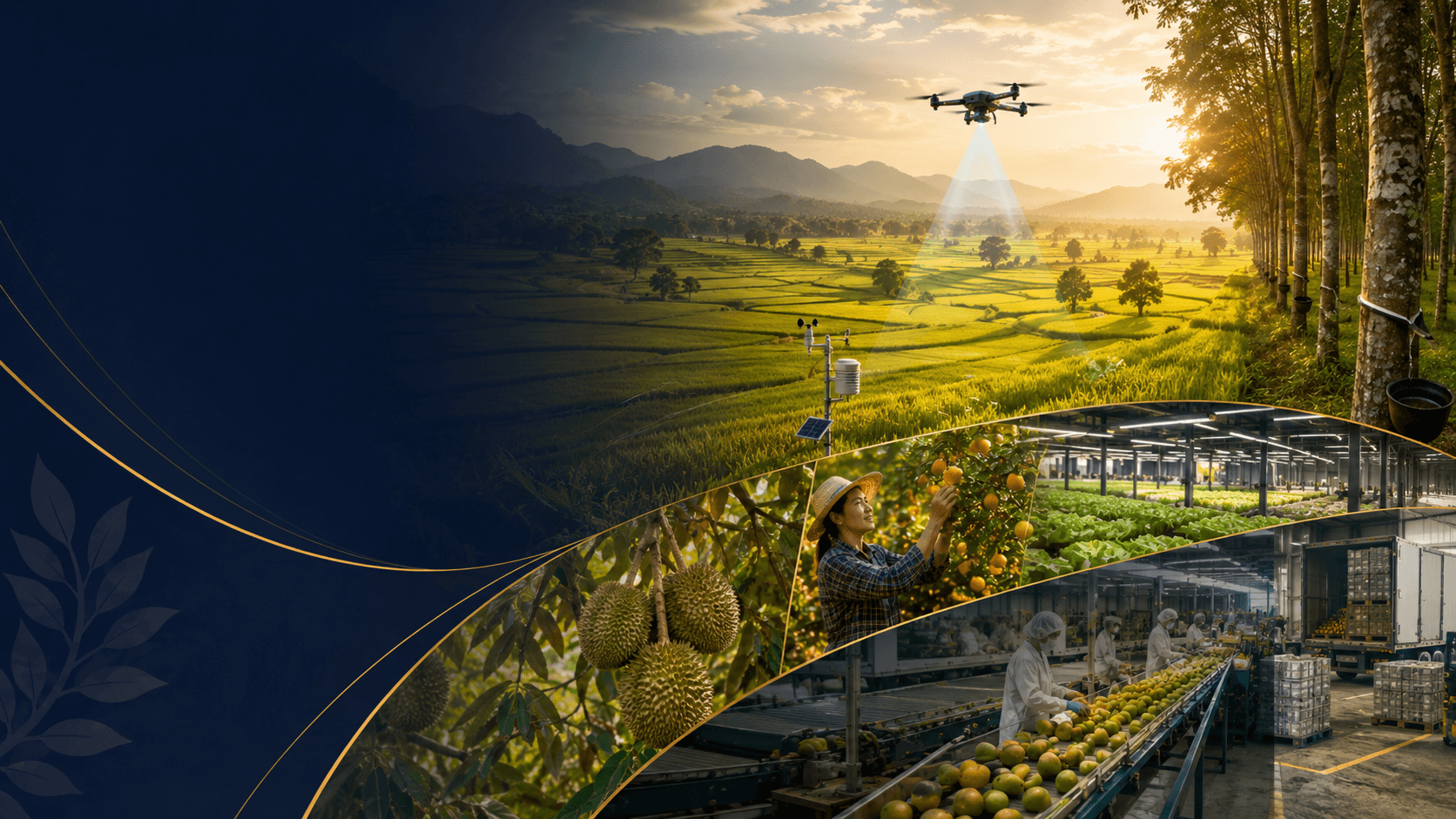
A founding pillar of the Thai economy — feeding the region, exporting to the world, and now modernizing for the next generation of agribusiness.
Thailand's Agricultural Value Chain
Agriculture at a Glance
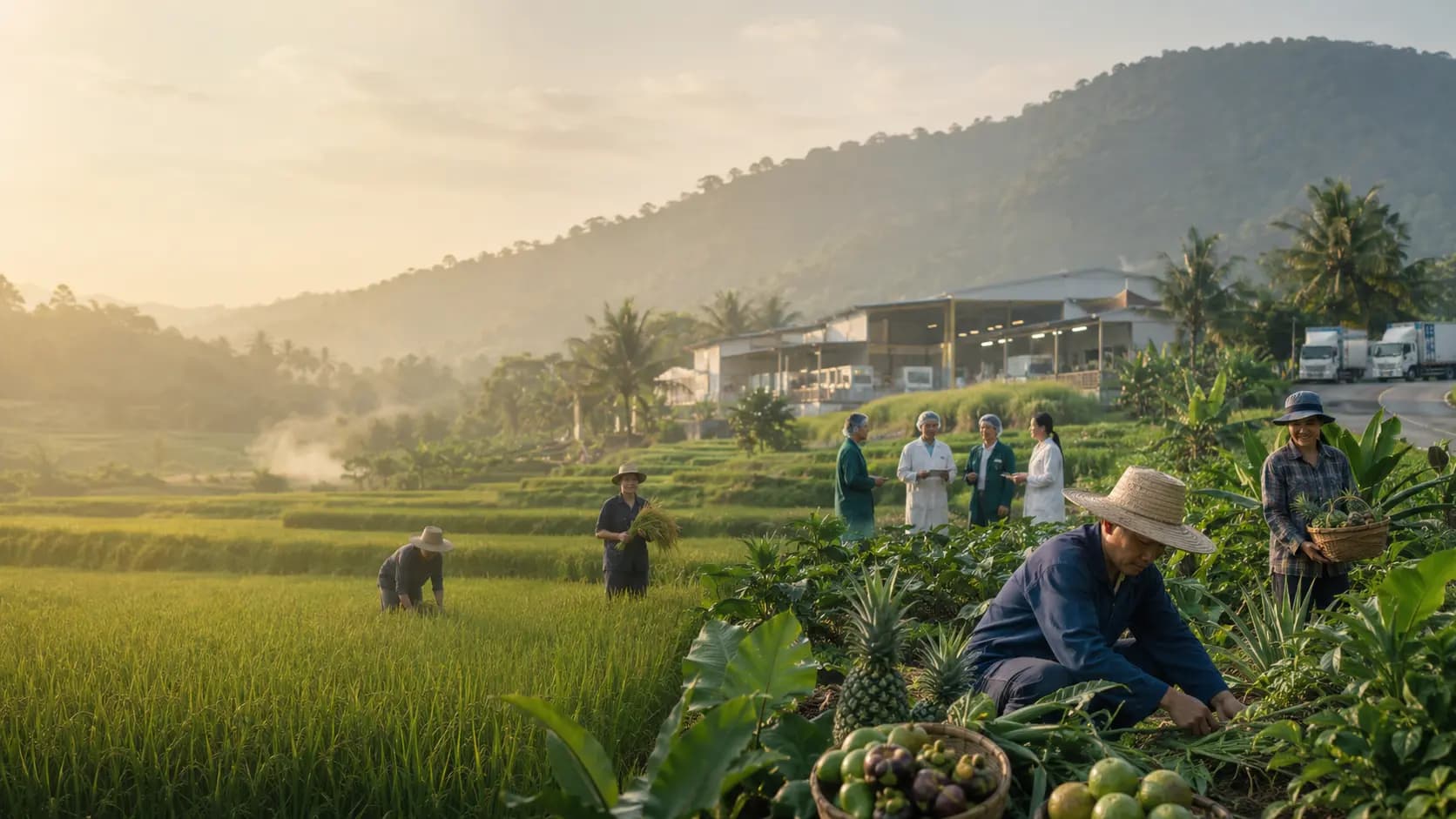
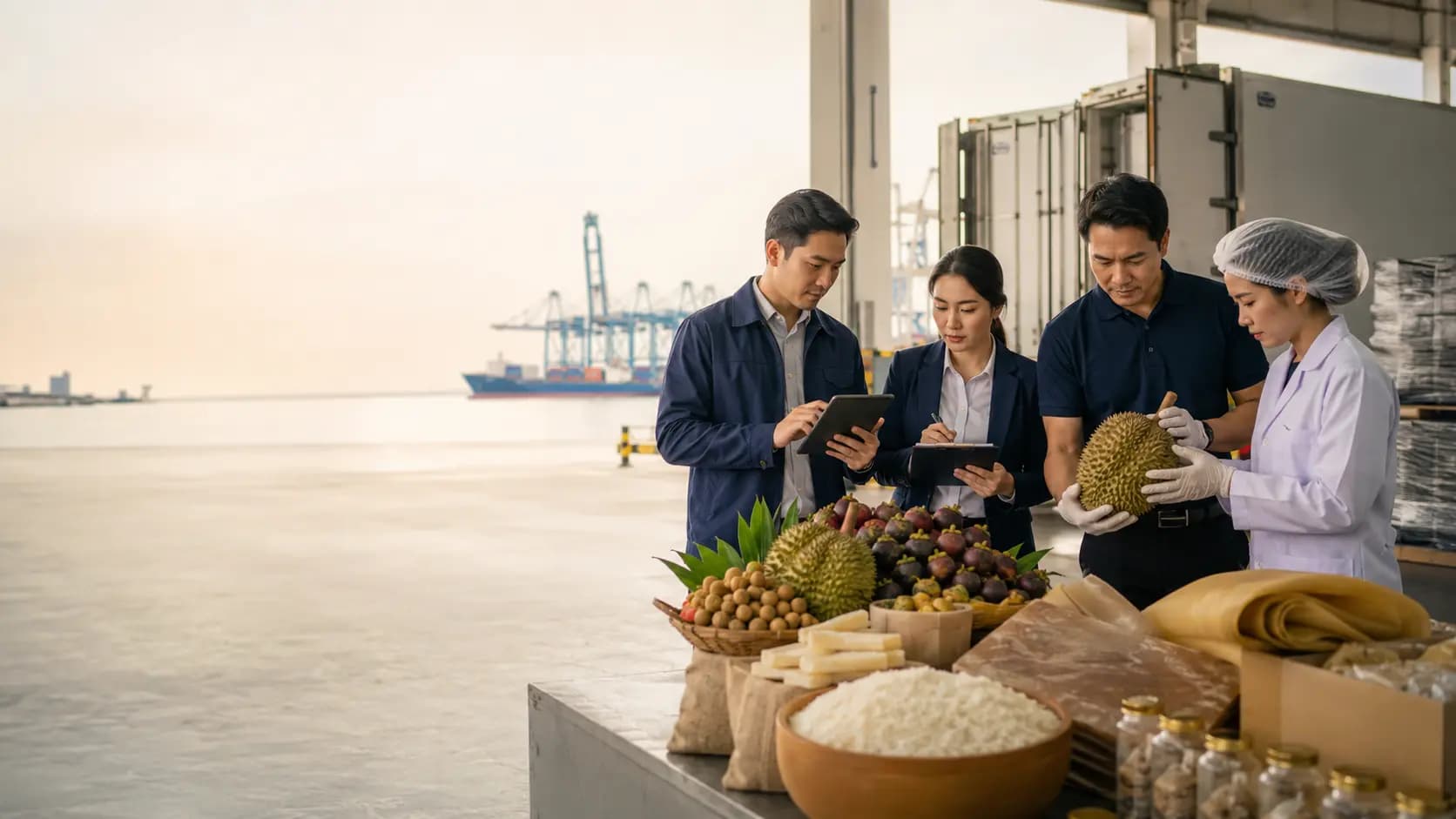
Agriculture remains a foundational pillar of the Thai economy and national identity. Thailand is a major exporter of rice, natural rubber, cassava products, sugar, poultry, and tropical fruit, and agriculture continues to anchor livelihoods across rural provinces nationwide. The sector spans a full value chain — from farming and raw commodity production, through processing and value-addition, to export and international trade — each stage distinct in how it operates and who it involves.
Farming & Cultivation
Smallholder farms, cooperatives, and larger agribusiness operations growing rice, rubber, cassava, sugarcane, fruit, and livestock across Thailand's regional growing clusters.
Raw Commodity Production
Harvested crops and livestock output enter the market as raw agricultural commodities — paddy rice, latex, fresh cassava root, cane sugar, live poultry, and fresh fruit.
Processing & Value-Add
Milling, starch extraction, rubber processing, sugar refining, poultry processing, and food manufacturing convert raw commodities into export-grade and consumer-ready products.
Export & Trade
Processed and raw agricultural products move through Thailand's customs and logistics infrastructure to destination markets across Asia, the Middle East, and beyond.
Key Agricultural Products
Six product categories anchor Thailand's agricultural export economy. Exact 2024 export figures for each are shown in the Export Intelligence section below.
Rice
Thailand's staple export crop, including white rice, Thai Hom Mali (jasmine) rice, parboiled, and glutinous rice, exported to markets worldwide.
Natural Rubber
Latex and primary-form natural rubber from Southern Thailand's plantations, exported mainly for tyre and industrial rubber manufacturing abroad.
Cassava Products
Cassava (tapioca) is exported both as dried chips/pellets and as processed starch — two distinct product categories with different export profiles.
Sugar
Cane sugar produced from Central and Northeastern sugarcane, refined and exported in solid form to regional markets.
Poultry
Fresh, chilled, and frozen chicken meat from Thailand's integrated poultry industry, exported primarily to East Asian markets.
Fresh Tropical Fruit
Durian and other fresh fruit not otherwise classified, led by strong and growing demand from China.

Where Thailand Grows
From the rice fields of the Central Plains to the rubber plantations of the South, Thailand's agricultural strength is spread across distinct regional clusters — each shaped by climate, geography, and generations of farming knowledge.
Rice — Central Plains & Isan
Thailand's staple crop, grown across the Central Plains and Lower North (Chai Nat, Suphanburi, Ayutthaya) and the Northeast for jasmine rice.
Rubber — the South
Concentrated in Southern Thailand, especially around Songkhla (Hat Yai), home to several national rubber-sector associations.
Cassava & Sugar — Northeast & Central
Cassava (tapioca) and sugarcane are grown widely across the Northeast and Central regions, feeding both food and industrial value chains.
Fruit — East & North
Durian, mangosteen, and longan from the Eastern provinces (Chanthaburi, Rayong, Trat), and temperate and highland fruit from the North (Chiang Mai, Chiang Rai).
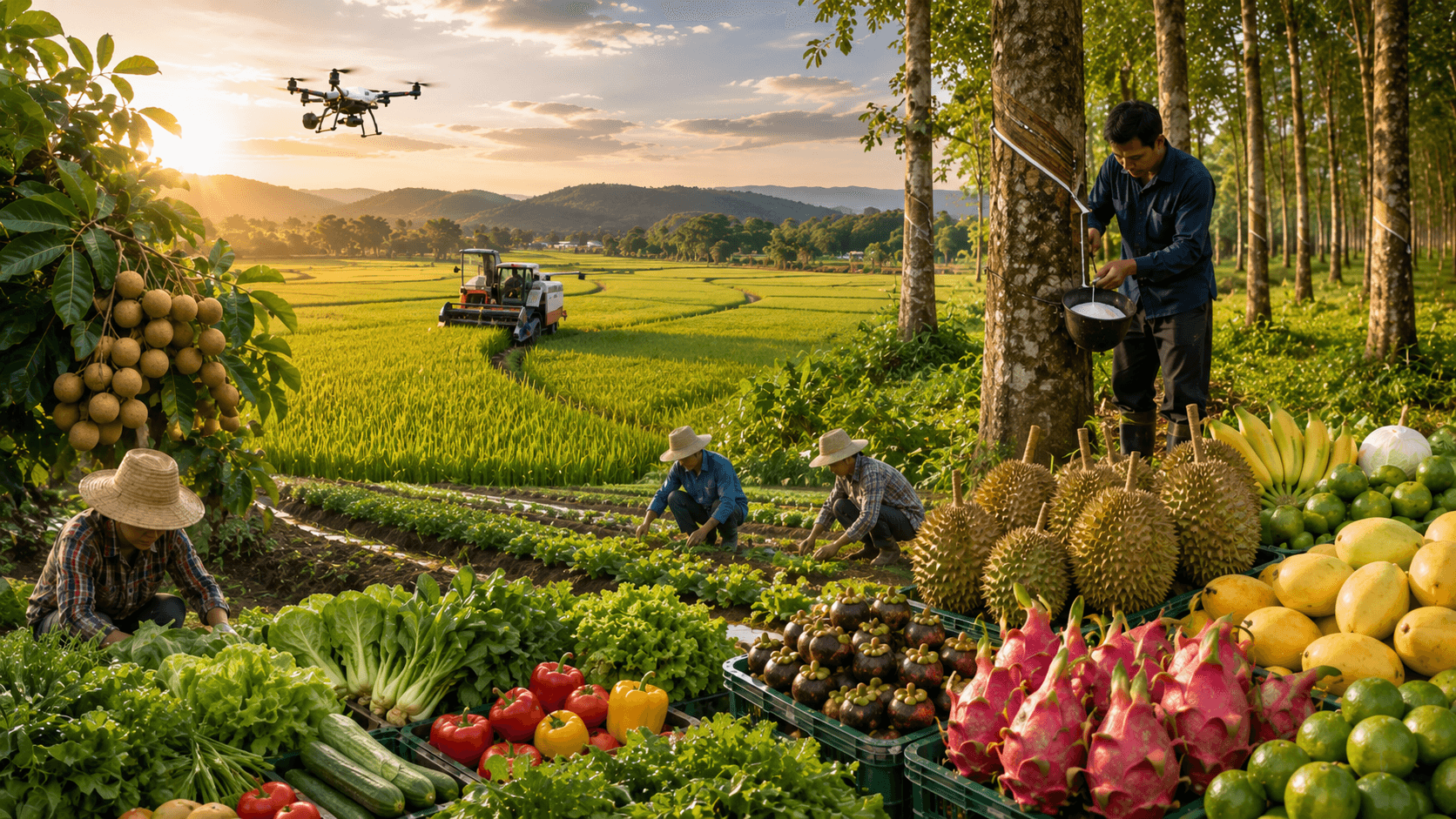
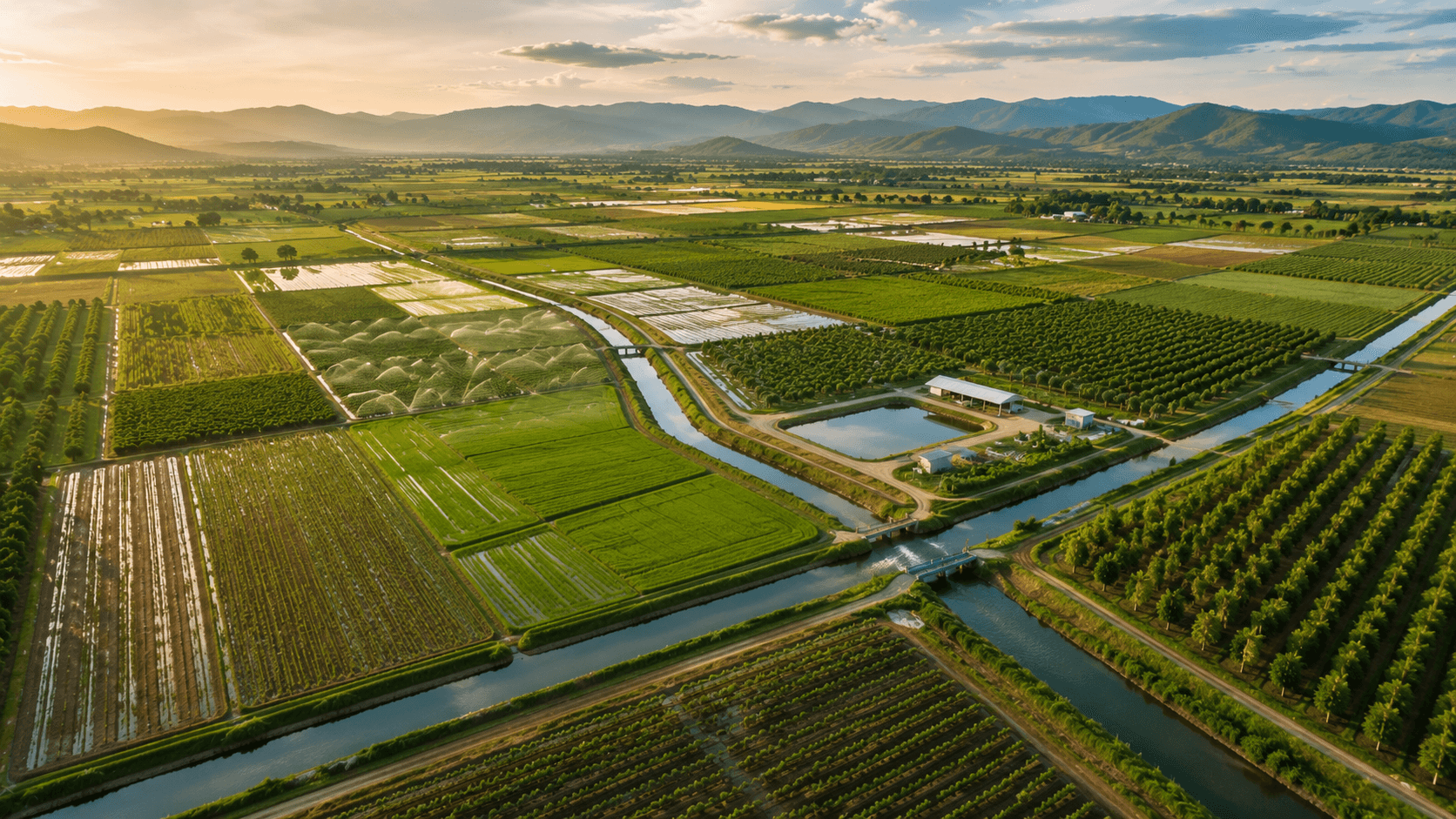
Crop Diversity Across the Regions
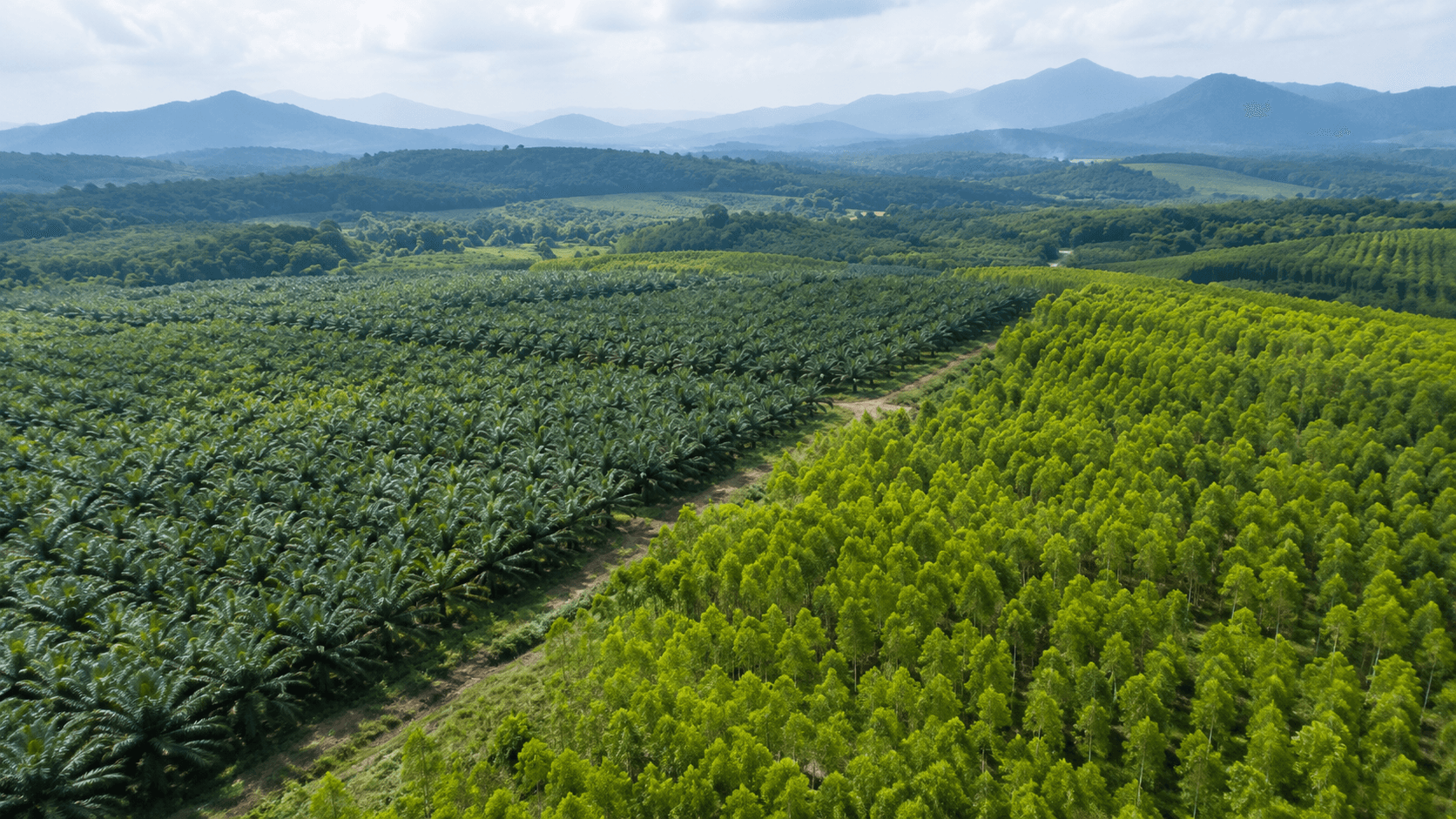
Rubber, specialty crops, and irrigated farmland — a glimpse of the variety behind Thailand's agricultural output.
The People Behind the Harvest
Much of Thailand's rice, rubber, and fruit production runs through smallholder farmers and agricultural cooperatives, not only large agribusiness operations.
Source: Olam Agri — Thailand (opens in a new tab) · Accessed 16 Aug 2026
Olam Agri's Sustainable Rice Platform programme, for example, operates directly with farmers in Ubon Ratchathani and Surin provinces in the Northeast — one concrete, verified example of a province-linked agriculture programme, not a claim about overall regional production share.
Cooperative-Driven Farming
Much of Thailand's rice, rubber, and fruit production runs through smallholder farmers and agricultural cooperatives, not only large agribusiness operations.
A Rural Economic Backbone
Agriculture continues to anchor livelihoods across rural Thailand, concentrated in provincial farming communities nationwide.
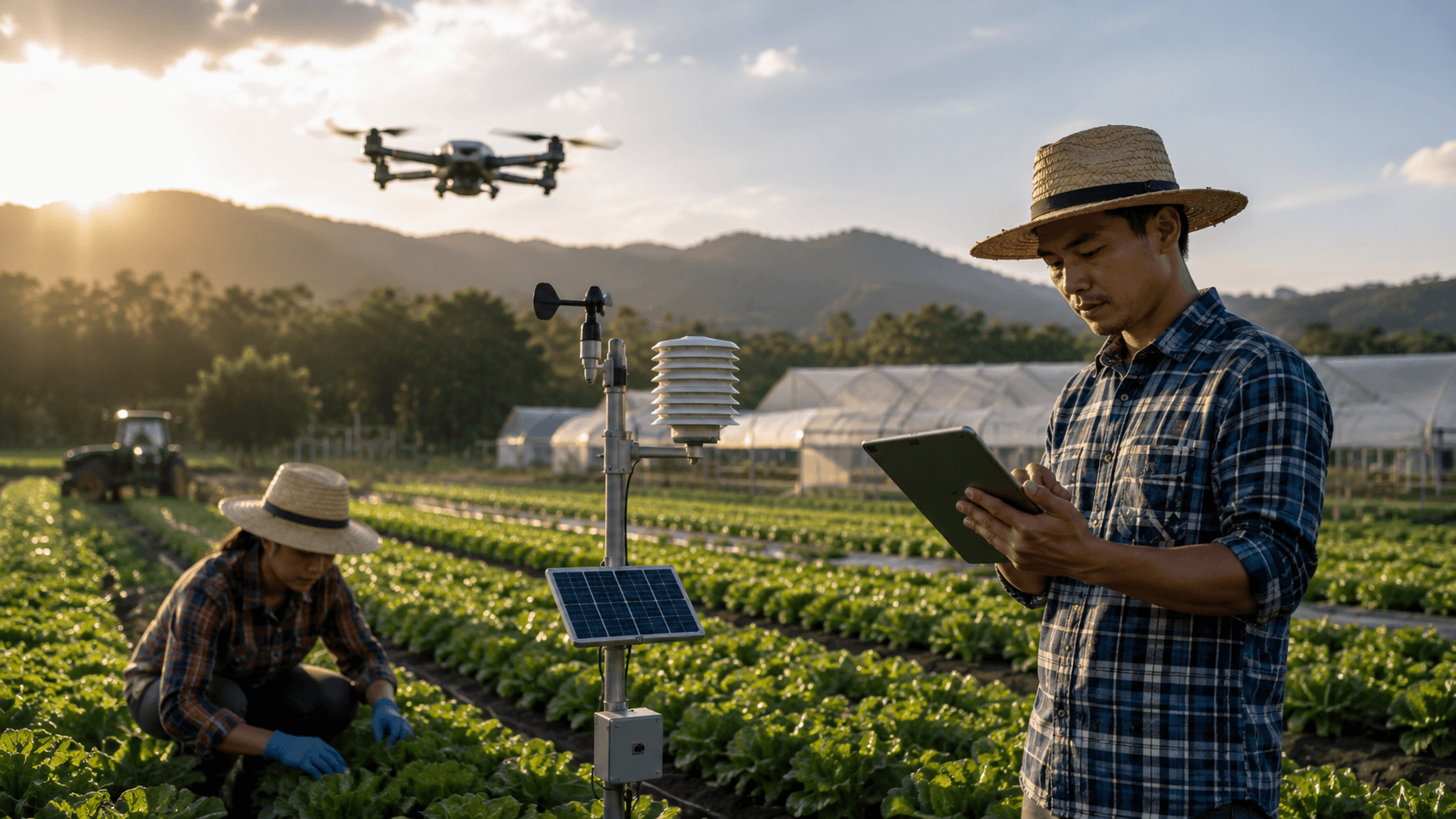
Tradition Meeting Technology
Generations of farming knowledge are increasingly paired with modern tools and techniques, from irrigation planning to precision agriculture.
Source-Based Agricultural Trade Data
Export Intelligence
Verified 2024 export figures for Thailand's seven principal agricultural products, shown exactly as reported by each source — in original currency and unit, with the precise HS-code or classification scope. Figures for different products are not added together into a single sector total, since each uses its own scope and, in some cases, its own reporting method.
Rice (all types)
HS —Ministry of Commerce / Customs Department aggregate rice-export classification (white rice, Thai Hom Mali, broken, parboiled, glutinous, and husked/brown rice combined) — not a single HS-6 code.
- Reporting year
- 2024
- Value
- 225,656 million Baht (THB)
- Volume
- 9,945,323 metric tons (MT)
| Country | Value | Volume |
|---|---|---|
| Indonesia | 27,688 million THB | 1,332,777 MT |
| Iraq | 21,506 million THB | 997,185 MT |
| USA | 28,029 million THB | 848,449 MT |
| South Africa | 16,713 million THB | 833,184 MT |
| Philippines | 11,590 million THB | 617,575 MT |
Natural Rubber
HS 4001Natural rubber, balata, gutta-percha, guayule, chicle and similar gums; in primary forms or in plates, sheets or strip. Does not include manufactured rubber products such as tyres or gloves.
- Reporting year
- 2024
- Value
- US$4,992.3 million
- Volume
- 2,816,940,000 kg (≈2,816,940 MT)
| Country | Value | Volume |
|---|---|---|
| China | US$1,498.7 million | 895,012,000 kg (≈895,012 MT) |
| Japan | US$564.6 million | 254,749,000 kg (≈254,749 MT) |
| USA | US$531.5 million | 267,961,000 kg (≈267,961 MT) |
| Malaysia | US$499.5 million | 368,206,000 kg (≈368,206 MT) |
Cassava Chips & Pellets
HS 0714Manioc (cassava), arrowroot, salep and similar roots and tubers with high starch content, fresh or dried, whether or not sliced or in pellet form. Does not include cassava starch (HS 1108).
- Reporting year
- 2024
- Value
- US$499.7 million
- Volume
- 2,100,940,000 kg (≈2,100,940 MT)
Scope note: China accounted for 97.5% of this category's export value and 98.4% of its volume in 2024.
| Country | Value | Volume |
|---|---|---|
| China | US$487.4 million | 2,067,940,000 kg (≈2,067,940 MT) |
Cassava / Tapioca Starch
HS 1108Starches and inulin (all starch types combined under this HS heading). Thailand's exports under this code are predominantly tapioca/cassava starch, but the code itself is not cassava-exclusive.
- Reporting year
- 2024
- Value
- US$1,640.7 million
- Volume
- 3,171,990,000 kg (≈3,171,990 MT)
| Country | Value | Volume |
|---|---|---|
| China | US$924.1 million | 1,868,050,000 kg (≈1,868,050 MT) |
| Indonesia | US$143.4 million | 271,533,000 kg (≈271,533 MT) |
| Malaysia | US$91.4 million | 178,187,000 kg (≈178,187 MT) |
Sugar
HS 1701Cane or beet sugar and chemically pure sucrose, in solid form.
- Reporting year
- 2024
- Value
- US$2,422.0 million
Scope note: World total volume was not published for this product/year in the source dataset; destination-level volumes are shown where available.
| Country | Value | Volume |
|---|---|---|
| Indonesia | US$528.8 million | 999,629,000 kg (≈999,629 MT) |
| Cambodia | US$485.9 million | 804,876,000 kg (≈804,876 MT) |
| Korea, Rep. | US$249.5 million | 483,404,000 kg (≈483,404 MT) |
Poultry Meat
HS 0207Fresh, chilled, or frozen meat and edible offal of poultry of the species Gallus domesticus (chickens). Does not include cooked or otherwise processed poultry (HS 1602).
- Reporting year
- 2024
- Value
- US$1,389.7 million
- Volume
- 479,138,000 kg (≈479,138 MT)
| Country | Value | Volume |
|---|---|---|
| Japan | US$519.1 million | 183,938,000 kg (≈183,938 MT) |
| China | US$444.1 million | 113,332,000 kg (≈113,332 MT) |
| Malaysia | US$195.2 million | 93,572,800 kg (≈93,573 MT) |
Fresh Fruit (predominantly durian)
HS 0810Fresh fruit, not elsewhere specified in Chapter 8 of the Harmonized System. For Thailand, exports recorded under this heading are predominantly durian, but the heading itself is not durian-exclusive.
- Reporting year
- 2024
- Value
- US$4,424.7 million
- Volume
- 1,463,810,000 kg (≈1,463,810 MT)
Scope note: China accounted for 92.7% of this category's export value and 83.7% of its volume in 2024.
| Country | Value | Volume |
|---|---|---|
| China | US$4,100.6 million | 1,225,680,000 kg (≈1,225,680 MT) |
Import Intelligence
Verified 2024 import figures, shown with the same sourcing standard as the export data above.
Wheat & Meslin
HS 1001Wheat and meslin (raw grain).
- Reporting year
- 2024
- Value
- US$1,157.6 million
- Volume
- 4,027,600,000 kg (≈4,027,600 MT)
| Country | Value | Volume |
|---|---|---|
| Ukraine | US$370.8 million | 1,392,150,000 kg (≈1,392,150 MT) |
| Australia | US$191.2 million | 605,324,000 kg (≈605,324 MT) |
| USA | US$190.9 million | 602,356,000 kg (≈602,356 MT) |
Soybean Meal (oil-cake)
HS 2304Oil-cake and other solid residues, whether or not ground or in pellet form, resulting from the extraction of soybean oil — an animal-feed input, distinct from whole soybeans (HS 1201), which are outside the scope of this table.
- Reporting year
- 2024
- Value
- US$1,363.4 million
- Volume
- 2,834,320,000 kg (≈2,834,320 MT)
Scope note: Brazil accounted for 91.0% of this category's import value and volume in 2024.
| Country | Value | Volume |
|---|---|---|
| Brazil | US$1,241.2 million | 2,591,170,000 kg (≈2,591,170 MT) |
Processing & Value-Added Opportunities
Thailand's Board of Investment specifically promotes processed agricultural products as a distinct investment category — starch manufacturing, plant and animal oils, natural rubber products, food preservation, future food, and animal feed among them. That is verified, documented BOI policy, not speculation.
Editorially, this points to a broader opportunity: Thailand exports large volumes of raw and semi-processed commodities (see the cassava chips/pellets and cassava starch figures above, for example) — suggesting room for further value-added processing within Thailand before export. This framing is T3's own interpretation of the verified trade and investment data, not a claim attributed to any source.
Modern Agriculture & Investment
Thailand's Board of Investment (BOI) promotes agriculture under its Agricultural, Food, and Biotechnology Industries category, organized into four groups of eligible activities.
- Economic forest plantation and energy crop plantation
- Animal propagation and animal husbandry
- Deep-sea fishery
- Slaughtering
- Animal quarantine facilities for export
Incentive tiers A1–A4 depending on the specific activity and its conditions (e.g. plantation area, forestry certification, traceability systems, GAP/GMP certification).
- Starch made from plants
- Oil or fat from plants or animals
- Tanneries or leather finishing
- Natural rubber products
- Preservation of food, beverages, food additives, ingredients, or dietary supplements
- Future food
- Animal feed or animal food ingredients
- Fuel or pharmaceutical-grade alcohol from agricultural products or waste
Incentive tiers typically A2–A3, with specific certification requirements (e.g. organic standards for organic starch/flour).
- Plant or animal breeding
- Manufacture or service of modern agricultural machinery and equipment
- Plant Factory (fully controlled-environment indoor cultivation)
Incentive tiers A3–A4.
- Biological, organic, and nano-coated organo-chemical fertilizers; bio-pesticides
- Crop drying and silo facilities
- Grading and storage of agricultural products (rice grading/storage capped at tier B)
- Cold storage, or cold storage and cold storage transportation
- Trading centers for agricultural goods
- Digital trade centers for agricultural products (requires ≥51% Thai shareholding; B2B sale of agricultural products only)
Incentive tiers A2–B depending on activity and technology used.
Source: Thailand Board of Investment — Investment Promotion Guide 2026 (opens in a new tab) · Accessed 17 Aug 2026
Eligibility and incentives depend on the applicant, activity, technology, location and current BOI rules. Investors should confirm directly with the Thailand Board of Investment.
Investment Incentives and Government Support
Incentive categories directly sourced from the BOI Investment Promotion Guide 2026 and the Investment Promotion Act's own statutory sections. Grouped by category — open a category to see the specific incentive, benefit, tier, and conditions.
BOI eligibility and benefits depend on the precise promoted activity, project scope, investment, technology, location and applicable conditions. Submission of an application does not guarantee promotion or approval.
Activity-based incentive tiers (A1+, A1, A2, A3, A4, B)Tier A1+ / A1 / A2 / A3 / A4 / B
Eligible scope: Any BOI-promoted activity, including the Agriculture, Food and Biotechnology categories listed above
Benefit: Tier determines the level of corporate income tax exemption and other incentives available to a promoted project
Conditions: Tier is set per specific activity and its stated conditions in the current guide
Automatic or requires qualification: Requires a promoted-activity application and BOI approval
Thailand Board of Investment — Investment Promotion Guide 2026 — Incentives section — checked 17 Aug 2026
Corporate income tax (CIT) exemption without capTier A1+, A1
Eligible scope: Activities promoted at tier A1+ or A1
Benefit: Exemption from corporate income tax on net profit from the promoted activity, not capped to the investment amount
Conditions: Per Sections 31, 31/1 and 34 of the Investment Promotion Act; includes exemption on dividends derived from the promoted activity during the exemption period
Automatic or requires qualification: Automatic upon promotion at the applicable tier
Thailand Board of Investment — Investment Promotion Act — Investment Promotion Guide 2026 — Tax Incentives — checked 17 Aug 2026
Corporate income tax (CIT) exemption with capTier A2, A3, A4
Eligible scope: Activities promoted at tiers A2 through A4
Benefit: Exemption from corporate income tax on net profit, capped at up to 100% of the eligible investment amount (excluding cost of land and working capital)
Conditions: Per Section 31 of the Investment Promotion Act; cap and exemption period vary by tier
Automatic or requires qualification: Automatic upon promotion at the applicable tier
Thailand Board of Investment — Investment Promotion Act — Investment Promotion Guide 2026 — Tax Incentives — checked 17 Aug 2026
50% corporate income tax reduction
Eligible scope: Activities/locations specified as eligible for this reduction (e.g. certain tier B or area-based cases)
Benefit: 50% reduction of the corporate income tax rate on net profit from the promoted activity for a specified period after the standard exemption ends
Conditions: Per Section 35(1) of the Investment Promotion Act
Automatic or requires qualification: Requires qualification per the specific activity/location conditions
Thailand Board of Investment — Investment Promotion Act — Investment Promotion Guide 2026 — Tax Incentives — checked 17 Aug 2026
Import duty exemption on machinery
Eligible scope: Machinery imported for use in a promoted project
Benefit: Exemption from import duty on qualifying machinery
Conditions: Per Sections 28 and 29 of the Investment Promotion Act
Automatic or requires qualification: Requires machinery approval through BOI's machinery-list process
Thailand Board of Investment — Investment Promotion Act — Investment Promotion Guide 2026 — Tax Incentives — checked 17 Aug 2026
Import duty reduction/exemption on raw and essential materials
Eligible scope: Raw or essential materials imported for a promoted project, including R&D materials and materials used for export production
Benefit: Reduction or exemption of import duty depending on material use (general raw material reduction; R&D material exemption; export-production material exemption)
Conditions: Per Section 30 (raw/essential materials), Section 30/1 (R&D materials) and Section 36 (materials for export production) of the Investment Promotion Act
Automatic or requires qualification: Requires application and approval per material category
Thailand Board of Investment — Investment Promotion Act — Investment Promotion Guide 2026 — Tax Incentives — checked 17 Aug 2026
Foreign ownership permission
Eligible scope: Promoted activities where BOI rules permit majority or full foreign ownership
Benefit: Permission to hold majority or 100% foreign ownership in the promoted company, subject to the activity's specific conditions
Conditions: Varies by activity; some agriculture activities carry Thai-shareholding conditions (e.g. the digital trade centre activity noted in the activity groups above, which requires at least 51% Thai shareholding)
Automatic or requires qualification: Requires qualification per activity
Thailand Board of Investment — Investment Promotion Guide 2026 — Non-tax Incentives — checked 17 Aug 2026
Land ownership permission
Eligible scope: Promoted companies needing to own land for the promoted business
Benefit: Permission to own land for use in the promoted business, an exception to the general restriction on foreign land ownership
Conditions: Per Section 27 of the Investment Promotion Act
Automatic or requires qualification: Requires BOI approval as part of, or following, promotion
Thailand Board of Investment — Investment Promotion Act — Investment Promotion Guide 2026 — Non-tax Incentives — checked 17 Aug 2026
Visa and work-permit facilitation
Eligible scope: Foreign experts, technicians, and their family members working on a promoted project
Benefit: Permission to bring in foreign experts/technicians and permission for foreign nationals to study project feasibility
Conditions: Per Sections 24, 25 and 26 of the Investment Promotion Act
Automatic or requires qualification: Requires BOI approval as part of, or following, promotion
Thailand Board of Investment — Investment Promotion Act — Investment Promotion Guide 2026 — Non-tax Incentives — checked 17 Aug 2026
Competitiveness Enhancing Incentive
Eligible scope: Promoted projects that invest in technology/innovation, HR development, or local supplier development on top of their core activity
Benefit: Additional corporate income tax exemption (without cap, in qualifying R&D cases) on top of the base activity incentive, for an additional period up to a stated maximum of 13 years total
Conditions: Covers three areas: (1) Technology and Innovation — R&D, technology licensing, product/package design, support for science & technology organisations; (2) HR Development — advanced technology training, student internships; (3) Development of Business Operators' Potential — local supplier development
Automatic or requires qualification: Requires a separate merit-based application in addition to the core activity promotion
Thailand Board of Investment — Investment Promotion Guide 2026 — Merit-based Incentives — checked 17 Aug 2026
R&D expenditure incentive (within the Competitiveness Enhancing Incentive)
Eligible scope: Promoted projects with R&D expenditure equal to at least 1% of sales revenue over the first three years, or at least 200 million baht
Benefit: Qualifies for corporate income tax exemption without cap under the merit-based Technology and Innovation category
Conditions: Spending threshold must be met and documented as R&D expenditure per BOI's definition
Automatic or requires qualification: Requires qualification and BOI review of R&D spending
Thailand Board of Investment — Investment Promotion Guide 2026 — Merit-based Incentives — checked 17 Aug 2026
Area-based incentive zones
Eligible scope: Projects located in designated zones
Benefit: Additional incentives layered on top of the base activity incentive, depending on zone
Conditions: Zones include industrial estates/promoted industrial zones, the 20 lowest-income provinces, Science and Technology Parks (including Thailand Science Park, Food Innopolis, and Space Krenovation Park), the Eastern Economic Corridor (EEC), Special Economic Zones (SEZ), the four regional economic corridors (Northern, Northeastern, Central-Western, Southern), and the Southern Border Provinces area
Automatic or requires qualification: Automatic where the project location matches a designated zone, subject to BOI confirmation
Thailand Board of Investment — Investment Promotion Guide 2026 — Area-based Incentives — checked 17 Aug 2026
Agenda-based incentive measures
Eligible scope: Projects matching specific national policy agendas
Benefit: Additional incentives for projects under the Smart and Sustainable Industrial Upgrade Programs, the EV/electrical local-content measure, or Community and Society Development projects
Conditions: Each agenda-based measure carries its own published conditions
Automatic or requires qualification: Requires application under the specific agenda-based measure
Thailand Board of Investment — Investment Promotion Guide 2026 — Agenda-based Incentives — checked 17 Aug 2026
Community and Society Development measure
Eligible scope: Projects with a defined community-development component, including certain agricultural and rural-linked projects
Benefit: Additional incentive under the agenda-based incentive framework
Conditions: Requires a defined community-development plan meeting BOI's published criteria
Automatic or requires qualification: Requires a separate application under this measure
Thailand Board of Investment — Investment Promotion Guide 2026 — Agenda-based Incentives — checked 17 Aug 2026
Import duty exemption on materials used in export production
Eligible scope: Materials imported for use in producing goods for export
Benefit: Exemption from import duty on qualifying materials used in export production
Conditions: Per Section 36 of the Investment Promotion Act
Automatic or requires qualification: Requires application and approval
Thailand Board of Investment — Investment Promotion Act — Investment Promotion Guide 2026 — Tax Incentives — checked 17 Aug 2026
Permission to remit foreign currency abroad
Eligible scope: Promoted companies remitting funds abroad (e.g. loan repayment, royalties) in foreign currency
Benefit: Permission to remit money abroad in foreign currency for specified purposes
Conditions: Per Section 37 of the Investment Promotion Act
Automatic or requires qualification: Requires BOI approval as part of, or following, promotion
Thailand Board of Investment — Investment Promotion Act — Investment Promotion Guide 2026 — Non-tax Incentives — checked 17 Aug 2026
Source: Thailand Board of Investment — Investment Promotion Guide 2026 (opens in a new tab) · Accessed 17 Aug 2026
Two requested categories are intentionally not listed as separate incentives here. 'Agricultural processing/value-addition incentives' and 'cold storage/grading/trading-centre support' are BOI-promoted activities (see the Processed Agricultural Products and Supporting Agricultural Industry groups above), not separate incentive instruments — listing them again here would misrepresent an activity as an incentive. 'Investment facilitation, matching or linkage services' is covered instead under Investment, Partnership and Trade Pathways below, since it is a service rather than a tax or non-tax incentive.
Investment, Partnership and Trade Pathways
General orientation on how investors, buyers, and partners commonly engage with Thailand's agriculture sector.
No agriculture-specific Thai–foreign joint-venture incentive was confirmed in the reviewed official sources.
Secure tax and non-tax incentives, and in many cases majority or full foreign ownership, for a promoted activity
First step
Review Step 3 (Review BOI eligibility) above and the Eligible Activities & Conditions page
Responsible institution
Thailand Board of Investment (BOI)
BOI promotion is not a joint-venture-matching service — it does not identify or introduce a partner.
Structure a compliant joint venture or partnership where the activity is not open to full foreign ownership
First step
Confirm Foreign Business Act status of the activity with a licensed Thai lawyer (see Step 2 above)
Responsible institution
Department of Business Development, Ministry of Commerce (foreign-ownership registration authority)
T3 has not independently verified an official URL for the Department of Business Development in this session, so none is shown — confirm directly before use. This is a general partnership structure, not a BOI incentive.
Access Thai processing capacity (e.g. milling, starch extraction, food manufacturing) through a commercial contract rather than direct investment
First step
Identify a suitable Thai processor via the sector associations or verified companies listed on this page
Responsible institution
No single regulator — a private commercial arrangement
T3 does not verify, endorse or guarantee the performance of any specific contract manufacturer.
Establish direct or cooperative-based sourcing relationships for raw commodities
First step
Contact the Department of Agricultural Extension (DOAE) for farmer/cooperative engagement channels
Responsible institution
Department of Agricultural Extension (DOAE)
DOAE supports farmer and cooperative engagement; it does not select or vet individual commercial partners on a business's behalf.
Reach the Thai market through an established local distributor or importer
First step
Register import/export activity with Thai Customs and identify prospective distributors through trade associations or trade fairs
Responsible institution
Thai Customs Department (import/export registration); no single regulator identifies distributor partners
This is a general commercial pathway, not a matchmaking service.
Connect Thai agricultural exporters with international buyers
First step
Engage with the Department of International Trade Promotion (DITP), Ministry of Commerce — already verified on this page as a co-organiser of THAIFEX–Anuga Asia
Responsible institution
Department of International Trade Promotion (DITP), Ministry of Commerce
DITP's role is confirmed on this page only as THAIFEX–Anuga Asia's co-organiser; its dedicated trade-facilitation service pages were not independently re-verified in this session — confirm current services directly with DITP.
Transfer technology into a Thai operation through a licensing agreement, which can also qualify for BOI's Technology and Innovation merit-based incentive
First step
Review the Competitiveness Enhancing Incentive (Technology and Innovation category) in the Investment Incentives section above
Responsible institution
Thailand Board of Investment (for the related incentive); no single verified regulator for the private licensing agreement itself
Technology licensing terms are a private commercial and legal matter; confirm intellectual-property registration requirements directly with a qualified adviser.
Undertake qualifying R&D that can support a BOI merit-based incentive application
First step
Review the R&D expenditure incentive in the Investment Incentives section above
Responsible institution
Thailand Board of Investment
Meeting the R&D spending threshold does not guarantee approval of the merit-based application.
Qualify for the Development of Business Operators' Potential category of the Competitiveness Enhancing Incentive by developing local suppliers
First step
Review the merit-based incentive conditions with BOI
Responsible institution
Thailand Board of Investment
This is a merit-based incentive category tied to BOI promotion, not a standalone supplier-matching service.
Build relationships through Thailand's agricultural trade associations and chambers of commerce
First step
Review the Institutions & Associations directory on this page for a relevant association
Responsible institution
Thai Chamber of Commerce and Board of Trade of Thailand; sector-specific associations listed on this page
T3 does not represent, and is not affiliated with, any listed association or chamber.
Meet counterparts at Thailand's major agriculture, food and Halal trade events
First step
Review the Trade Events & Networking section on this page for confirmed and recurring events
Responsible institution
Varies by event — see individual event organisers listed on this page
T3 does not organise or represent any listed trade event.
This section provides general orientation on investment, partnership and trade pathways. It is not legal, tax, investment or regulatory advice, and T3 does not identify, vet or guarantee any specific business partner.
Key Companies
Company inclusion on this page is informational only and does not constitute a ranking, endorsement, or partnership with T3.
Thai Companies
Charoen Pokphand Group (CP Group)
Diversified agribusiness conglomerate
A major Thai private conglomerate, with an integrated agribusiness arm spanning animal feed, crop integration, seed, fertilizer, and aquaculture.
Official website (opens in a new tab)Verified via T3 sector company research (high-confidence tier); official site URL confirmed 16 Aug 2026
Charoen Pokphand Foods PCL (CPF)
Integrated agribusiness and food company
Core CP Group subsidiary focused on animal feed, livestock and crop integration, seed, fertilizer, and plant protection.
Official website (opens in a new tab)Verified via T3 sector company research (high-confidence tier); official site URL confirmed 16 Aug 2026
Mitr Phol Group
Sugar producer
A major Thai sugar producer, combining sugarcane farming with sugar milling and agro-adjacent energy, fertilizer, and logistics businesses.
Official website (opens in a new tab)Verified via T3 sector company research (high-confidence tier); official site URL confirmed 16 Aug 2026
GFPT PCL
Integrated poultry producer
Integrated poultry business spanning broiler farming, hatcheries, breeding farms, and feed milling.
Official website (opens in a new tab)Verified via T3 sector company research (high-confidence tier); official site URL confirmed 16 Aug 2026
Betagro Public Company Limited
Integrated agro-industrial and food company
SET-listed (BTG) integrated agro-industrial and food company covering animal feed, livestock and poultry production, pharmaceuticals, and pet food, with a publicly filed 56-1 One Report.
Official website (opens in a new tab)Betagro official investor relations site, opened directly, 16 Aug 2026
Chia Tai Seed
Vegetable and field-crop seed producer
Thai seed company producing and distributing vegetable and field-crop seed under the Chia Tai brand for Thai and regional farmers.
- Product category:
- Vegetable and field-crop seed
- Thailand connection:
- Thailand-headquartered seed producer and distributor
Chia Tai Seed official site, opened directly, 17 Aug 2026
Thai Wah Public Company Limited
Tapioca starch and food producer
SET-listed (TWPC) manufacturer of tapioca starch and noodle/food products, with over 75 years of operating history in Thailand.
- Product category:
- Tapioca starch, noodles and food products
- Thailand connection:
- Thailand-headquartered, SET-listed under ticker TWPC
- International presence:
- Operations and/or distribution referenced across multiple Southeast Asian markets on the company's own site
Thai Wah PCL official site, opened directly, 17 Aug 2026; address, phone and email confirmed on site
Sri Trang Agro-Industry Public Company Limited
Natural rubber producer and processor
SET-listed (STA) natural rubber producer and processor headquartered in Hat Yai, Songkhla, in Southern Thailand's rubber-growing region.
- Product category:
- Natural rubber (block rubber, latex, concentrated latex)
- Thailand connection:
- Headquartered in Hat Yai, Songkhla, Thailand
Sri Trang Agro-Industry official site, opened directly, 17 Aug 2026; phone contact confirmed on site
Malee Group Public Company Limited
Fruit juice and beverage manufacturer
SET-listed fruit juice, beverage and food manufacturer; company site also references an agricultural dairy-farm business (PPO Farm) alongside its beverage operations.
- Product category:
- Fruit juice, beverages and dairy
- Thailand connection:
- Thailand-headquartered, with a published office address
Malee Group official site, opened directly, 17 Aug 2026; office address confirmed on site
Tipco Foods Public Company Limited
Fruit juice and pineapple processor
SET-listed (TIPCO) fruit juice and processed-pineapple company with a dedicated agricultural-business section on its official site.
- Product category:
- Fruit juice and processed pineapple
- Thailand connection:
- Thailand-headquartered, SET-listed under ticker TIPCO
Tipco Foods official site, opened directly, 17 Aug 2026; office address and phone confirmed on site
Bangsue Chia Meng Rice Mill Co., Ltd. (BSCM)
Rice miller and exporter
Thai rice milling company founded in 1937; company site states exports of over 200,000 tons of rice per year to more than 50 countries.
- Product category:
- Milled export rice
- Thailand connection:
- Thailand-headquartered rice mill, founded 1937
- International presence:
- Exports to more than 50 countries per the company's own site (a company-reported figure, not independently cross-verified against Customs data)
BSCM official site, opened directly, 17 Aug 2026; export volume and country-count figures are company-stated and were not independently cross-verified against government trade data
International Companies Operating in Thailand
Cargill (Thailand) Ltd.
Protein, feed, and agricultural commodities
Operating in Thailand since 1968 with more than 15,000 employees; protein, animal feed, and grain/oilseed operations, including Cargill Meats Thailand plants in Saraburi and Nakhon Ratchasima.
Official website (opens in a new tab)Cargill Thailand official site, opened directly, 16 Aug 2026
Olam Agri (Thailand)
Rice trading and processing
A major rice trader and exporter in Thailand, with a mid-stream processing and packing facility on the Chao Phraya River in Bangkok and sustainable rice programmes in Ubon Ratchathani and Surin provinces.
Official website (opens in a new tab)Olam Agri official site, opened directly, 16 Aug 2026
Syngenta (Thailand)
Seed production and agricultural technology
Operates a hybrid corn seed factory in Thailand under the NK brand, exporting seed regionally, and runs a Thailand-focused farmer-support programme.
Official website (opens in a new tab)Syngenta Group official site, opened directly, 16 Aug 2026
East-West Seed (Thailand)
Vegetable seed research, production and distribution
Thailand operation of the East-West Seed Group, breeding and supplying tropical vegetable seed to smallholder farmers.
- Product category:
- Tropical vegetable seed
- Thailand connection:
- Thailand-based production and distribution operations, with a published office address and phone contact
East-West Seed Thailand official site, opened directly, 17 Aug 2026; address and phone contact confirmed on site
From Product to Market
Brands, Institutions and the Agricultural Export Ecosystem
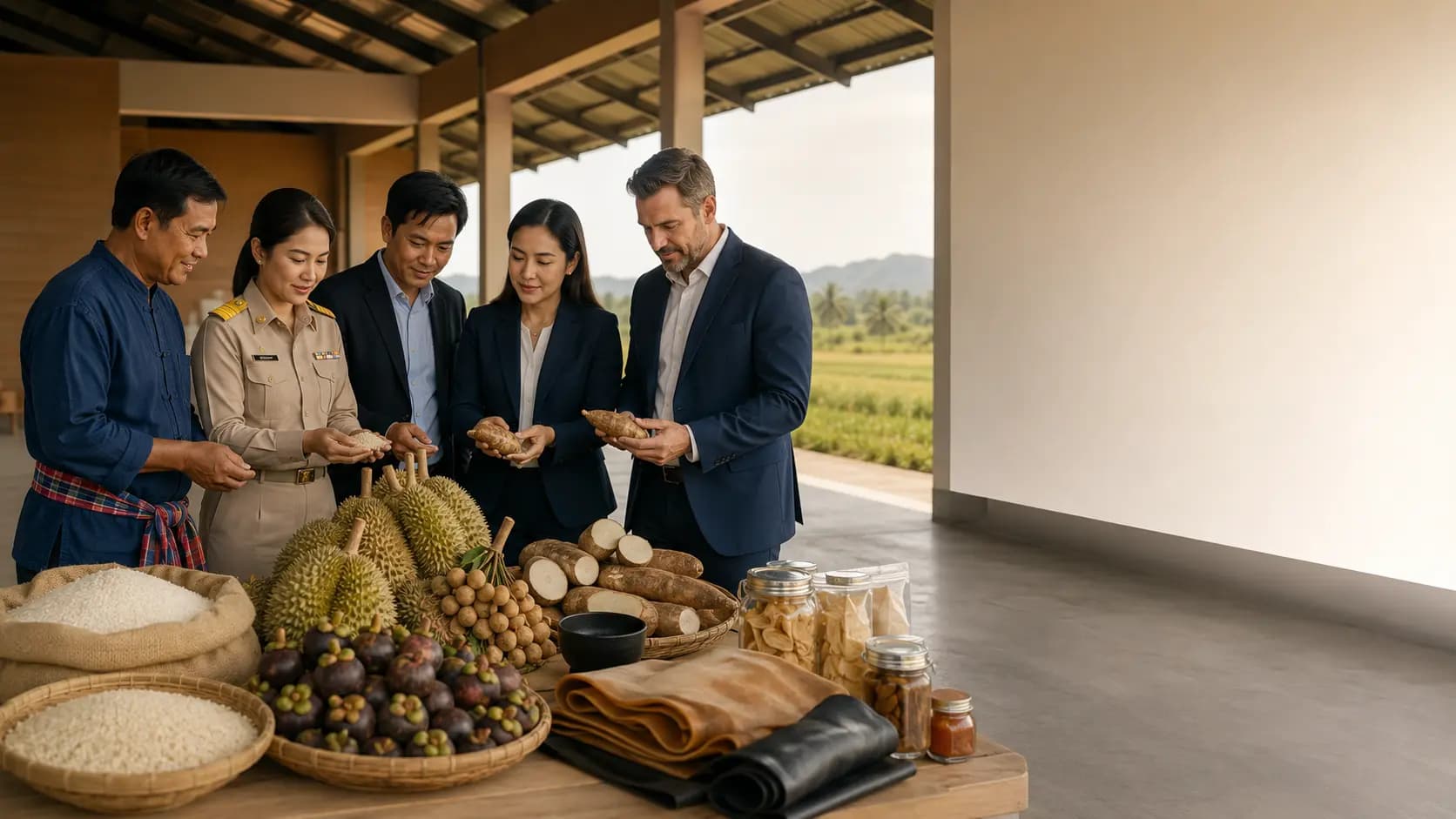
Thailand's agricultural economy connects farms and cooperatives with processors, consumer brands, exporters, regulators and industry organizations. The directory below separates commercial brands from their parent companies and institutional support bodies so each organization's role remains clear.
Selected Export-Facing Brands
Consumer or export brand names kept distinct from their parent company above — shown only where a brand name is genuinely separate from the corporate name itself. Company inclusion on this page is informational only and does not constitute a ranking, endorsement, or partnership with T3.
Export-facing brand
Malee
Parent company: Malee Group Public Company Limited
Fruit juice, beverages and dairy
Official company website (opens in a new tab)Export-facing brand
Tipco
Parent company: Tipco Foods Public Company Limited
Fruit juice and processed pineapple
Official company website (opens in a new tab)Export-facing brand
Golden Phoenix
Parent company: Bangsue Chia Meng Rice Mill Co., Ltd. (BSCM)
Milled export rice
Official company website (opens in a new tab)Associations & Trade Bodies
Verified associations, chambers, federations, business councils and government bodies connected to Agriculture in Thailand.
- Government Agency
Thai Customs Department
Manages customs declarations, tariff classification, valuation and cargo clearance for all cross-border trade.
- Government Agency
Ministry of Agriculture and Cooperatives
กระทรวงเกษตรและสหกรณ์
MOAC
National policy authority for agriculture — oversees the Department of Agriculture, Rubber Authority of Thailand and Office of Agricultural Economics.
- Government Agency
Office of Agricultural Economics
สำนักงานเศรษฐกิจการเกษตร
OAE
Publishes Thailand's agricultural sector data, planning and forecasting, including production and trade data relevant to food and rubber supply.
- Government Agency
Department of Agriculture
กรมวิชาการเกษตร
DOA
Research, standards, and crop regulation — enforces the Plant Quarantine, Plant Variety Protection, Fertilizer, Rubber Regulation and Toxic Substances Acts.
- Government Agency
Department of Agricultural Extension
กรมส่งเสริมการเกษตร
DOAE
Farmer support and extension services under the Ministry of Agriculture and Cooperatives.
- Government Agency
Rubber Authority of Thailand
การยางแห่งประเทศไทย
RAOT
Statutory body under the Rubber Authority of Thailand Act B.E. 2558 (2015), responsible for rubber-sector development, grower registration, plantation-area data and price-stabilisation support.
- Government Agency
Halal Standard Institute of Thailand
HSIT
Sets Halal standards and guidelines for certification of Halal products and services in Thailand, under the Central Islamic Council of Thailand (CICOT); established 2003.
- Apex Federation
Thai Chamber of Commerce and Board of Trade of Thailand
TCC / Board of Trade
Thailand's principal apex chamber — represents the national trade and commerce community, operates a dedicated Agriculture & Food Center, issues export Certificates of Origin, and engages government on cross-sector business policy.
- Industry Association
Thai Food Processors' Association
TFPA
Represents Thailand's processed and canned food manufacturing and export industry; established 1970, serves close to 200 member companies.
- Industry Association
Thai Frozen Foods Association
TFFA
Represents Thailand's frozen food manufacturing and export industry; originally founded in 1968 as the Thai Aquatic Animal Traders Association.
- Industry Association
Thai Broiler Processing Exporters Association
TBPEA
Represents Thailand's processed poultry (chicken meat) export industry, established 1991.
- Industry Association
Thai Rice Exporters Association
TREA
Represents Thailand's rice export industry — Thailand is one of the world's leading rice exporters; publishes official rice export statistics.
- Industry Association
Thai Rice Millers Association
Represents Thailand's rice milling industry.
- Industry Association
Thai Seed Trade Association
สมาคมการค้าเมล็ดพันธุ์ไทย
THASTA
Represents Thailand's commercial seed trade; observer member of the International Seed Federation (ISF).
- Industry Association
Thai Tapioca Starch Association
Represents Thai cassava/tapioca starch producers; publishes tapioca starch pricing statistics.
- Industry Association
Thai Sugar Millers Corporation Limited
TSMC
Represents Thai sugar milling companies, distinct from private milling groups such as Thai Sugar Mill Group and Mitr Phol.
- Industry Association
Thai Feed Mill Association
สมาคมผู้ผลิตอาหารสัตว์ไทย
TFMA
Represents Thai animal-feed manufacturers; registered under the Trade Association Act since 1978.
- Industry Association
Thai Durian Association
สมาคมทุเรียนไทย
TDA
Represents Thai durian growers and trade; publishes durian safety and quality guidance.
- Industry Association
Thai Society of Agricultural Engineering
สมาคมวิศวกรรมเกษตรแห่งประเทศไทย
TSAE
Professional society for agricultural engineering in Thailand, covering farm mechanisation and agricultural machinery research; hosts an annual TSAE conference and publishes the TSAE Journal.
- Industry Association
Muslim Business Matching
MBM
A Muslim entrepreneur and business-matching network based in Bangkok that supports member connections, referrals, knowledge sharing, collaboration and ethical business development — not a government body, industry regulator, bank or halal-certification authority.
Standards & Market Access
The Department of Agriculture (DOA) is Thailand's primary regulator for crop and plant standards, enforcing the Plant Quarantine Act, Plant Variety Protection Act, Fertilizer Act, Plant Variety Act, Rubber Regulation Act, and Toxic Substances Act. Separately, Thailand's Board of Investment requires certification against recognized standards — including Good Agricultural Practice (GAP), Good Manufacturing Practice (GMP), and international organic and forestry standards (IFOAM, COR, NOP, FSC, PEFC) — as a condition of incentive eligibility for many promoted agricultural activities.
This section is general orientation only and does not constitute legal, customs, food-safety, or certification advice. Confirm product-specific standards and certification requirements directly with the Department of Agriculture, the National Bureau of Agricultural Commodity and Food Standards (ACFS), or a qualified adviser.
How to Enter Thailand's Agriculture Sector
An orientation and official-resource directory for founders and investors exploring Thailand's agriculture sector — not a substitute for professional advice.
This pathway is general business orientation only and is not legal, investment, customs, tax, licensing or regulatory advice.
Decide precisely which agricultural product or activity you plan to operate in Thailand. The applicable rules, BOI eligibility, and responsible authority all depend on this choice.
Key questions
- Is the activity primary production (e.g. farming, livestock, deep-sea fishery), processing (e.g. starch, oil, food preservation), or a modern/Plant Factory activity?
- Which specific product or product group does it fall under — rice, rubber, cassava, sugar, poultry, fruit, or another category?
- Is the activity likely to match one of BOI's promoted Agriculture, Food and Biotechnology categories? (See Step 3.)
Prepare
- A short written description of the intended product and activity
- Any existing production, sourcing, or processing plan
Responsible Thai authority
No single authority at this planning stage. The Ministry of Agriculture and Cooperatives (MOAC) and its departments become relevant once the activity is defined.
Official resource
Recommended next action
Write a one-paragraph description of the intended activity and product before moving to Step 2.
Confirm whether the activity is open to full foreign ownership, requires a Thai-majority structure under the Foreign Business Act, or may qualify for BOI-supported foreign-ownership provisions.
Key questions
- Does the Foreign Business Act restrict foreign ownership for this specific activity?
- Would BOI promotion (Step 3) allow majority or full foreign ownership for this activity?
- What corporate structure — limited company, branch, or representative office — fits the plan?
Prepare
- A draft shareholding structure
- Details of any foreign shareholders or directors
Responsible Thai authority
Department of Business Development (Ministry of Commerce) administers the Foreign Business Act; BOI administers foreign-ownership provisions tied to promoted activities.
Recommended next action
Confirm with a qualified Thai corporate lawyer whether the activity is Foreign Business Act–restricted before choosing a structure.
This is not legal advice on foreign-ownership rules. Confirm directly with a licensed Thai lawyer or the Department of Business Development.
Thailand's Board of Investment promotes a defined set of agriculture, food, and biotechnology activities, each with its own conditions and incentive tier (A1+ through B). This step checks whether the planned activity qualifies, and what applying would involve.
Key questions
- Does the activity appear in BOI's Agricultural, Food, and Biotechnology Industries category (see the activity groups earlier in this section)?
- Which incentive tier and conditions apply — for example, minimum project area, required certifications, or technology standards?
- Does the activity qualify for BOI-supported foreign-ownership provisions?
Prepare
- See the 'Prepare before applying' checklist below
BOI application orientation pathway
- Confirm the activity matches one of BOI's promoted Agriculture, Food and Biotechnology categories (see the activity groups above and the Eligible Activities & Conditions link).
- Identify the incentive tier (A1+ through B) and the specific conditions that apply to that activity in the current guide.
- Review activity-specific conditions in detail — for example, minimum project area, required certifications, or technology standards — in the Investment Promotion Guide.
- Confirm foreign-ownership rules applicable to the activity, including any BOI-supported foreign-ownership provisions.
- Prepare the project information and supporting documents the application will require (see the checklist below).
- Register for an account on the e-Investment Promotion System (boi-investment.boi.go.th), noting the system is stated to work best in Google Chrome.
- Submit the application through the e-Investment Promotion System, using the relevant promotion-acceptance and application forms.
- Respond to any BOI request for additional information — the e-Investment Promotion System's own published terms note a 30-calendar-day window to complete corrections once BOI returns a request.
- Receive the BOI decision and, if approved, the Promotion Certificate.
- Fulfil any activity-specific conditions before the stated full-operation deadline (for example, completing a required certification).
- Use BOI's e-Services (e-Monitoring, e-Tax, machinery tracking, and related systems) for ongoing compliance and reporting once promoted.
Prepare before applying
Typical project information — exact requirements depend on the activity and application.
- Company registration details, or a plan for incorporating a Thai entity if not yet registered
- A description of the proposed activity and how it matches a BOI-promoted category
- Investment capital plan and estimated project cost
- Proposed shareholding and ownership structure
- Proposed location and facility plans
- A description of the production or operating process
- Machinery and equipment list, where applicable
- Any certifications or standards the activity is expected to require (e.g. GAP, GMP, organic, forestry standards)
Responsible Thai authority
Thailand Board of Investment (BOI)
Official resources
Recommended next action
Review the Eligible Activities & Conditions page and the current Investment Promotion Guide for the specific activity, then use the e-Investment Promotion System to begin an application if it qualifies.
Eligibility and incentives depend on the applicant, activity, technology, location and current BOI rules. This page summarises the general pathway only — investors should confirm directly with BOI.
Decide whether the business will grow, source from farmers and cooperatives, process, or trade agricultural products. This choice shapes the licensing, land, and supply-chain requirements that follow.
Key questions
- Will the business grow or raise the product directly, source from farmers/cooperatives, process purchased raw material, or trade finished product?
- Does the chosen model match one of the BOI activity groups reviewed in Step 3?
- What supply relationships or contracts will the model require?
Prepare
- A draft description of the sourcing or operating model
Responsible Thai authority
Department of Agricultural Extension (DOAE) supports farmer and cooperative engagement; the choice of model otherwise sits with the business.
Official resource
Recommended next action
Document the chosen sourcing or operating model and carry it into the land/facility planning in Step 5.
Identify suitable land, factory, or processing-location requirements. Some BOI-promoted activities set specific conditions — for example, forest and energy-crop plantation activities require a minimum contiguous plantation area of 50 rai under the current Investment Promotion Guide.
Key questions
- Does the activity carry a BOI area, facility, or technology condition (e.g. a minimum plantation area)?
- Is the intended location zoned appropriately for the activity?
- Will the facility need to meet any certification standard before the full-operation deadline?
Prepare
- Proposed location and facility plans
- Land title or lease documentation, where available
Responsible Thai authority
Local land and provincial authorities for land matters; BOI for any activity-specific area or facility conditions tied to incentives.
Recommended next action
Check the specific area, facility, or technology condition for the activity in the current Investment Promotion Guide before committing to a site.
Confirm which product-specific registrations, certifications, or licences apply. Responsibility is split across several regulators depending on the product and whether BOI incentives are involved.
Key questions
- Which regulator is responsible for the specific product or activity?
- Does the activity require a certification (e.g. GAP, GMP, an organic or forestry standard) as a condition of a BOI incentive?
- Are there product-specific licences (e.g. fertilizer, plant variety, animal husbandry) that apply before the certification stage?
Prepare
- A list of the specific registrations, licences, or certifications identified as relevant
| Topic | Responsible authority |
|---|---|
| Plant/crop standards, quarantine, and variety registration | Department of Agriculture (DOA) |
| Farmer and cooperative extension, registration and support | Department of Agricultural Extension (DOAE) |
| Rubber-specific regulation | Rubber Authority of Thailand (RAOT) |
| Food and agricultural commodity standards | National Bureau of Agricultural Commodity and Food Standards (ACFS) — contact directly; ACFS-specific certification detail was not independently verified for this page |
| Certification tied to BOI incentive conditions (e.g. GAP, GMP, organic or forestry standards) | Confirm the activity-specific requirement in the BOI Investment Promotion Guide |
| Import/export clearance and tariff classification | Thai Customs Department |
Responsible Thai authority
Split across several regulators — see the responsibility table below.
Recommended next action
Use the responsibility table below to identify which authority to contact first for the specific product.
This section is general orientation only and does not constitute regulatory or certification advice. Confirm requirements directly with the responsible authority.
Build relationships with farmers, cooperatives, processors, or trading partners appropriate to the chosen sourcing or distribution model from Step 4.
Key questions
- Will sourcing run through individual farmers, a cooperative, or an established processor/trader?
- Which trade association or chamber is relevant for introductions and market context?
- What commercial terms and quality standards will the partnership require?
Prepare
- A shortlist of prospective suppliers or partners
Responsible Thai authority
Department of Agricultural Extension (DOAE) for farmer/cooperative engagement; trade associations such as the Thai Chamber of Commerce for broader commercial networking.
Official resource
Recommended next action
See the Institutions & Associations directory on this page for verified contact details before reaching out.
Register as an importer/exporter with Thai Customs and confirm the applicable import or export clearance procedures for the specific product.
Key questions
- Is the product subject to any import or export licensing beyond standard Customs clearance?
- What tariff classification (HS code) applies, and what duties or restrictions attach to it?
- Does the product require a Certificate of Origin or other trade document for the destination market?
Prepare
- Company registration details for Customs registration
- Product tariff classification, if already known
Responsible Thai authority
Thai Customs Department
Official resource
Recommended next action
Contact Thai Customs directly (Call Center 1164) to confirm registration and clearance requirements for the specific product.
Arrange transport, storage, and — where relevant — cold-chain handling appropriate to the product and target markets.
Key questions
- Does the product require cold-chain or temperature-controlled transport and storage?
- Will distribution be domestic, export, or both?
- What storage or grading facilities does the product require before shipment?
Prepare
- A draft logistics and distribution plan
Responsible Thai authority
No single verified authority for private logistics arrangements; Thai Customs remains the relevant authority for export/import clearance.
Official resource
Recommended next action
Assess cold-chain and storage needs specific to the product before selecting logistics partners.
This page does not name or endorse any specific port, facility, or logistics provider as leading, largest, or best — verified comparative data was not available for this section.
Engage directly with MOAC, BOI, Thai Customs, relevant trade associations, and qualified legal, tax, and customs advisers before proceeding.
Key questions
- Which institutions from this page's directory are relevant to the specific activity?
- Has the plan been reviewed by a qualified Thai legal, tax, or customs adviser?
Prepare
- A summary of the plan developed through Steps 1–9, ready to share with advisers or institutions
Responsible Thai authority
Depends on the specific activity — see the Institutions & Associations directory on this page.
Recommended next action
Use the two links below to view T3's verified institution directory or submit a T3 business enquiry.
Questions about entering Thailand's agriculture sector?
T3 provides general orientation and connection support. T3 is not a government authority and does not issue licences, approve investments or guarantee business outcomes.
Have a quick question? The T3 AI Concierge is available anytime via the chat icon in the bottom-right corner of this page.
Trade Events & Networking
A. Upcoming Confirmed Events
THAIFEX – Anuga Asia
Food and beverage trade show for the Asia region
Thailand's largest food and beverage trade event; directly relevant to agricultural, food-processing, and Halal-food businesses seeking Thai and regional buyers
- Venue:
- IMPACT Muang Thong Thani, Bangkok, Thailand
- Organiser:
- Department of International Trade Promotion (DITP), Ministry of Commerce, jointly organised with Koelnmesse (Anuga)
- Suitable for:
- Exporters, processors, buyers, and distributors across agriculture and food
Verify the next edition before planning travel or participation.
Last verified 16 Aug 2026
VIV Asia
Feed-to-food trade show covering livestock production, animal husbandry, and related sectors
Directly relevant to livestock, feed, poultry, and animal-husbandry businesses, and to the wider feed-to-food supply chain
- Venue:
- Bangkok, Thailand (co-located with Meat Pro Asia and HortiAgri Next Asia)
- Organiser:
- VIV worldwide / Royal Dutch Jaarbeurs
- Suitable for:
- Feed producers, livestock and poultry businesses, animal-husbandry technology suppliers
Verify the next edition before planning travel or participation.
Last verified 16 Aug 2026
B. Recent and Recurring Trade Platforms
MEGA HALAL Bangkok
Halal trade platform covering Halal food, products, and related industries
Directly relevant to Halal-certified agricultural and food exporters and buyers
- Venue:
- Queen Sirikit National Convention Center (QSNCC), Bangkok, Thailand
- Organiser:
- Recurring Halal trade platform; specific 2027 organiser confirmation was not established in this session
- Suitable for:
- Halal food and agricultural producers, exporters, and buyers
Recent and recurring trade platform — check the official organiser website for the next confirmed edition. A direct fetch of this website resolved via redirect to grandhalalbangkok.com and returned no extractable page text confirming future dates.
Last verified 17 Aug 2026
Grand Halal Bangkok
Halal trade platform covering Halal food, products, and related industries
Directly relevant to Halal-certified agricultural and food exporters and buyers. This is a separate event from MEGA HALAL Bangkok, held at a different venue — the two are not the same event, even though their 2026 editions overlapped in dates.
- Venue:
- Bangkok International Trade & Exhibition Centre (BITEC), Bangkok, Thailand
- Organiser:
- Recurring Halal trade platform; specific 2027 organiser confirmation was not established in this session
- Suitable for:
- Halal food and agricultural producers, exporters, and buyers
Recent and recurring trade platform — check the official organiser website for the next confirmed edition. The organiser website is JavaScript-rendered and returned no extractable page text confirming future dates on direct fetch.
Last verified 17 Aug 2026
No visitor, exhibitor or country-count figures are shown for any event on this page unless directly confirmed by the organiser. Please verify current dates and details directly with the organiser before travel, registration or participation.
Explore More of Thailand with T3
Investing in Thailand
Explore Thailand's wider investment landscape, including BOI incentives across priority sectors.
ASEAN Gateway
Understand Thailand's role as a regional food and commodity trade hub within ASEAN.
Food & Halal in Thailand
See how agriculture connects into Thailand's wider food-processing and Halal production ecosystem.
Thailand Business & Trade Gateway
See how agriculture fits within Thailand's broader business, manufacturing, and trade ecosystem.

Sources, Methodology & Data Coverage
Data on this page comes from official primary sources — including the Thai Rice Exporters Association (reproducing Ministry of Commerce / Customs Department data), the Thailand Board of Investment, and the World Bank's WITS interface, which serves UN Comtrade international trade statistics. Open a section below for the full methodology, verification standard, and known limitations behind every figure and directory record on this page.
Page last updated: 17 August 2026
Trade and investment figures on this page are drawn from official primary sources — the Thai Rice Exporters Association (itself reproducing Ministry of Commerce / Customs Department data) and the Thailand Board of Investment. Institution contact details were checked directly against each organisation's official site.
Non-rice trade tables are UN Comtrade data as compiled and served through the World Bank's WITS interface. WITS/Comtrade is an international statistical database, not a Thai government publication, and is labelled as such throughout this page.
Different commodities may use different reporting years or periods; each figure shows its own year, currency, and unit exactly as published, and HS codes (where applicable) define the precise scope of each figure. Values from different products or different HS codes are never added together into a single "agriculture sector total."
Directory records carry one of two verification tiers, noted on each card: records opened directly at the source website, and records confirmed by cross-matching the organisation's name, domain, and published contact details across independent search results without a direct page fetch in this pass.
Company listings are illustrative examples with verified Thailand operations, not a ranking or endorsement. Brand inclusion does not indicate a partnership, sponsorship, or preference between organisations.
Several candidate organisations and one candidate brand were reviewed and not published this pass, including sources that returned no usable content, a name mismatch that could not be resolved, and two sources (National Food Institute, Thai Union Group) where a direct fetch did not succeed — these are held for future verification rather than shown here.
Partner With Thailand's Agriculture Sector
Connect with verified companies, trade bodies, and investment resources through T3 — The True Thailand.
T3 — The True Thailand is an independent knowledge and business-gateway platform. T3 is not a government agency, investment adviser, customs broker, or authorised representative of any institution or company listed on this page.