
Business Gateway · Logistics
Thailand Logistics Industry Gateway
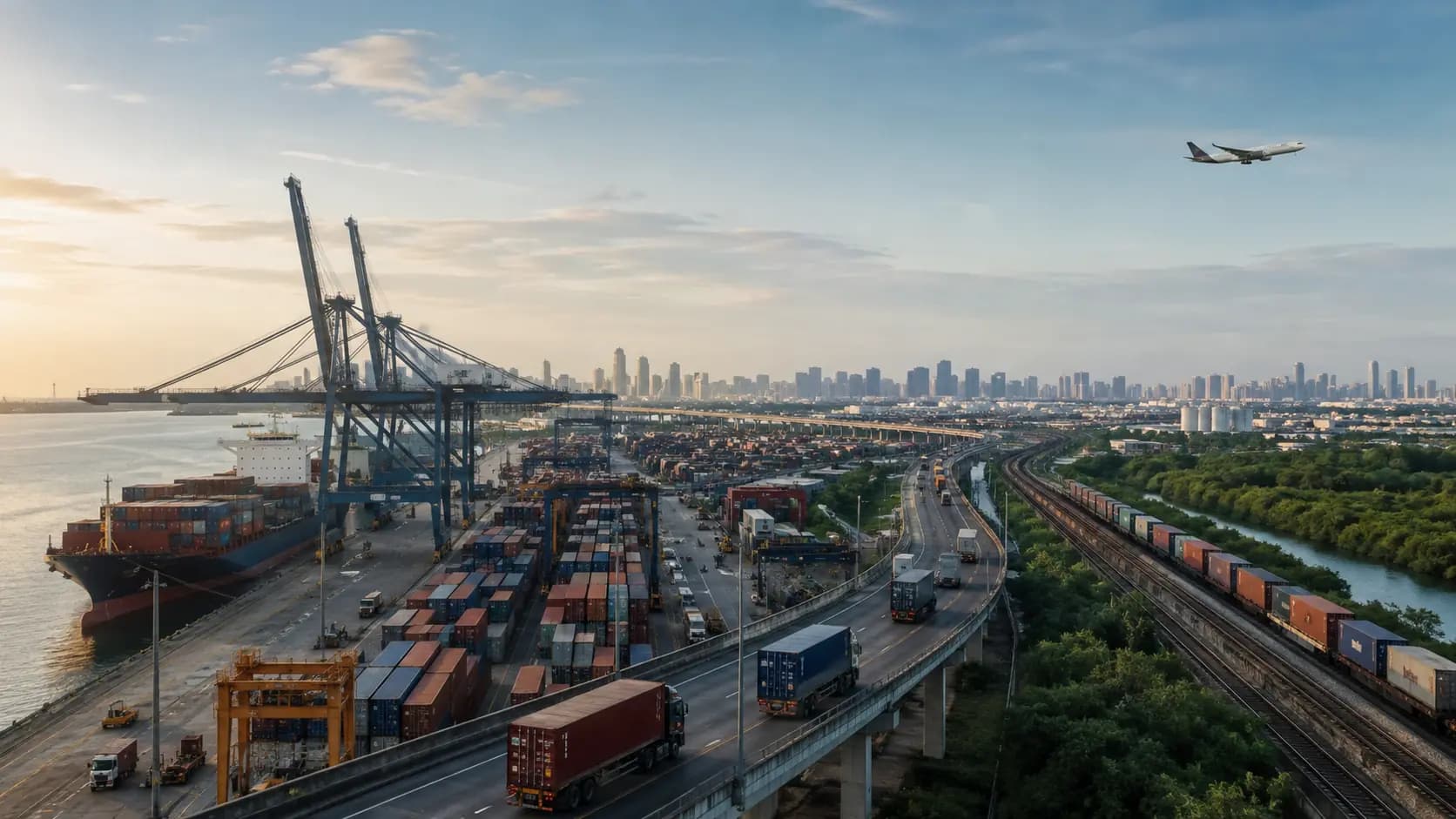
Thailand sits at the geographic centre of mainland Southeast Asia, linking maritime, road, rail and air corridors between the Greater Mekong Subregion, ASEAN and global supply chains. This gateway page maps the country's logistics infrastructure, customs and tax framework, investment incentives, and verified market participants for investors evaluating Thailand as a regional logistics base.
Research current as of 19 August 2026
A Regional Logistics Base at the Centre of ASEAN
Thailand's logistics sector connects the country's manufacturing and agricultural export base to Southeast Asia's largest consumer markets and to global shipping and air-cargo networks. The system combines a deep-sea container gateway at Laem Chabang, two major international airports serving the Bangkok metropolitan area, an expanding rail network, and land routes into Laos, Cambodia, Myanmar and Malaysia.
The Eastern Economic Corridor (EEC) concentrates much of the country's logistics-park, container-yard and cold-chain warehousing capacity around Laem Chabang port. The Board of Investment (BOI) treats logistics service centres, distribution centres and smart-warehousing operators as an eligible promoted activity, offering corporate income tax exemptions, import-duty relief on qualifying machinery, and streamlined foreign-ownership pathways for qualifying projects.
Verification Approach
Every figure, date and status on this page is sourced against an official government, BOI, customs or venue/organiser page wherever that source could be opened and read directly. Where a claim is corroborated only through independent secondary reporting, it is labelled Cross-Verified rather than presented as a primary source. Statistics that could not be confirmed either way are omitted; the full list and reasons are in Sources & Methodology.
ASEAN Gateway Location
Land borders with Myanmar, Laos, Cambodia and Malaysia, plus sea access via the Gulf of Thailand and Andaman coast, position Thailand as a natural transshipment and distribution base for Greater Mekong Subregion trade.
EEC Logistics Concentration
The Eastern Economic Corridor clusters container terminals, logistics parks, and cold-chain and smart-warehousing capacity around Laem Chabang, Thailand's principal deep-sea container port.
BOI-Promoted Activity
Distribution centres, international distribution centres, logistics parks, container yards and smart-warehousing projects are eligible activities under the Board of Investment's promotion framework.
Expanding FTA Network
Thailand participates in ATIGA, RCEP and multiple ASEAN+1 and bilateral free trade agreements, with newer agreements — including with EFTA and Bhutan — signed and moving toward entry into force.
Latest Indicators
Statistics shown here met this page's direct-verification bar. See the note below for figures that were intentionally excluded, and why.
VAT standard rate
OFFICIAL — CURRENT POLICY7%
Current rate, as published
Source: The Revenue Department — Value Added Tax (opens in a new tab) · Accessed 19 August 2026
Corporate income tax, standard rate
OFFICIAL — CURRENT POLICY20%
Net profit, standard corporate rate
Reduced rates of 15% apply to net profit between 300,000–3,000,000 baht for companies meeting the Revenue Department's small-company definition (paid-up capital under 5 million baht).
Source: The Revenue Department — Corporate Income Tax (opens in a new tab) · Accessed 19 August 2026
VAT registration threshold
OFFICIAL — CURRENT POLICY1.8 million baht
Annual turnover
Source: The Revenue Department — Value Added Tax (opens in a new tab) · Accessed 19 August 2026
EFTA–Thailand Free Trade Agreement
SIGNED — NOT YET IN FORCESigned, not yet in force
Signed 23 January 2025
Concluded 29 November 2024; signed at the World Economic Forum in Davos on 23 January 2025. Thailand's Parliament approved the agreement on 17 June 2026. Entry into force is pending completion of ratification procedures on the EFTA member-state side.
Source: European Free Trade Association (EFTA) — Thailand (opens in a new tab) · Accessed 19 August 2026
Data Availability Note
Several commonly-cited logistics statistics — Thailand's logistics-cost-to-GDP ratio, exact 2025 container throughput at Laem Chabang, and airport-specific 2025/2026 cargo tonnage — are intentionally left off this page because their primary sources could not be opened as text. The full list and reasons are documented in Sources & Methodology.

Logistics Cost Structure
Thailand's National Economic and Social Development Council (NESDC) publishes an annual Thailand Logistics Report that breaks total logistics cost into three components. NESDC's most recent published edition covers 2024. Its underlying PDF could not be opened as extractable text during this research pass, so this page describes the report's structure without republishing specific cost-to-GDP percentages or baht figures.
Transportation cost
The largest single component of Thailand's logistics cost base, covering domestic and cross-border freight movement by road, rail, sea and air.
Inventory and warehousing cost
The cost of holding, storing and managing goods in transit or in distribution — tracked by NESDC separately from pure transportation cost.
Administrative cost
Documentation, customs processing and logistics-management overhead — the smallest of the three components in NESDC's published cost framework.
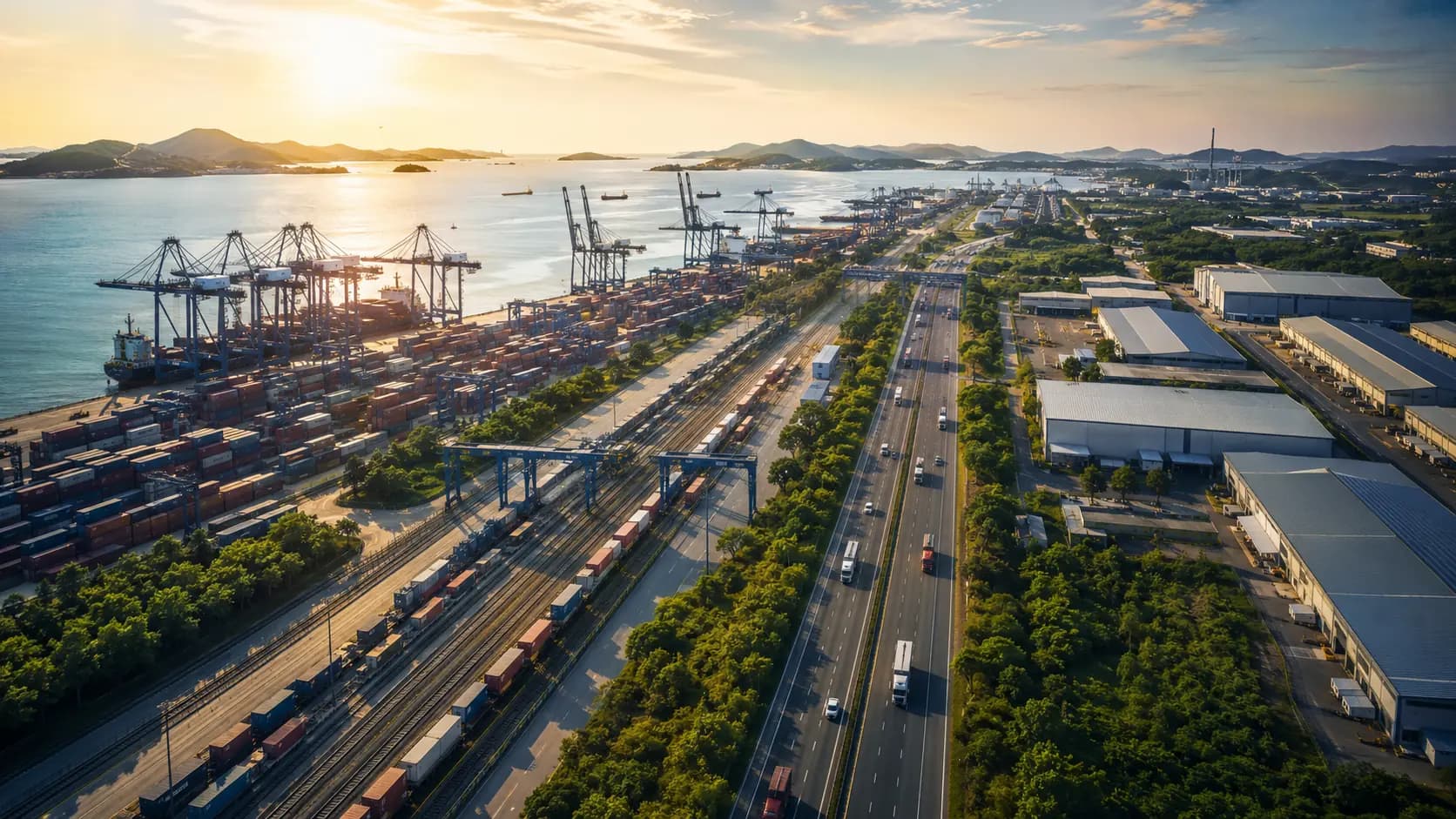
A Multimodal Network Anchored on the Eastern Seaboard
Road freight carries the large majority of Thailand's domestic cargo, feeding into the country's seaports, airports and an expanding rail network. Four connected layers make up the system:
Deep-sea port access
Laem Chabang and Bangkok Port provide Thailand's principal maritime gateways, connected inland by road and rail.
Road and rail connections
The State Railway of Thailand (SRT) operates a bimodal rail–road transfer facility linked to Laem Chabang, alongside double-track expansion projects to shift more freight from road to rail.
Inland container depots
ICDs away from the port gate provide bonded storage, container consolidation and customs clearance, reducing congestion at Laem Chabang.
Industrial and logistics parks
BOI-promoted logistics parks and IEAT industrial estates provide warehousing and distribution capacity close to the country's main transport corridors.
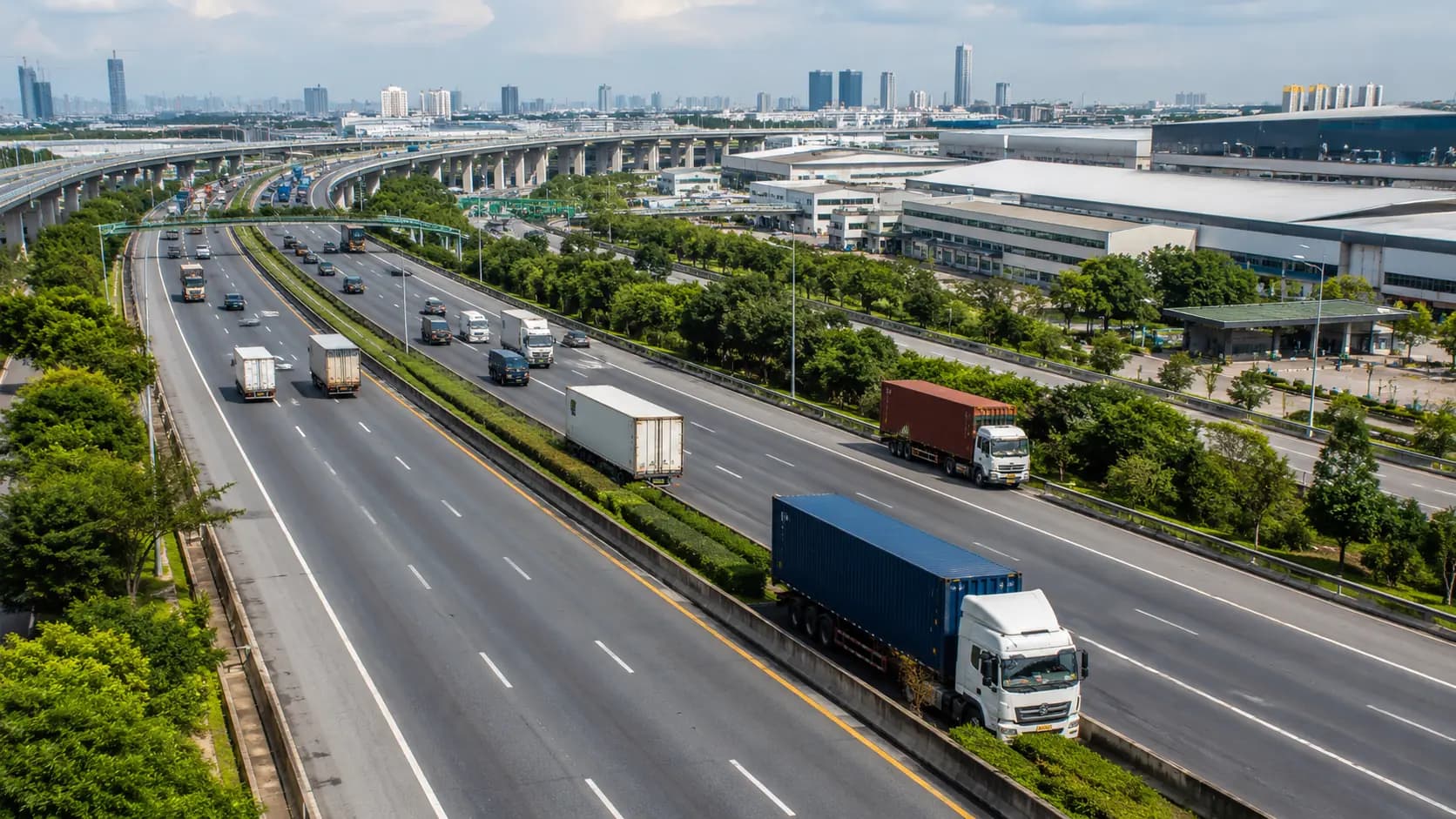
Road Freight
Road transport carries the majority of Thailand's domestic freight volume and is the dominant first- and last-mile mode connecting factories, farms and distribution centres to ports, airports and rail terminals. The Department of Land Transport (DLT) regulates commercial vehicle registration, driver licensing and freight-operator standards; the Department of Rural Roads (DRT) and Department of Highways maintain the country's road network.
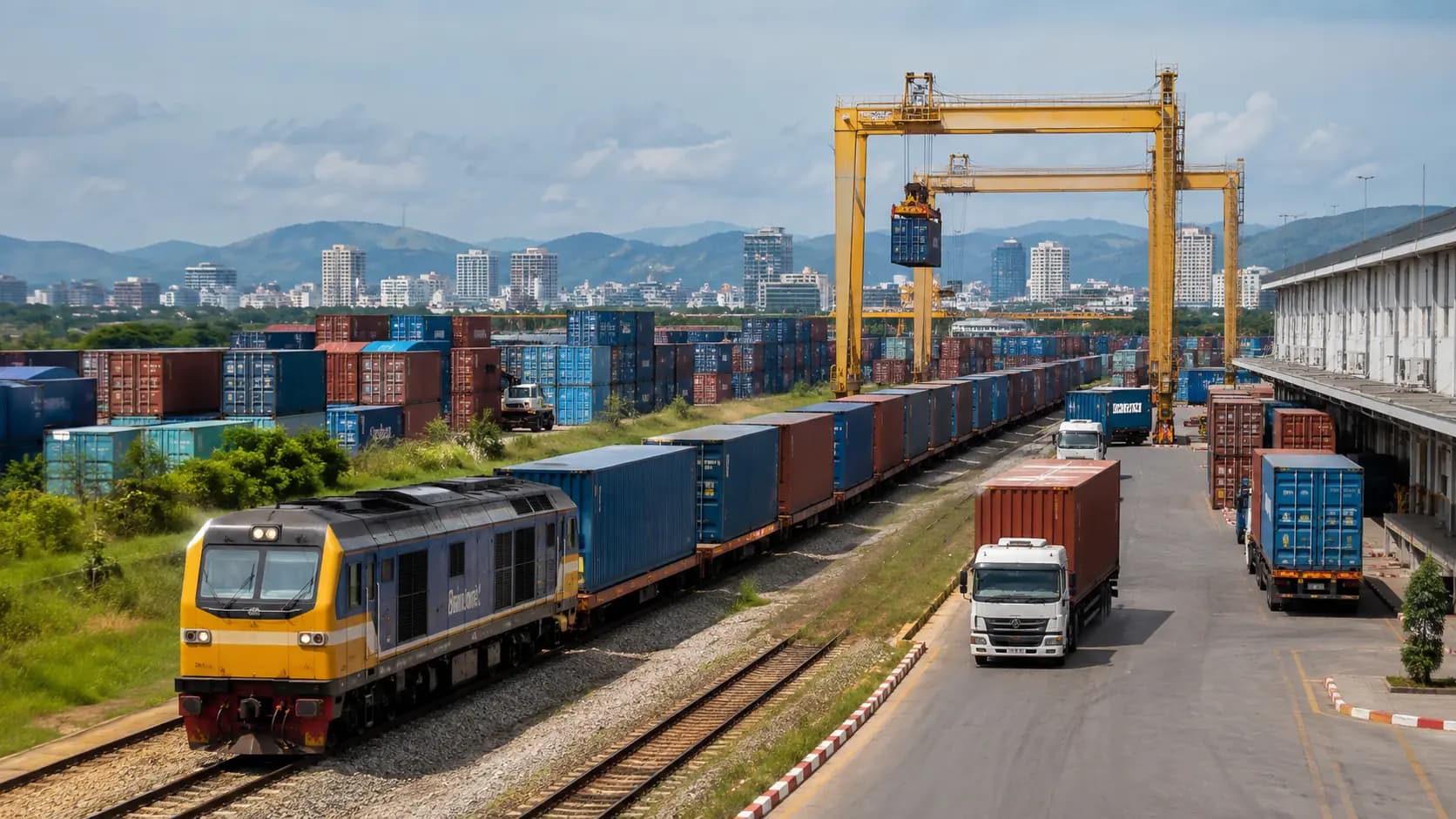
Rail & Multimodal Transport
The State Railway of Thailand (SRT) operates the national rail network and a bimodal (rail-to-road) container transfer facility linked to Laem Chabang port, allowing containers to move inland by rail rather than exclusively by truck. Double-track expansion projects on several SRT mainlines are underway to increase freight capacity. A second, rail-dedicated Nong Khai–Vientiane Friendship Bridge is in the design stage to link Thailand's standard-gauge rail network directly with the Laos–China Railway, easing a current bottleneck on the existing combined road-and-rail bridge.

Smart Warehousing & Distribution Centres
The Board of Investment recognises distribution centres (DC) and international distribution centres (IDC) as promoted logistics service activities, alongside a newer 'distribution centre with smart system' category requiring automated storage-and-retrieval systems (ASRS) and computerised inventory-management technology. Industrial-estate developers including WHA Group, Amata and Rojana lease ready-built warehouse and distribution-centre space within the Eastern Economic Corridor.
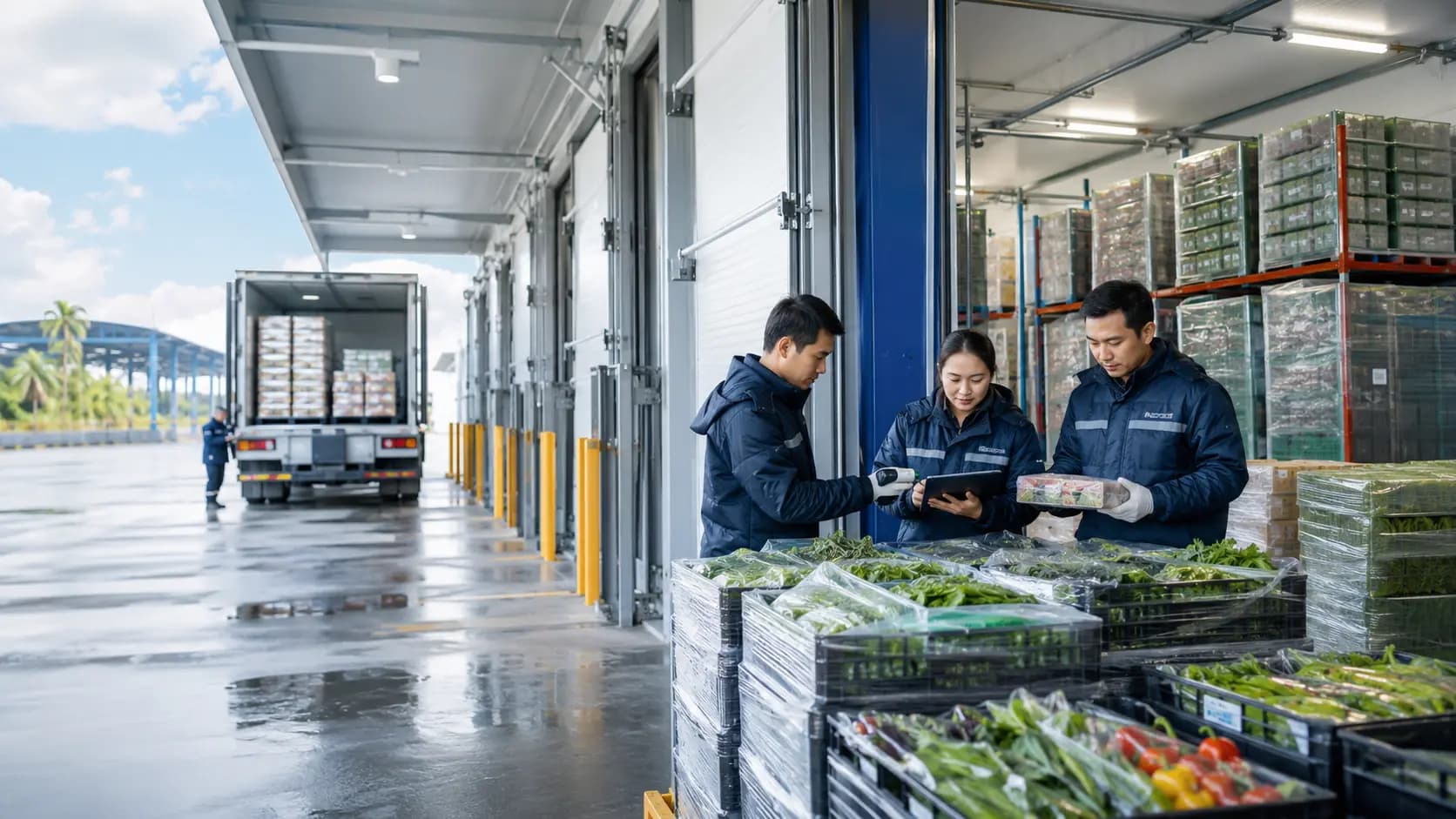
Cold Chain Logistics
Thailand's cold-chain logistics sector serves its large frozen-food, seafood-export and fresh-produce industries, alongside pharmaceutical and healthcare cold-chain demand. SCG Nichirei Logistics — a joint venture between Thailand's SCG Logistics and Japan's Nichirei Logistics Group — and SCGJWD Logistics (formed through the merger of SCG Logistics Management and JWD InfoLogistics) operate temperature-controlled warehousing and transport networks. Kerry Express and Betagro jointly operate a co-branded cold-chain last-mile delivery service, and dedicated cold-storage operators such as Thai Yokorei serve import/export cold-chain demand around Bangkok and the Eastern Seaboard.

Digital Logistics & Platform Technology
Thailand's customs and trade-documentation processes have moved to a fully digital model through the Thailand National Single Window (NSW) and e-Customs system, under which import and export declarations, supporting documents and certificates of origin are submitted electronically. Alongside this government digital infrastructure, Thai logistics-technology startups have built freight marketplace and booking platforms — Giztix, a Bangkok-based digital freight-matching platform connecting shippers with truck operators, has raised institutional funding including from WHA Group and Bualuang Ventures.
Logistics Clusters
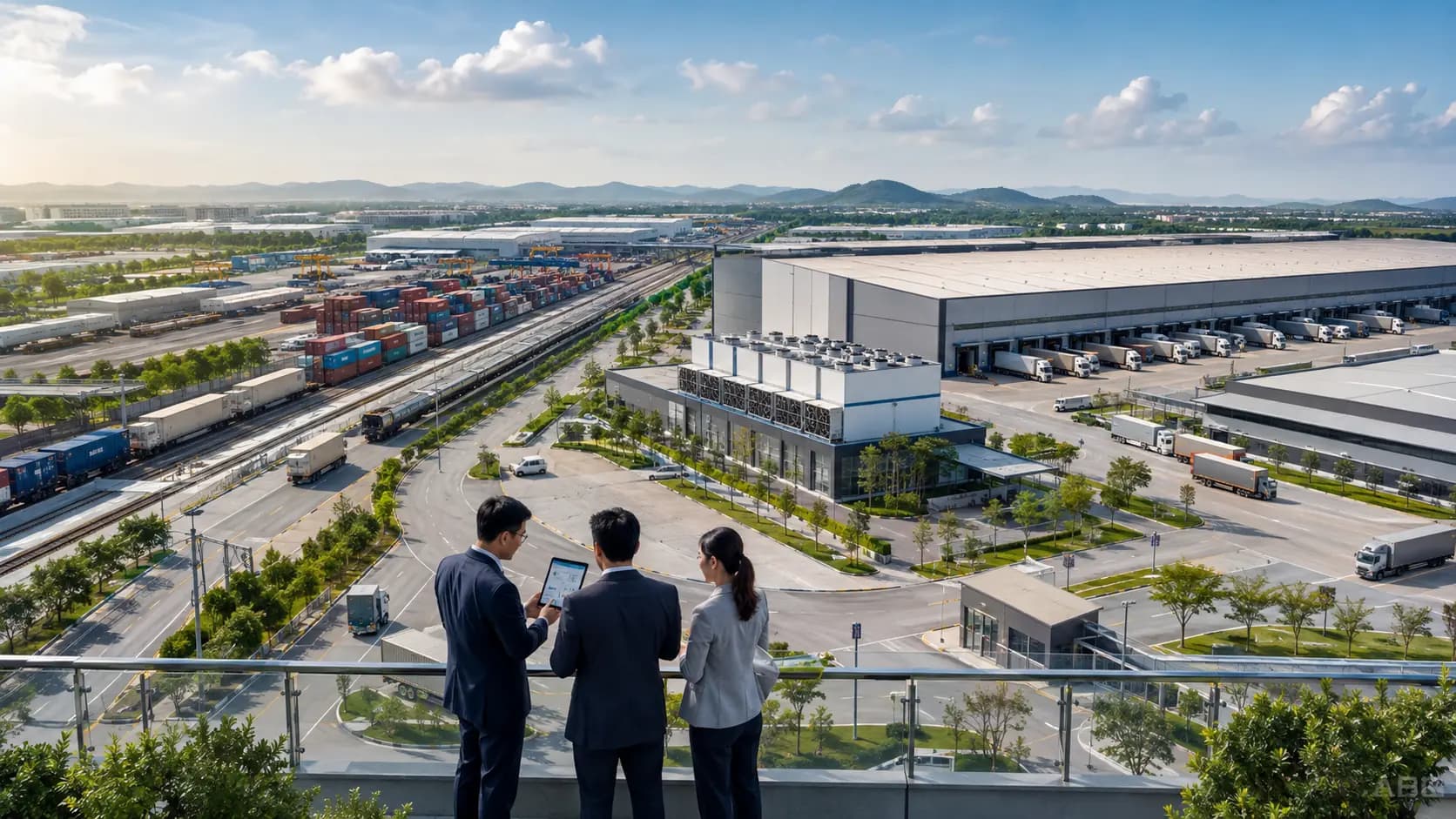
Only one of the groupings below carries a specific legal designation. The Eastern Economic Corridor is established by the Eastern Economic Corridor Act and coordinated by the EEC Office (EECO); the other regional groupings describe geographic concentrations of industrial estates and border-trade infrastructure and are not official 'cluster' designations.
Eastern Economic Corridor (EEC)
Official — established under the Eastern Economic Corridor Act
- Location:
- Chachoengsao, Chonburi and Rayong provinces
- Functions:
- Container-terminal capacity at Laem Chabang, logistics parks, cold-chain and smart warehousing
- Connections:
- Laem Chabang Port, Map Ta Phut, U-Tapao Airport, EEC road and rail links
- Industries:
- Automotive, petrochemicals, electronics, food processing, logistics and distribution
Greater Bangkok & Central Industrial Provinces
Unofficial grouping — concentration of industrial estates, not a designated cluster
- Location:
- Bangkok, Samut Prakan, Pathum Thani and Ayutthaya
- Functions:
- General manufacturing, warehousing and distribution serving the Bangkok metropolitan consumer market
- Connections:
- Bangkok Port, Suvarnabhumi and Don Mueang airports, national road and rail network
- Industries:
- Consumer goods, electronics, general manufacturing
Northeastern Gateway Corridor
Unofficial grouping — corridor description, not a designated cluster
- Location:
- Nong Khai and Mukdahan provinces
- Functions:
- Cross-border road and rail trade with Laos, onward connection toward Vietnam and southern China
- Connections:
- Thai–Lao Friendship Bridges (Nong Khai, Mukdahan), Laos–China Railway connection at Nong Khai
- Industries:
- Agricultural export, cross-border trade and transit logistics
Northern Gateway Corridor
Unofficial grouping — corridor description, not a designated cluster
- Location:
- Chiang Rai province (Chiang Khong)
- Functions:
- Cross-border road trade with Laos and onward transit to southern China via Route R3A
- Connections:
- Fourth Thai–Lao Friendship Bridge (Chiang Khong–Huay Xai), Route R3A to Kunming
- Industries:
- Agricultural export, regional cross-border trade
Southern Border Corridor
Unofficial grouping — corridor description, not a designated cluster
- Location:
- Songkhla province (Sadao, Padang Besar)
- Functions:
- Cross-border road and rail trade with Malaysia and onward connection toward Singapore
- Connections:
- Sadao–Bukit Kayu Hitam road crossing, Padang Besar road-and-rail crossing
- Industries:
- Rubber, agricultural export, regional distribution
Customs Import Process
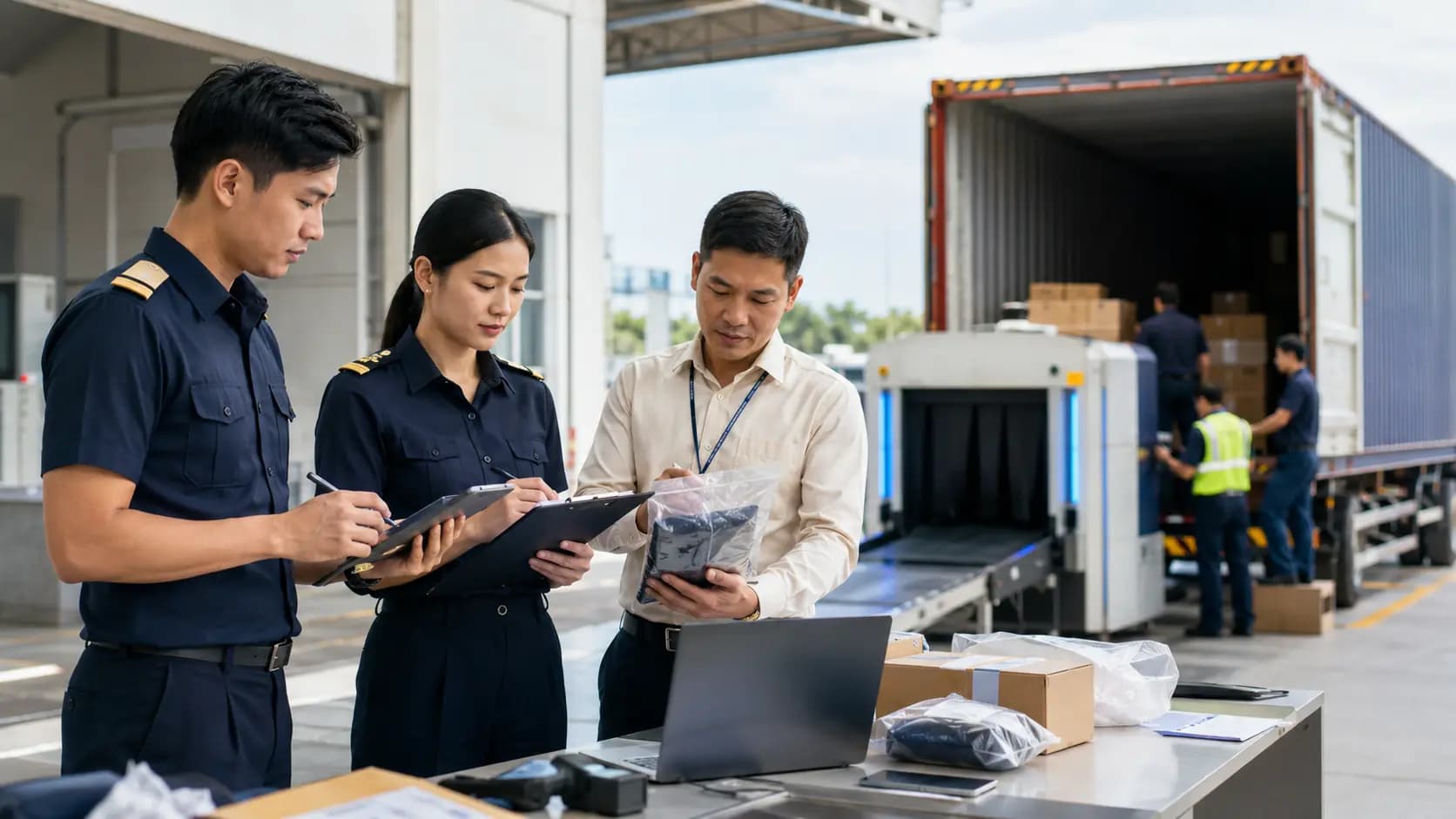
A 14-step orientation walkthrough of Thailand's National Single Window / e-Customs import process.
Process Verification Note
This walkthrough is a practical orientation based on cross-checked customs and trade-advisory sources. Businesses should confirm current procedural requirements directly with Thai Customs or a licensed customs broker before acting.
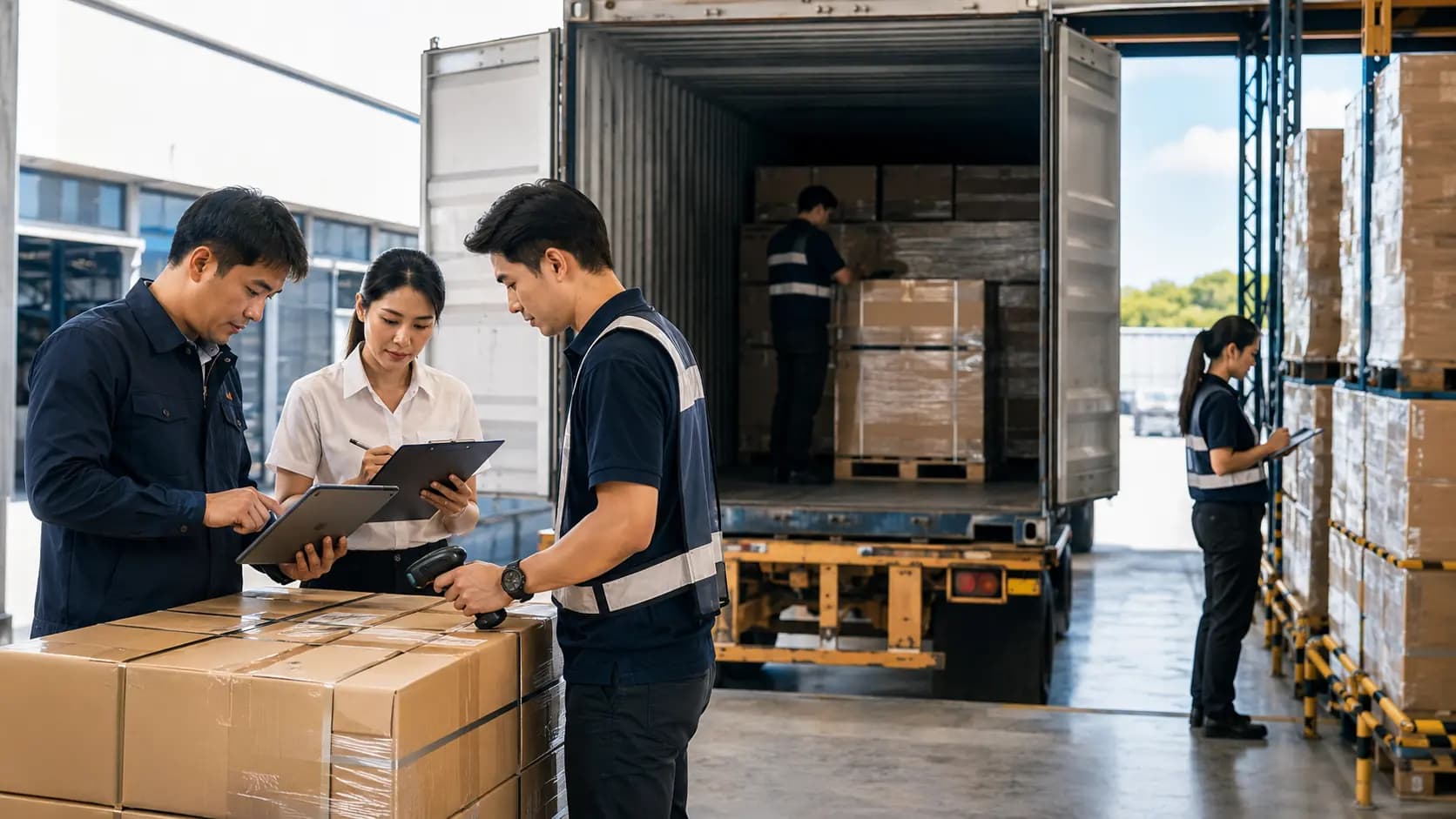
Customs Export Process
Export requirements vary by product, destination and transport mode — not every shipment requires the same documents or level of inspection. The steps below are a general orientation sequence.
- 1
Exporter & Customs Trader registration
Register a Customs Trader ID with Thai Customs before conducting export transactions.
- 2
HS/AHTN classification
Classify the goods under the correct tariff heading, which determines documentation and any licensing requirements.
- 3
Commercial & transport documentation
Prepare the commercial invoice, packing list, and bill of lading or air waybill.
- 4
Product-specific permits (where required)
Obtain any regulator-issued export permit or certificate — phytosanitary, health, or standards-body certification — that applies to the specific product.
- 5
Electronic export declaration
Submit the export declaration through Thailand's National Single Window / e-Customs system.
- 6
Customs controls & inspection (where selected)
Shipments may be selected for document review or physical inspection under Customs' risk-based selectivity system.
- 7
Certificate of origin (where FTA preference is claimed)
Apply to the Department of Foreign Trade for a certificate of origin, or use self-certification if registered, when the importer will claim a preferential tariff.
- 8
Cargo release, loading & recordkeeping
Once cleared, cargo is released for loading; exporters must retain documentation for the period prescribed by Thai Customs regulations.

Duties & Tariff Classification
There is no single, universal import-duty rate in Thailand — the applicable rate depends on the product's HS/AHTN classification and whether a preferential FTA rate applies. The elements below apply across most shipments; product-specific rates should always be confirmed against the current tariff schedule.
HS/AHTN classification
Every import is classified under the ASEAN Harmonized Tariff Nomenclature, which determines the applicable duty rate and any non-tariff requirements.
Customs value
Duty and import VAT are assessed against the customs (CIF) value — cost, insurance and freight — not the ex-factory price.
MFN versus preferential FTA treatment
Goods are dutied at Thailand's Most Favoured Nation (MFN) rate under WTO commitments unless a valid certificate of origin supports a lower preferential rate under an applicable FTA.
Rules of origin
Preferential treatment requires the goods to meet the specific origin criterion of the relevant agreement — see Rules of Origin below.
Certificate-of-origin requirement
A valid certificate of origin (or a registered self-certification declaration) must accompany the shipment to claim a preferential rate.
Import VAT calculation base
Import VAT is calculated on CIF value plus import duty plus any excise tax, at the standard 7% rate.
Excise tax (only where applicable)
Excise tax applies only to specific product categories — for example vehicles, alcohol, and certain luxury or environmentally-taxed goods — not to imports generally.
Advance rulings
Importers and exporters can request an advance ruling from Thai Customs on classification or origin ahead of shipment, reducing clearance-time uncertainty for complex or high-value cargo.
Post-clearance audit readiness
Thai Customs conducts post-clearance audits; importers should retain classification, valuation and origin records for the prescribed retention period.
Thailand's Trade Gateways: Sea, Air & Land Borders
Thailand connects regional and global trade through three distinct gateway systems: deep-sea and river ports, international air-cargo terminals, and land and rail border crossings. Because their capacity, authorities and operating conditions differ, each network is presented separately.
Sea Gateways
Laem Chabang, Bangkok Port and Map Ta Phut
Air Cargo Gateways
Suvarnabhumi, Don Mueang and U-Tapao
Land & Rail Borders
Seven verified crossings into Laos, Cambodia, Myanmar and Malaysia
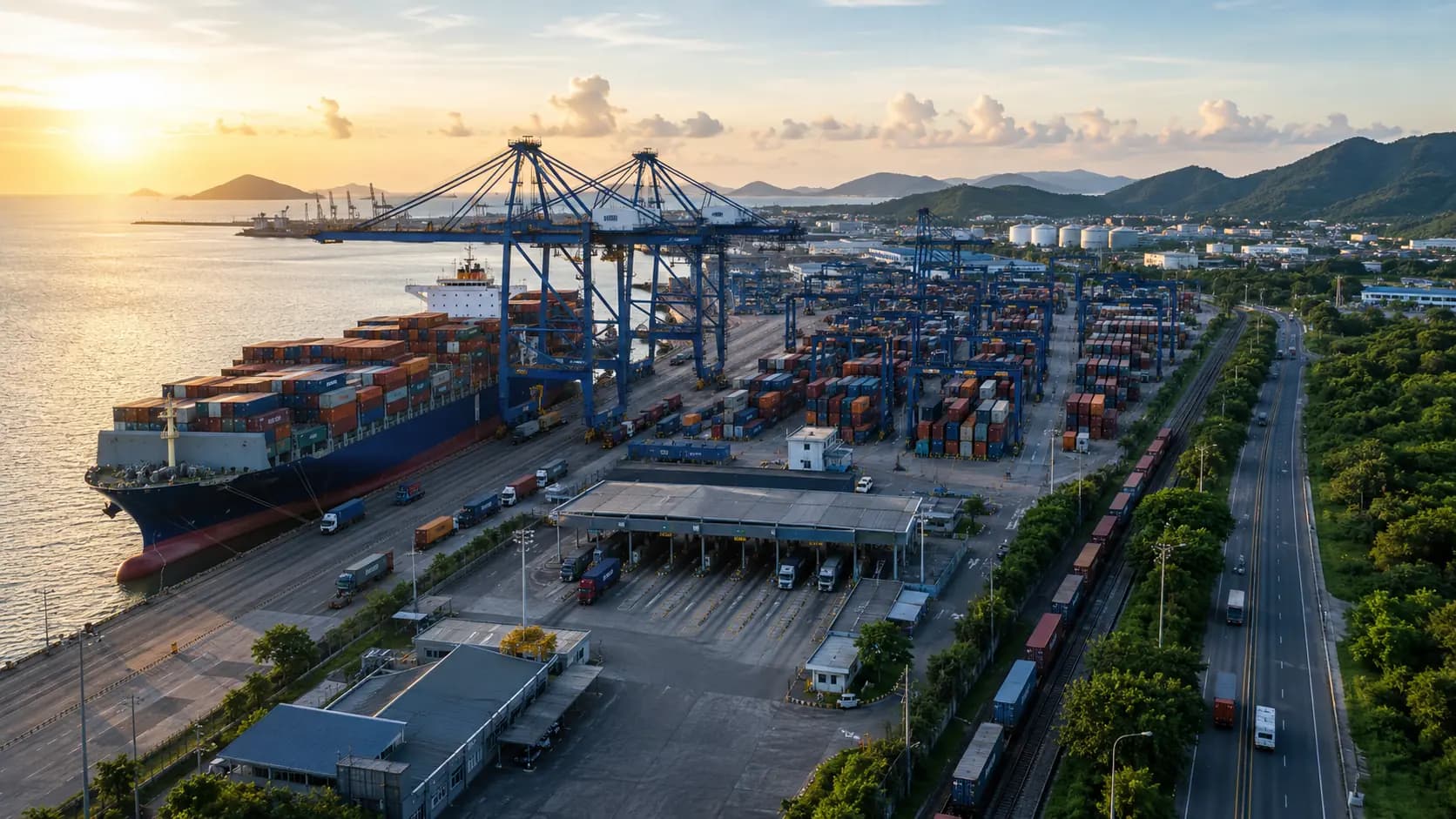
Sea Trade Gateways
The Port Authority of Thailand (PAT) reported record annual revenue and profit for fiscal year 2024 according to national business-press coverage of its own results; PAT's detailed throughput-statistics pages did not return extractable data during this research pass, so container-throughput (TEU) or cargo-tonnage figures are not published on this page.
Laem Chabang Port
OperationalChonburi province, Eastern Economic Corridor
- Role:
- Thailand's principal deep-sea container port and main containerised export/import gateway
- Connections:
- Road network to the EEC industrial estates; SRT bimodal rail-road container transfer facility
- Authority:
- Port Authority of Thailand (PAT), with private terminal operators including Hutchison Ports Thailand under concession
Current operating note
Phase 3 expansion underway with EECO to add deep-water berths and container-handling capacity.
Bangkok Port (Khlong Toei)
OperationalBangkok, on the Chao Phraya River
- Role:
- Thailand's original main port; now handles a smaller share of container traffic, serving more as a domestic and regional feeder facility
- Connections:
- Central Bangkok road network; river access constrains vessel size relative to Laem Chabang
- Authority:
- Port Authority of Thailand (PAT)
Current operating note
Secondary role to Laem Chabang for containerised trade.
Map Ta Phut Industrial Port
OperationalRayong province, Eastern Economic Corridor
- Role:
- Thailand's principal deep-sea port for petrochemical, energy and bulk-cargo traffic — not general containerised freight
- Connections:
- Serves the adjacent Map Ta Phut Industrial Estate and EEC petrochemical cluster
- Authority:
- Industrial Estate Authority of Thailand (IEAT) / Port Authority of Thailand
Current operating note
Industrial and bulk-cargo role only, not general containerised freight.
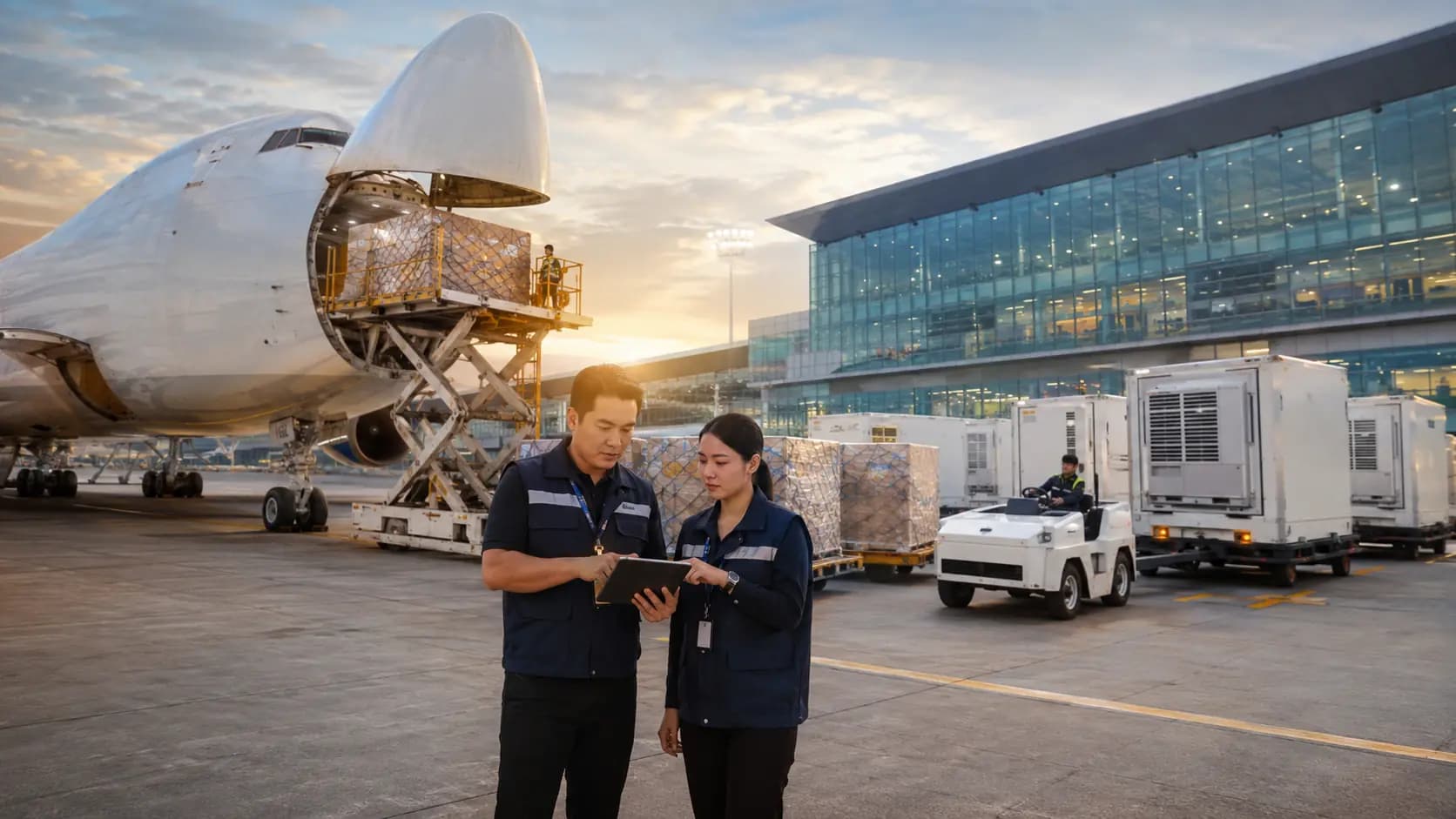
Air Trade Gateways
AOT's combined cargo and postal throughput across all six of its airports was approximately 1.42 million tonnes in fiscal year 2025 (cross-verified via independent financial-data and news reporting on AOT's published results; AOT's own investor traffic-statistics page did not return extractable data during this research pass). This figure covers all six airports combined, not Suvarnabhumi or Don Mueang individually.
Suvarnabhumi Airport
OperationalSamut Prakan province, greater Bangkok
- Role:
- Thailand's primary long-haul passenger and freighter gateway and main air-cargo hub, with a designated Airport Free Zone
- Connections:
- Multimodal Transportation Center within the Free Zone integrating road, rail, sea and air cargo handling; AOT's 'Cargo Network 2025' initiative and a new Mixed-Use Logistics Centre are under development
- Authority:
- Airports of Thailand (AOT); Customs Service Centre operated by AOT Ground Aviation Services (AOTGA) within Free Zone 3
Current operating note
Cargo-capacity expansion projects under development alongside current operations.
Don Mueang International Airport
OperationalBangkok
- Role:
- Serves a larger share of low-cost carrier and regional passenger traffic than Suvarnabhumi; a secondary cargo role
- Connections:
- Domestic and regional route network
- Authority:
- Airports of Thailand (AOT)
Current operating note
Airport-specific current cargo-tonnage figures were not independently confirmed during this research pass and are not published here.
U-Tapao International Airport & Eastern Aviation City
Project under developmentRayong province, Eastern Economic Corridor
- Role:
- Planned regional aviation hub and air-cargo logistics centre, intended to become Bangkok's third international airport
- Connections:
- EEC road and rail links; designed to support a 1-million-tonne-per-year air-cargo logistics hub and an MRO (maintenance, repair and overhaul) centre
- Authority:
- Eastern Economic Corridor Office (EECO) and U-Tapao International Aviation Co., Ltd. (UTA — a consortium of Bangkok Airways, BTS Group and STECON)
Current operating note
The 50-year concession project formally launched on 3 April 2026; cargo and MRO facilities are not yet operational.
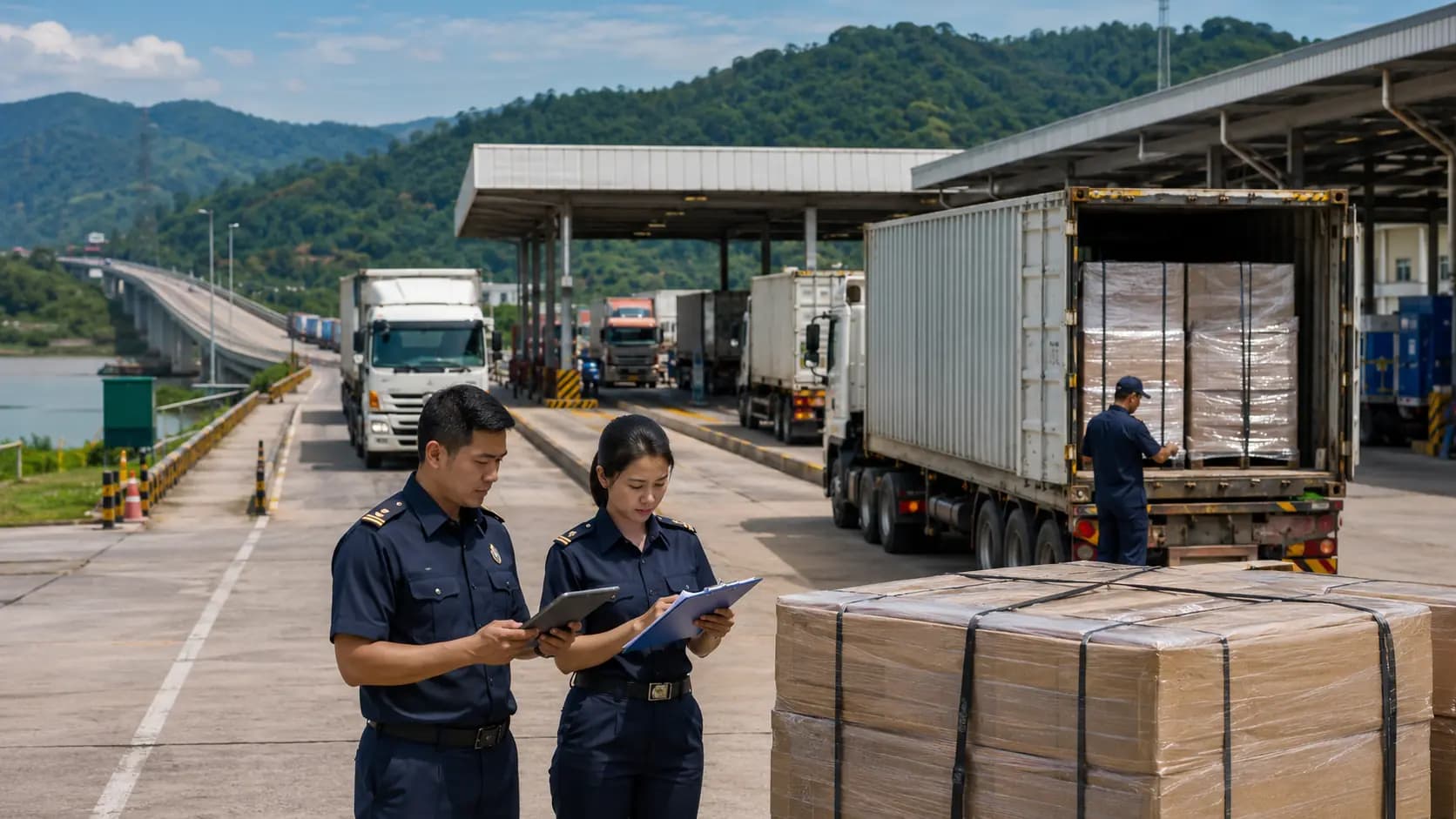
Land-Border Road & Rail Gateways
Thailand's land borders with Myanmar, Laos, Cambodia and Malaysia carry substantial cross-border road and rail freight, supported by ASEAN Trade in Goods Agreement (ATIGA) tariff preferences. Border conditions can change quickly — the entries below state each crossing's current operational status as verified during this research pass, not an assumed default of full operation.
Nong Khai (First Thai–Lao Friendship Bridge)
OperationalNong Khai province, Thailand — Vientiane, Laos
- Role:
- Main road and rail crossing to Vientiane; rail traffic connects toward the Laos–China Railway
- Connections:
- Combined road-and-rail bridge (a current bottleneck); a second, rail-dedicated bridge is in the design stage
- Authority:
- Department of Land Transport / State Railway of Thailand / Marine Department (for related river infrastructure)
Current operating note
Existing combined bridge in service; a dedicated rail bridge project has not yet been built.
Mukdahan (Second Thai–Lao Friendship Bridge)
OperationalMukdahan province, Thailand — Savannakhet, Laos
- Role:
- Main crossing on the East–West Economic Corridor (Route 9), linking Thailand, Laos and Vietnam
- Connections:
- Route 9 road corridor toward Da Nang, Vietnam
- Authority:
- Department of Land Transport
Chiang Khong (Fourth Thai–Lao Friendship Bridge) / Route R3A
OperationalChiang Rai province, Thailand — Huay Xai, Laos
- Role:
- Road gateway to Route R3A, the approximately 1,800 km corridor linking Bangkok to Kunming, China via Laos
- Connections:
- Route R3A via Bokeo, Luang Namtha and Boten (Laos) to Yunnan province, China
- Authority:
- Department of Land Transport
Aranyaprathet–Poipet
Temporarily closedSa Kaeo province, Thailand — Banteay Meanchey province, Cambodia
- Role:
- Historically Thailand's principal land crossing for Cambodia trade, including rail service on the Eastern Line
- Connections:
- Eastern Line rail terminus at Aranyaprathet; road corridor to Phnom Penh
- Authority:
- Royal Thai Police / Customs Department border checkpoint administration
Current operating note
Closed since a border conflict began in mid-2025; as of mid-2026 it remained closed with no general reopening announced, causing significant reported trade losses. This is a materially important limitation for supply-chain planning — confirm current status directly with Thai Customs before relying on this crossing.
Mae Sot–Myawaddy
Restricted operationTak province, Thailand — Kayin State, Myanmar
- Role:
- Thailand's largest land crossing for Myanmar trade by volume, historically over half of bilateral border-trade volume
- Connections:
- Asian Highway corridor toward Yangon and onward South Asia links
- Authority:
- Customs Department border checkpoint administration
Current operating note
Closed to heavy vehicles from mid-2025 due to conflict in Myawaddy, reopened 28 May 2026 after roughly ten months; trade volumes remained well below prior-year levels in the months following reopening.
Sadao–Bukit Kayu Hitam
OperationalSongkhla province, Thailand — Kedah, Malaysia
- Role:
- Busiest road crossing between Thailand and Malaysia, where both countries' main trans-national highways meet
- Connections:
- Road corridor toward Kuala Lumpur and Singapore
- Authority:
- Customs Department border checkpoint administration
Current operating note
A new permanent border-crossing complex opened to traffic on 11 July 2026, operating 05:00–23:00 Thailand time.
Padang Besar
OperationalSongkhla province, Thailand — Perlis, Malaysia
- Role:
- Thailand's main road-and-rail crossing to Malaysia, with a railway station on both sides of the border
- Connections:
- Rail link toward Malaysia's national rail network and onward to Singapore; quieter road crossing than Sadao
- Authority:
- State Railway of Thailand / Customs Department border checkpoint administration
Free Zones & Bonded Warehouse Schemes
Thailand offers several duty-deferral and duty-exemption regimes relevant to logistics operators handling import, re-export or manufacturing-for-export cargo. The right scheme depends on whether goods will be re-exported unchanged, processed, or distributed domestically.
Duty exemption
No import duty is payable at all on qualifying goods (for example machinery approved under a BOI promotion certificate).
Duty suspension or deferral
Import duty is not paid while goods remain within a bonded warehouse or free zone, but becomes payable if the goods later enter the Thai domestic market.
VAT treatment
Import VAT follows a separate rule set from CIT — it is generally collected at the point of import, though supplies between bonded warehouses or EPZ enterprises are zero-rated.
BOI corporate-income-tax incentives
A time-limited CIT exemption or reduction tied to a specific approved BOI activity and its conditions, distinct from any customs duty or VAT treatment.
Non-tax facilitation
Streamlined foreign-ownership pathways, work-permit processing (OSOS, SMART Visa, LTR) and import-licensing support that BOI promotion provides alongside — not instead of — its tax incentives.
| Scheme | Administrator | Duty treatment | Typical use |
|---|---|---|---|
| Customs Bonded Warehouse | Thai Customs Department | Import duty and VAT deferred while goods remain in the bonded warehouse | Storage of imported goods pending re-export or domestic clearance |
| Customs Free Zone | Thai Customs Department | Duty and VAT relief for goods held for re-export without entering the Thai domestic market | Transshipment, consolidation and re-export operations |
| IEAT Free Zone (industrial estate) | Industrial Estate Authority of Thailand (IEAT) | Duty and VAT exemption on imported raw materials/machinery used for export production | Manufacturing and logistics operations within an IEAT-designated free zone |
| BOI-Promoted Logistics Park / Distribution Centre | Board of Investment (BOI) | Import-duty relief on qualifying machinery; project area may be designated wholly or partly as a Free Zone under the BOI-promoted Logistics Park activity; separate CIT incentive tied to the promotion certificate | Large-scale BOI-promoted logistics parks and distribution/international distribution centres |
Source Limitation
This is a structural orientation table, not exhaustive legal guidance. Confirm current scheme conditions and eligibility directly with IEAT, Thai Customs, or the BOI before structuring a facility around a specific regime.
Tax Policy for Logistics Operators
Corporate Income Tax (CIT)
The standard corporate income tax rate is 20% of net profit. A reduced rate structure applies to companies meeting the Revenue Department's small-company definition (paid-up capital under 5 million baht): 15% on net profit from 300,000 up to 3 million baht, and 20% above that threshold. BOI-promoted logistics activities may separately qualify for a CIT exemption period under their investment promotion certificate — see BOI-Promoted Logistics Activities below.
Value Added Tax (VAT)
The standard VAT rate is 7%, charged on the supply of goods and services and on imports. Businesses with annual turnover exceeding 1.8 million baht must register for VAT. Exports, international transport services, and supplies between bonded warehouses or enterprises within an Export Processing Zone are zero-rated. VAT on imports is assessed by Thai Customs at the point of import.
Withholding Tax (WHT)
Payments for services and professional fees to Thai companies, or to foreign companies with a permanent branch in Thailand, are generally subject to 3% withholding tax; payments to foreign companies without a Thai branch are generally subject to 5%. Dividends are subject to 10% withholding tax, interest generally 1%, and royalties generally 3%, subject to any applicable double-tax treaty.
Transfer pricing
Thailand's transfer-pricing rules require related-party transactions to be conducted on an arm's-length basis, with disclosure and documentation requirements above prescribed revenue thresholds — relevant for multinational logistics groups pricing intercompany freight or management-fee arrangements with their Thai subsidiary.
Customs–tax interaction
Import VAT is collected by Thai Customs at the point of import alongside import duty, separate from the normal monthly VAT filing cycle — factor this into cash-flow planning for import-heavy operations.
Tax, Customs & Legal Notice
This information is provided for general orientation only and does not constitute tax, legal, customs or other professional advice. Tax rates, thresholds and procedures can change, and their application depends on each business's specific facts. Businesses should confirm current requirements directly with the Revenue Department, Thai Customs Department, or a licensed Thai tax advisor, auditor or customs broker before making investment or compliance decisions.
Free Trade Agreement Network
Status is shown exactly as verified — a signed agreement is never presented as already in force, and negotiations are never presented as signed agreements.
Showing 12 of 12 entries
In force
ASEAN (ATIGA)
IN FORCEThe ASEAN Trade in Goods Agreement underpins tariff liberalisation among ASEAN member states, forming the base layer of Thailand's regional trade preferences.
In force
RCEP (ASEAN+5)
IN FORCEThe Regional Comprehensive Economic Partnership entered into force for Thailand on 1 January 2022.
In force
China (ASEAN–China, ACFTA)
IN FORCEASEAN–China Free Trade Area preferential tariff arrangements applicable to Thailand as an ASEAN member.
In force
Japan (AJCEP / JTEPA)
IN FORCEThailand participates in the ASEAN–Japan Comprehensive Economic Partnership and maintains its own bilateral Japan–Thailand Economic Partnership Agreement.
In force
South Korea (AKFTA)
IN FORCEASEAN–Korea Free Trade Area preferential tariff arrangements applicable to Thailand.
In force
Australia & New Zealand (AANZFTA, TAFTA, TNZCEP)
IN FORCEASEAN–Australia–New Zealand FTA, alongside Thailand's own bilateral agreements with Australia (TAFTA) and New Zealand (TNZCEP).
In force
Chile
IN FORCEThe Thailand–Chile Free Trade Agreement entered into force in November 2015.
In force
Peru
IN FORCEThe original Thailand–Peru Free Trade Agreement has been in force since December 2011. A separate negotiation to upgrade the agreement has reached substantive conclusion on core issues, but the upgraded text was not yet signed as of this research pass — do not treat the upgrade as already in effect.
Only the original 2011 agreement is currently in force. The upgrade negotiation is tracked separately and should not be relied on for tariff planning until signed and ratified.
In force
India (bilateral Early Harvest) & ASEAN–India (AITIGA)
IN FORCE — LIMITED SCOPEThailand and India never concluded a comprehensive bilateral free trade agreement — only an Early Harvest Scheme covering a limited product list. Broader tariff preferences with India run through the regional ASEAN–India Trade in Goods Agreement (AITIGA), in force since 1 January 2010.
Do not present this as a comprehensive bilateral Thailand-India FTA — its preferential scope is limited to the Early Harvest product list plus whatever AITIGA separately covers.
Signed — not yet in force
EFTA (Iceland, Liechtenstein, Norway, Switzerland)
SIGNED — NOT YET IN FORCESigned at the World Economic Forum in Davos on 23 January 2025. Thailand's Parliament approved the agreement on 17 June 2026. Entry into force is pending completion of ratification procedures on the EFTA member-state side.
Primary source opened directly: efta.int.
Signed — not yet in force
Bhutan
SIGNED — NOT YET IN FORCESigned in 2025 as Thailand's 17th free trade agreement. Thailand's cabinet approved submission of the agreement to Parliament for constitutional approval; the agreement is targeted to take effect from 1 January 2027, pending completion of both countries' ratification processes.
Cross-verified via multiple independent sources (Thai national press and Bhutan's National Assembly); DTN's own dedicated status page for this agreement was not directly opened during this research pass.
Under negotiation
European Union
NEGOTIATIONThailand and the European Union are in active free trade agreement negotiations. No agreement has been concluded or signed; this entry should not be read as indicating any current preferential access.
How to Use an FTA
A 13-step orientation pathway for claiming preferential tariff treatment under one of Thailand's free trade agreements.
Rules of Origin & Documentation
Exact requirements depend on the specific product, its origin, its destination market and the transport mode used — the cards below describe the general concepts, not a single universal rule.
Wholly obtained
Goods entirely grown, extracted or produced in the exporting country, with no non-originating inputs.
Regional value content (RVC)
A minimum percentage of the product's value must originate within the FTA region — commonly 40% under ASEAN-linked agreements, though the exact threshold varies by agreement.
Change in tariff classification (CTC)
The finished product's HS heading must differ from that of any non-originating input used in its production.
Product-specific rules
Certain goods carry a specific manufacturing-process requirement (for example a defined chemical reaction or assembly step) instead of, or alongside, RVC or CTC.
Direct consignment / transit requirements
Many agreements require goods to move directly, or under customs control if transiting a third country, to preserve originating status.
Certificate of origin
A certificate issued by the Department of Foreign Trade (or an approved chamber, for non-preferential certificates) evidencing the goods meet the applicable origin rule.
Approved-exporter self-certification
Registered, qualified exporters may issue their own origin declarations under DFT's self-certification scheme rather than applying for a certificate on each shipment.
Electronic certificate formats
DFT issues electronic certificates such as e-Form D through its Smart C/O system, transmitted via Thailand's National Single Window to the ASEAN Single Window.
Shipment Documentation Checklist
- Commercial invoice
- Packing list
- Bill of lading or air waybill
- Customs declaration
- Certificate of origin, when preferential tariff treatment is claimed
- Product-specific licence or certificate, where required by the product category or destination market
Trade Compliance & Market Entry
Successful logistics and trading operations depend on correct documentation, product-specific regulatory clearance and an appropriate ownership or licensing structure.
Certificates & Documentation
- Certificate of origin
- Commercial invoice
- Packing list
- Bill of lading or air waybill
- Product-specific certificate
- Destination-market documents
Non-Tariff Measures
- Thai FDA licensing
- TISI-regulated goods
- Agriculture and quarantine controls
- Product labelling
- Standards and testing
- Sector-specific permits
Foreign Ownership & Licensing
- Foreign Business Act considerations
- Restricted transport activities
- Foreign Business Licence route
- BOI-promoted activity route
- Thai-majority structures where required
- Sector-specific operating licences
General orientation only — confirm current requirements with Thai Customs, the relevant regulator, or a licensed Thai advisor before acting.
BOI-Promoted Logistics Activities
BOI Guide Coverage Note
The conditions below are drawn from BOI's published 'General List of Activities Eligible for Investment Promotion,' cross-checked against multiple 2025/2026 professional investment-advisory summaries describing the same qualifying conditions and capital thresholds. BOI's current (July 2026) 'A Guide to the Board of Investment' confirms the incentive-tier lettering system has been restructured to A1+ / A1 / A2–A4 / B (a single B group, rather than the previous B1/B2 split); its detailed activity-by-activity pages were not retrievable in full during this research pass, so this page describes qualifying conditions without asserting a specific current tier-letter code. Confirm the current incentive tier directly with BOI or a BOI-registered consultant before relying on it for investment planning.
Activity 7.4.1
Distribution Centre (DC)
Paid-up registered capital of at least 10 million baht; must provide a goods storage facility controlled by a modern computerised system. DC projects are not eligible for merit-based (additional) privileges.
Activity 7.4.2
International Distribution Centre (IDC)
Meets the DC conditions above, plus a minimum investment (excluding land and working capital) of at least 100 million baht, and the centre must distribute goods to at least 5 countries.
Activity 10.11.1
Distribution Centre with Smart System
A newer activity category requiring an automated storage-and-retrieval system (ASRS) and computerised inventory-management and information-technology support systems.
Activity 7.9.1.3
Logistics Park
Total project area of at least 200 rai, including a warehouse for lease or sale of at least 50,000 square metres; must be located within 50 kilometres of a port, airport, customs checkpoint or inland container depot, or within a designated Free Zone; must provide container loading/unloading facilities or a truck terminal handling at least 50 containers; must install high-speed telecommunications infrastructure; and Thai nationals must hold at least 51% of total registered capital.
Activity 7.1.3 / 7.1.4
Container Yards, Inland Container Depots & Cargo Loading/Unloading Facilities
Must be approved by relevant government agencies and use modern technology approved by the Board.
Activity 7.7
Trade & Investment Support Office (TISO)
Annual selling and administrative expenses of at least 10 million baht, with an approved business plan covering monitoring/servicing of associated enterprises, sourcing information services, or wholesaling of Thai-manufactured products. TISO projects are not eligible for merit-based privileges.
How to Apply for BOI Promotion
A 12-step orientation pathway — not a reproduction of BOI's complete application guide.
Market-Entry Roadmap
Seventeen practical steps for logistics operators, freight forwarders, and warehousing investors entering the Thai market.
The Logistics Value Chain
Inbound Freight Forwarding
Ocean, air and land freight booking and consolidation, connecting overseas suppliers to Thai ports, airports and border crossings.
Customs Clearance
Import declaration, tariff classification, duty and VAT assessment, and release of goods through Thai Customs' e-Customs system.
Warehousing & Distribution Centres
Bonded and non-bonded storage, inventory management, and BOI-promoted distribution-centre operations.
Value-Added Logistics
Kitting, labelling, light assembly, and quality-control services performed within a distribution or fulfilment facility.
Domestic Distribution & Last-Mile
Road-freight distribution to retail, industrial or e-commerce end customers across Thailand's provinces.
Cross-Border & Export
Certificate-of-origin processing, export customs clearance, and cross-border road, rail, sea or air movement to regional and global markets.
Reverse Logistics
Returns processing, refurbishment and recycling flows supporting e-commerce and manufacturing supply chains.
Companies
Verified shipping lines, freight forwarders, warehousing developers, cold-chain operators and digital logistics platforms operating in Thailand.
Showing 13 of 13 entries
Shipping & Container Lines
Maersk (Thailand)
CROSS-VERIFIEDGlobal container shipping line with local Thailand operations, offering ocean freight, inland logistics and customs-clearance services to and from Thai ports.
Verified 19 August 2026.
Shipping & Container Lines
CMA CGM (Thailand) Ltd.
CROSS-VERIFIEDContainer shipping line operating three Thailand offices (Bangkok, Laem Chabang and Songkhla) with an in-house forwarding arm, CMA CGM Logistics, providing customs clearance and inland logistics.
Verified 19 August 2026.
Shipping & Container Lines
Hutchison Ports Thailand
CROSS-VERIFIEDThe largest container-terminal operator at Laem Chabang port, operating under concession from the Port Authority of Thailand.
Verified 19 August 2026.
Freight Forwarding & 3PL
Kerry Logistics (Thailand)
CROSS-VERIFIEDRegional third-party logistics operator providing freight forwarding, warehousing and distribution services across Thailand, part of the wider Kerry Logistics Network.
Verified 19 August 2026.
Freight Forwarding & 3PL
DHL Supply Chain (Thailand)
CROSS-VERIFIEDContract logistics and supply-chain management operator providing warehousing, distribution and freight-forwarding services in Thailand as part of the global DHL network.
Verified 19 August 2026.
Freight Forwarding & 3PL
SCG Logistics
CROSS-VERIFIEDLogistics arm of Siam Cement Group (SCG), providing freight, warehousing and supply-chain services, including its SCG Express parcel-delivery unit and cold-chain joint venture SCG Nichirei Logistics.
Verified 19 August 2026.
Freight Forwarding & 3PL
SCGJWD Logistics
CROSS-VERIFIEDLogistics group formed through the merger of SCG Logistics Management and JWD InfoLogistics, offering integrated logistics, warehousing and cold-chain services across Thailand.
Verified 19 August 2026.
Express & Parcel Delivery
Kerry Express (Thailand)
CROSS-VERIFIEDDomestic parcel-delivery operator with service points across all Thai provinces, providing next-day delivery and, jointly with Betagro, a cold-chain last-mile delivery service.
Verified 19 August 2026.
Warehousing & Industrial Estates
WHA Group
CROSS-VERIFIEDIndustrial-estate and logistics-property developer offering ready-built factories and warehouses for lease across Thailand, including within the Eastern Economic Corridor, and an investor in logistics-technology platform Giztix.
Verified 19 August 2026.
Warehousing & Industrial Estates
Amata Corporation
CROSS-VERIFIEDIndustrial-estate developer with major estates in Chonburi and Rayong within the Eastern Economic Corridor, offering freehold and leasehold industrial and logistics land.
Verified 19 August 2026.
Cold Chain
Thai Yokorei Co., Ltd.
CROSS-VERIFIEDCold-storage and cold-chain logistics operator serving Thailand's frozen-food and import/export cold-chain sector.
Verified 19 August 2026.
Cold Chain
SCG Nichirei Logistics
CROSS-VERIFIEDJoint venture between SCG Logistics and Japan's Nichirei Logistics Group operating temperature-controlled logistics centres in the Eastern Seaboard region.
Verified 19 August 2026.
Digital Logistics Platforms
Giztix
CROSS-VERIFIEDBangkok-based digital freight-matching and booking platform connecting shippers with road-freight operators, backed by institutional investors including WHA Group and Bualuang Ventures.
Verified 19 August 2026.
Associations & Trade Bodies
Verified associations, chambers, federations, business councils and government bodies connected to Logistics in Thailand.
- Government Agency
Thailand Board of Investment
BOI
Thailand's national investment-promotion agency — grants tax and non-tax incentives for promoted activities and coordinates investor support through offices across Asia, Europe, Australia and the US.
- IT & AI
- Textiles
- Food, Beverage & FMCG
- Rubber & Raw Materials
- Energy & Renewable Energy
- Cosmetics
- Seafood
- Gems, Jewellery & Precious Stones
- Packaging, Printing & Labelling
- Furniture, Wood & Interior Products
- Electrical, Electronics & Semiconductors
- Halal Economy
- Education
- Real Estate / Living
- Spa, Wellness & Beauty Services
- Logistics
- Trade Services
- Manufacturing
- Professional & Business Services
- Healthcare
- Government Agency
Department of Business Development
DBD
Handles company registration, corporate filings, business licensing records and business-development services in Thailand.
- Government Agency
Department of Trade Negotiations
DTN
Negotiates and administers Thailand's free trade agreements and publishes official FTA status information.
- Government Agency
Department of Foreign Trade
DFT
Administers rules of origin, certificates of origin, import/export licensing and trade-remedy measures under the Ministry of Commerce.
- Government Agency
Thai Customs Department
Manages customs declarations, tariff classification, valuation and cargo clearance for all cross-border trade.
- Government Agency
Revenue Department
Administers corporate income tax, VAT, withholding tax and taxpayer registration.
- Government Agency
Industrial Estate Authority of Thailand
IEAT
Develops and manages 66 industrial estates and free zones across 16 provinces, including investor services for estate-based manufacturers.
- Government Agency
Eastern Economic Corridor Office
EECO
Coordinates investment and infrastructure development across the Eastern Economic Corridor provinces of Chachoengsao, Chonburi and Rayong.
- Government Agency
Ministry of Commerce
MOC
Thailand's ministry overseeing trade, commerce, consumer protection and export policy, and Thailand's representative at the WTO.
- Government Agency
Ministry of Transport
MOT
Thailand's cabinet-level ministry overseeing land, rail, marine and air transport policy and its constituent departments and agencies.
- Government Agency
Office of Transport and Traffic Policy and Planning
OTP
Ministry of Transport department responsible for national transport and traffic policy, including logistics-sector planning research.
- Government Agency
National Economic and Social Development Council
NESDC
Publishes Thailand's national economic plans and the annual Thailand Logistics Report, tracking logistics cost as a share of GDP.
- Government Agency
Department of Land Transport
DLT
Regulates commercial vehicle registration, driver licensing, and road-freight operator standards.
- Government Agency
Department of Rail Transport
DRT
Ministry of Transport department responsible for rail-transport policy and regulation, distinct from SRT's operating role.
- Government Agency
State Railway of Thailand
SRT
State-owned operator of Thailand's national rail network, including freight and the Laem Chabang bimodal rail terminal.
- Government Agency
Marine Department
Regulates maritime transport, vessel registration and shipping-agency licensing.
- Government Agency
Port Authority of Thailand
PAT
State enterprise operating Laem Chabang, Bangkok Port and other Thai ports through terminal concessions — the primary export point referenced in the Thai Rubber Association's daily FOB pricing benchmark.
- Government Agency
Airports of Thailand
AOT
Listed operator of six Thai airports including Suvarnabhumi and Don Mueang, the country's principal air-cargo gateways.
- Government Agency
Civil Aviation Authority of Thailand
CAAT
Thailand's civil-aviation regulator, overseeing airline, airport and air-cargo licensing and safety oversight.
- Industry Association
Thai International Freight Forwarders Association
TIFFA
Represents Thailand's freight forwarding and international logistics industry.
- Industry Association
Thai National Shippers' Council
TNSC
Represents Thai exporters and importers on shipping and logistics policy.
- Industry Association
Thai Transportation and Logistics Association
TTLA
Represents Thailand's freight transportation sector.
- Industry Association
Thai Muslim Trade Association
TMTA
Represents Thailand's Muslim business community and promotes halal-economy trade internationally via the OIC network. Functions as a cross-sector trade and market-access association connecting Muslim entrepreneurs and Thai businesses across food processing, logistics, digital services, tourism, textiles and energy, alongside its home base in the halal economy — not the formal specialist regulator or association for any one of those industries.
Trade Shows, Conferences & Industry Networking
Verified events and professional networks relevant to Thailand's logistics, freight, warehousing, cold-chain, maritime and supply-chain sectors.
TILOG–LOGISTIX 2026
ASEAN's most comprehensive exhibition for logistics service providers and intralogistics technologies.
- Venue:
- BITEC (Hall EH 98), Bangkok
- Organiser:
- Department of International Trade Promotion (DITP), Ministry of Commerce, with RX BITEC
- Focus:
- Logistics services, intralogistics and supply-chain technology
- Accessed:
- 19 August 2026
Cold Chain Exhibition 2026
Asia's B2B exhibition for cold-storage infrastructure, refrigeration and temperature-controlled logistics. Recurring annually — most recent edition shown.
- Venue:
- BITEC (Hall EH 101), Bangkok
- Organiser:
- Connect Exposition Asia (C.E.A.)
- Focus:
- Cold-chain infrastructure and refrigeration
- Accessed:
- 19 August 2026
ProPak Asia 2026
Asia's premier processing and packaging exhibition, including a dedicated Coldchain, Logistics, Warehousing & Factory Asia zone.
- Venue:
- IMPACT Muang Thong Thani (Challenger Halls), Bangkok
- Organiser:
- Informa Markets
- Focus:
- Processing, packaging and logistics/warehousing technology
- Accessed:
- 19 August 2026
Thai International Freight Forwarders Association (TIFFA)
- Member profile:
- Licensed freight forwarders and multimodal transport operators
- Function:
- Industry advocacy, training and trade-facilitation coordination with Thai Customs and DFT
Thai Airfreight Forwarders Association (TAFA)
- Member profile:
- IATA-affiliated air-cargo agents and air freight forwarders
- Function:
- Air-cargo industry representation and coordination with airlines and customs authorities
Thai National Shippers' Council (TNSC)
- Member profile:
- Thai exporting companies and shippers across manufacturing and agricultural sectors
- Function:
- Represents exporter interests on freight rates, trade policy and logistics-cost issues
Thai Shipowners' Association (TSA)
- Member profile:
- Thai vessel operators, shipping agencies and non-vessel-operating common carriers
- Function:
- Represents shipowner and shipping-agency interests; founding member of the Federation of ASEAN Shipowners' Associations
Thai Transportation & Logistics Association (TTLA)
- Member profile:
- Domestic road-transport and logistics-service operators
- Function:
- Sector coordination on transport regulation, road safety and logistics-service standards
Purchasing and Supply Chain Management Association of Thailand (PSCMT)
- Member profile:
- Purchasing, procurement and supply-chain management professionals
- Function:
- Professional training and certification (C.P.S., CPSM); Thailand's member body of the International Federation of Purchasing and Supply Management (IFPSM)
Source Limitation
Only events and associations with a directly-opened or cross-verified official website are listed here. TILOG–LOGISTIX's date was confirmed directly on BITEC's own event page; ProPak Asia's 2026 dates could not be confirmed as text on the organiser's own site during this pass, so no specific date is shown. Full source detail for every entry is in Sources & Methodology.
Risks & Due Diligence
Foreign Business Act compliance
Domestic transportation activities sit within the Foreign Business Act's restricted List 2, so foreign investors should confirm early whether their intended activity qualifies for BOI promotion, a Foreign Business Licence, or requires a Thai-majority joint-venture structure.
Border-checkpoint closures and variability
As shown in the Land-Border Gateways section above, crossings can close entirely for extended periods due to bilateral tension (Aranyaprathet–Poipet) or reopen after a long closure (Mae Sot–Myawaddy) — build contingency routing into any cross-border supply chain rather than assuming year-round operation.
Rules-of-origin complexity
Claiming FTA preferential tariffs requires product-specific origin qualification; multi-input or multi-country supply chains should get origin status confirmed and documented before relying on a preferential rate in pricing or contracts.
Tax and customs timing mismatch
Import VAT is collected at the point of customs clearance, separate from the standard monthly VAT filing cycle for domestic supplies — factor this into working-capital planning for import-heavy operations.
Licensing dependencies for regulated cargo
Food, pharmaceutical, cosmetic, agricultural and certain industrial-standard-regulated products require sector-specific import licences in addition to standard customs clearance — confirm licensing requirements before committing shipment schedules.
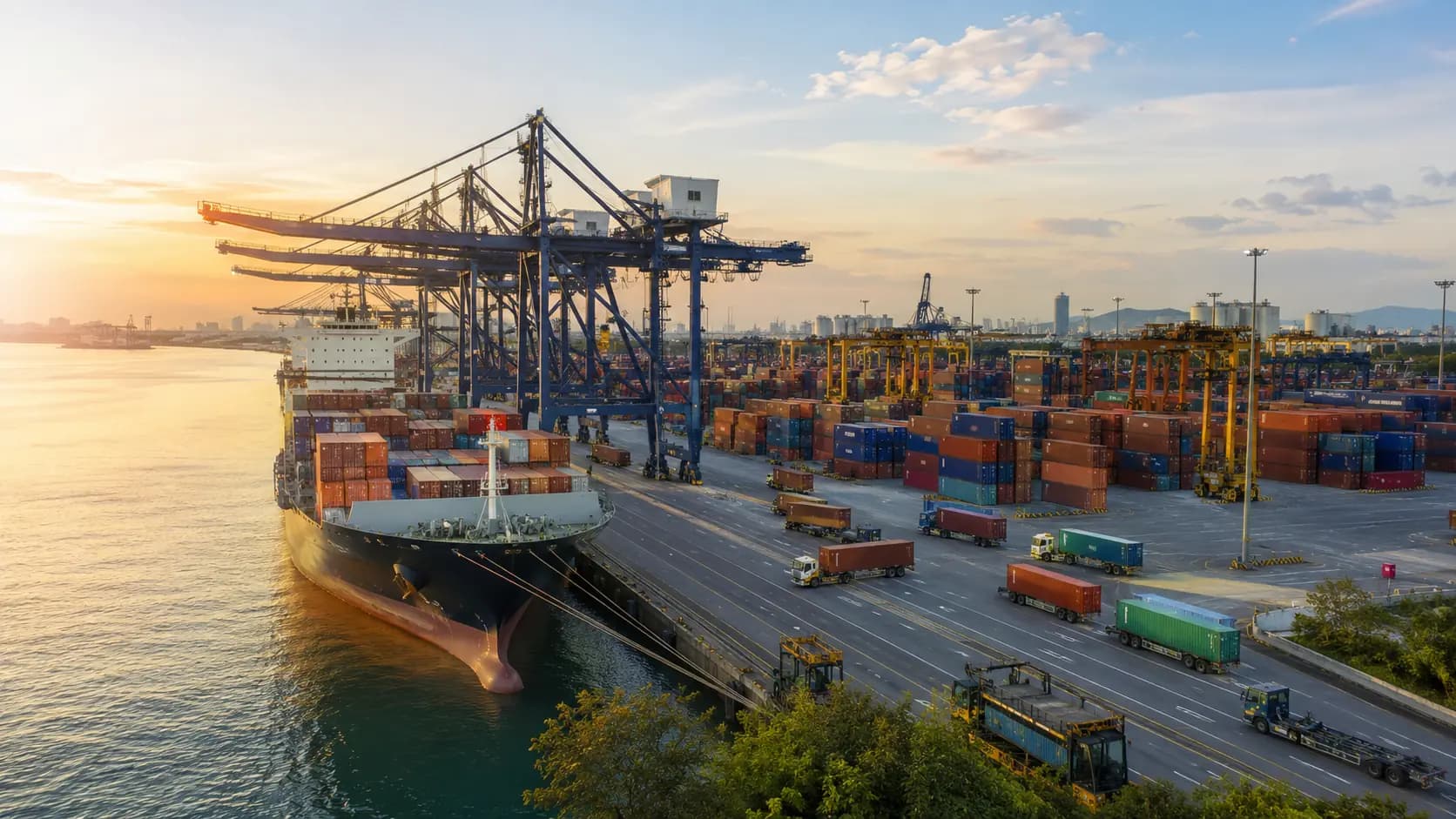
Sources, Methodology & Data Coverage
This page was built through direct verification against Thai government, BOI, trade-association, venue/organiser and official international-organisation sources wherever those sources could be opened and read as text.
Claims corroborated only via independent secondary reporting are labelled Cross-Verified rather than treated as primary; claims that met neither bar are omitted from the page rather than estimated. The full source register is grouped by topic below.
Primary-source verification
Government, BOI, customs and official venue/organiser pages opened and read directly wherever accessible.
Current-status verification
Time-sensitive claims — border-crossing status, FTA status, event dates — checked against the most recent available official or cross-verified reporting.
Source limitations
Statistics whose only source returned no extractable text are omitted from the page and documented here with the reason.
Research current as of 19 August 2026
Detailed source register
Infrastructure & transport statistics
Official link: https://www.nesdc.go.th/wordpress/wp-content/uploads/2025/09/logistics-2567-Full-Report-ENG-F.pdf (opens in a new tab)
Supports: Cost-structure component framework (transportation / warehousing / administrative)
Limitation: PDF returned no extractable text; cost-to-GDP percentage and baht figures are not published on this page.
Official link: https://www.port.co.th/ (opens in a new tab)
Supports: Seaport identity, role and operator information
Limitation: Detailed throughput (TEU/tonnage) pages returned no extractable data; specific 2025 figures are not published.
Official link: https://investor.airportthai.co.th/ar.html (opens in a new tab)
Supports: Airport identity and role information
Limitation: Traffic-statistics page returned no extractable data; the FY2025 group cargo figure used on this page is cross-verified via secondary financial reporting instead.
Official link: https://www.dlt.go.th/ (opens in a new tab)
Supports: General regulatory role description for road freight
Limitation: Live fleet-registration dashboard was not accessible as extractable data; the previously-published 2019 truck-count figure has been removed from the main page as outdated and is not republished as a current statistic.
Official link: https://www.railway.co.th/ (opens in a new tab)
Supports: Rail network and bimodal-terminal role description
Limitation: Public site returned no extractable freight-tonnage statistics; specific rail freight-volume figures are not published on this page.
Customs procedures
Official link: https://www.customs.go.th/ (opens in a new tab)
Supports: Customs Trader ID, National Single Window and general clearance process references
Limitation: Step-by-step procedural pages returned no extractable text; the import/export process walkthroughs on this page are a cross-verified synthesis from professional trade-advisory sources, not a verbatim reproduction of an official procedural page.
Tax and tariff information
Official link: https://www.rd.go.th/english/6044.html (opens in a new tab)
Supports: CIT rates, small-company thresholds, withholding-tax rates
Limitation: None — opened and read directly.
Official link: https://www.rd.go.th/english/6043.html (opens in a new tab)
Supports: VAT rate, registration threshold, zero-rating rules
Limitation: None — opened and read directly.
Official link: https://www.boi.go.th/un/guides (opens in a new tab)
Supports: Confirmation of the current incentive-tier restructuring (A1+/A1/A2-A4/B) and edition date
Limitation: Full activity-by-activity pages (covering the bulk of the document) were not retrievable in extractable-text form; specific logistics-activity conditions on this page instead come from BOI's separately-hosted activity list, cross-checked against current professional advisory sources, without asserting a specific current tier-letter code.
FTA status
Official link: https://www.efta.int/trade-relations/free-trade-network/thailand (opens in a new tab)
Supports: EFTA-Thailand FTA conclusion and signature dates
Limitation: None — opened and read directly.
Official link: https://aric.adb.org/fta (opens in a new tab)
Supports: Effective dates for the Thailand–Chile and Thailand–Peru agreements, and the scope of Thailand–India arrangements
Limitation: Cross-verified via multiple independent sources rather than a single government database opened directly.
Official link: https://www.dtn.go.th/en (opens in a new tab)
Supports: Reference for ongoing negotiation status
Limitation: DTN's own dedicated status pages for these specific negotiations were not directly opened; status is cross-verified via Thai national press and Bhutan's National Assembly.
Events and associations
Official link: https://www.bitec.co.th/event/tilog-logistix-2026 (opens in a new tab)
Supports: Confirmed dates (19–21 August 2026) and venue
Limitation: None — opened and read directly.
Official link: https://www.bitec.co.th/event/cold-chain-exhibition-2026 (opens in a new tab)
Supports: Confirmed dates (1–3 July 2026, already concluded) and venue
Limitation: None — opened and read directly.
Official link: https://www.propakasia.com/ppka/2026/en/index.asp (opens in a new tab)
Supports: Venue move to IMPACT Muang Thong Thani and confirmation of a dedicated Coldchain/Logistics/Warehousing/Factory Asia zone
Limitation: The event's specific 2026 dates were displayed only as an image on the organiser's site and could not be confirmed as extractable text; no specific date is published on this page as a result.
Official link: https://www.thaishipowners.com/ (opens in a new tab)
Supports: Maritime shipping and ship-agent association listing
Limitation: None — opened and read directly.
Official link: https://www.ttla.or.th/ (opens in a new tab)
Supports: Warehousing and logistics-provider association listing
Limitation: Site content is Thai-language; English translation not independently verified beyond the association's stated scope.
Official link: https://pscmt.or.th/ (opens in a new tab)
Supports: Supply-chain and procurement professionals association listing, including its IFPSM membership
Limitation: None — opened and read directly.
Explore Thailand's Logistics Opportunity
This information is provided for general orientation only and does not constitute tax, legal, customs or other professional advice. Tax rates, thresholds and procedures can change, and their application depends on each business's specific facts. Businesses should confirm current requirements directly with the Revenue Department, Thai Customs Department, or a licensed Thai tax advisor, auditor or customs broker before making investment or compliance decisions.