T3 Business Gateway — Seafood
Thailand Seafood Industry Gateway
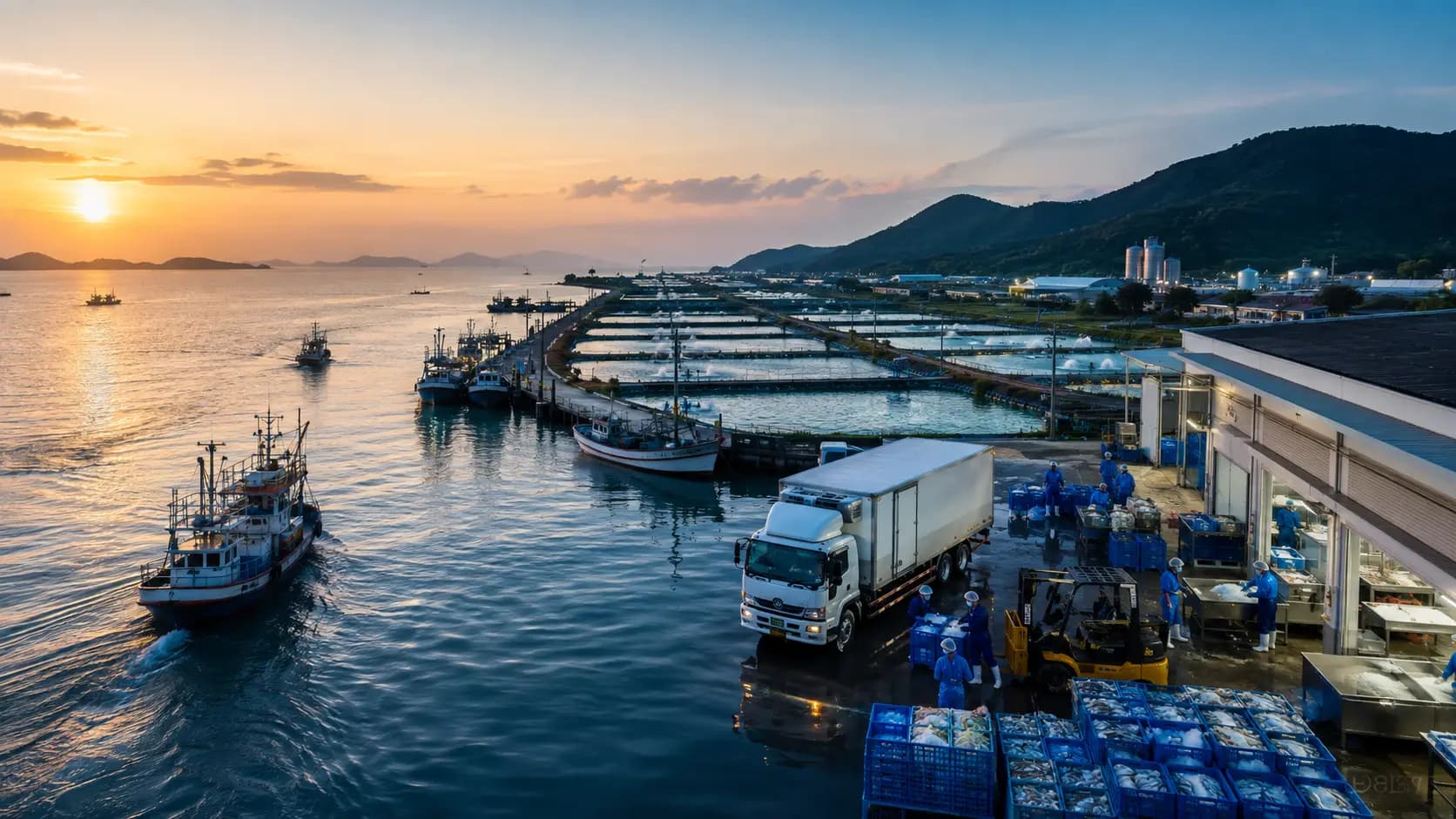
A century-old fishing tradition built into one of the world's most globally connected seafood processing and export industries — from Gulf of Thailand and Andaman Sea catch and Gulf-coast shrimp farms to canned-tuna lines that reach tables in over 100 countries.
Seafood Industry Overview
Thailand's seafood industry connects Gulf of Thailand and Andaman Sea capture fisheries, a fast-growing aquaculture sector led by farmed shrimp, and a globally competitive processing and export base built around canned tuna and frozen shrimp. All three subsectors sit inside a regulatory framework rebuilt since 2015 to prevent illegal, unreported and unregulated (IUU) fishing.
A Top-Tier Global Exporter
Thailand ranked among the world's leading fish and fishery product exporters in 2024, built on decades of processing expertise in canned tuna, frozen shrimp, and value-added seafood.
Canned Tuna's World Capital
Thailand is one of the largest canned-tuna processing bases on earth, exporting 415,703 tonnes worth roughly USD 1.9 billion in 2023 alone — led by processors such as Thai Union and Sea Value.
Shrimp: Farm to Export Leader
Marine shrimp is Thailand's single highest-value aquaculture product, with a mature farm-to-processor-to-export pipeline centred on Samut Sakhon and Gulf-coast provinces.
Three Interlocking Subsectors
Capture fisheries (marine and inland), aquaculture, and downstream processing/export together form an integrated value chain regulated for both food-safety and sustainability compliance.
Certified for Demanding Markets
Thai processors widely hold GMP, HACCP, ISO 22000, BRCGS, ASC, BAP and Halal certification, supporting continuous access to the United States, Japan, EU, and Middle East markets.
IUU-Compliant, Traceable Supply
Since reforming its fisheries law in 2015, Thailand operates a vessel-monitoring, licensing, and port-state-control system built to prevent illegal, unreported and unregulated (IUU) fishing.
The Seafood Value Chain
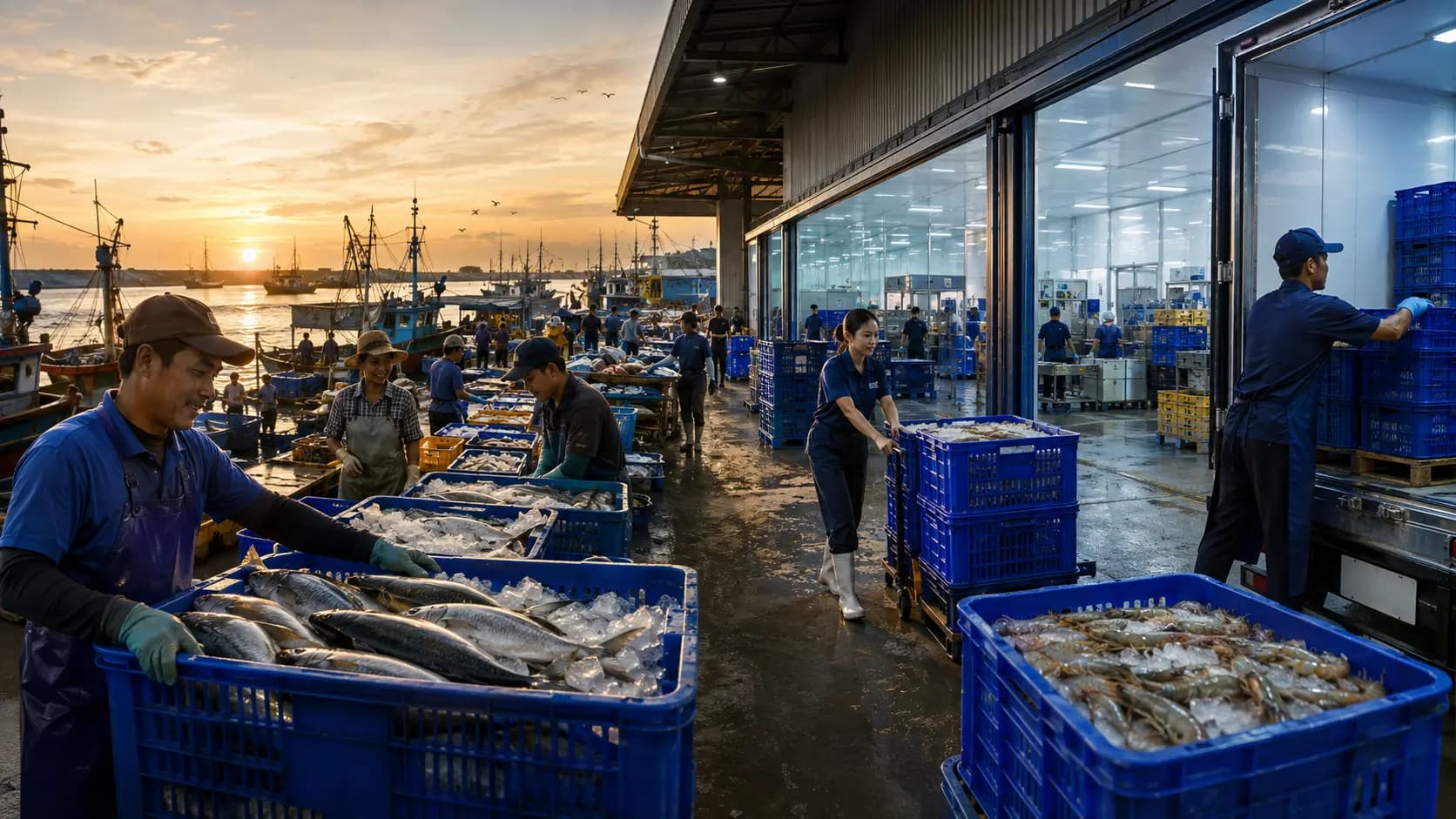
Thailand's fisheries supply chain runs through three linked stages: upstream production (marine and inland capture fisheries plus aquaculture, including imported raw material), midstream handling (fish-landing ports, wholesale markets, and processing plants), and downstream distribution (domestic consumption and export). Each stage is covered in its own section below.
Key Verified Indicators
Every figure below is drawn from the Department of Fisheries Thailand's 2023/2024 statistical reporting, republished with full citations by SEAFDEC and opened directly in this research pass.
| Metric | Value | Period | Status |
|---|---|---|---|
| Fisheries share of GDP | 2.3% | 2023 | Actual |
| Per-capita fish and seafood consumption | 36.45 kg/person/year | 2023 | Actual |
| Marine capture fisheries production | 1.35 million tonnes | 2023 | Actual |
| Aquaculture production (5-year average) | ~993,000 tonnes/year | 2019–2023 average | Actual |
| Marine shrimp aquaculture production | 392,470 tonnes, valued at approximately USD 1.65 billion | 2023 | Actual |
| Canned tuna exports | 415,703 tonnes, valued at approximately USD 1.91 billion | 2023 | Actual |
| Fresh & frozen shrimp exports | 79,813 tonnes, valued at approximately USD 691 million | 2023 | Actual |
| Total fish and fishery product export value to top market (USA) | USD 12.34 billion combined trade value across all Thai exports to the USA in the fisheries dataset ranking; USA is the top single destination by both quantity and value | 2023 | Actual |
| Licensed fishing vessels | 54,692 vessels (45,799 artisanal, 8,893 commercial) | 2023 | Actual |
| Thailand's global rank among fish exporters | Ranked among the top exporting nations, cited as 7th-largest by one industry tracker with an export value of approximately USD 5.9 billion | 2024 | Actual |
Source: SEAFDEC Fisheries Country Profile: Thailand, citing Office of the National Economic and Social Development Council (opens in a new tab) · Official dataset — opened. Figure covers fisheries' direct contribution to national GDP.
Source: SEAFDEC Fisheries Country Profile: Thailand, citing Department of Fisheries Thailand (opens in a new tab) · Official dataset — opened.
Source: SEAFDEC Fisheries Country Profile: Thailand, citing Department of Fisheries Thailand (2024) (opens in a new tab) · Official dataset — opened. Recovered slightly from a low of 1.28 million tonnes in 2022.
Capture Fisheries — Marine and Inland
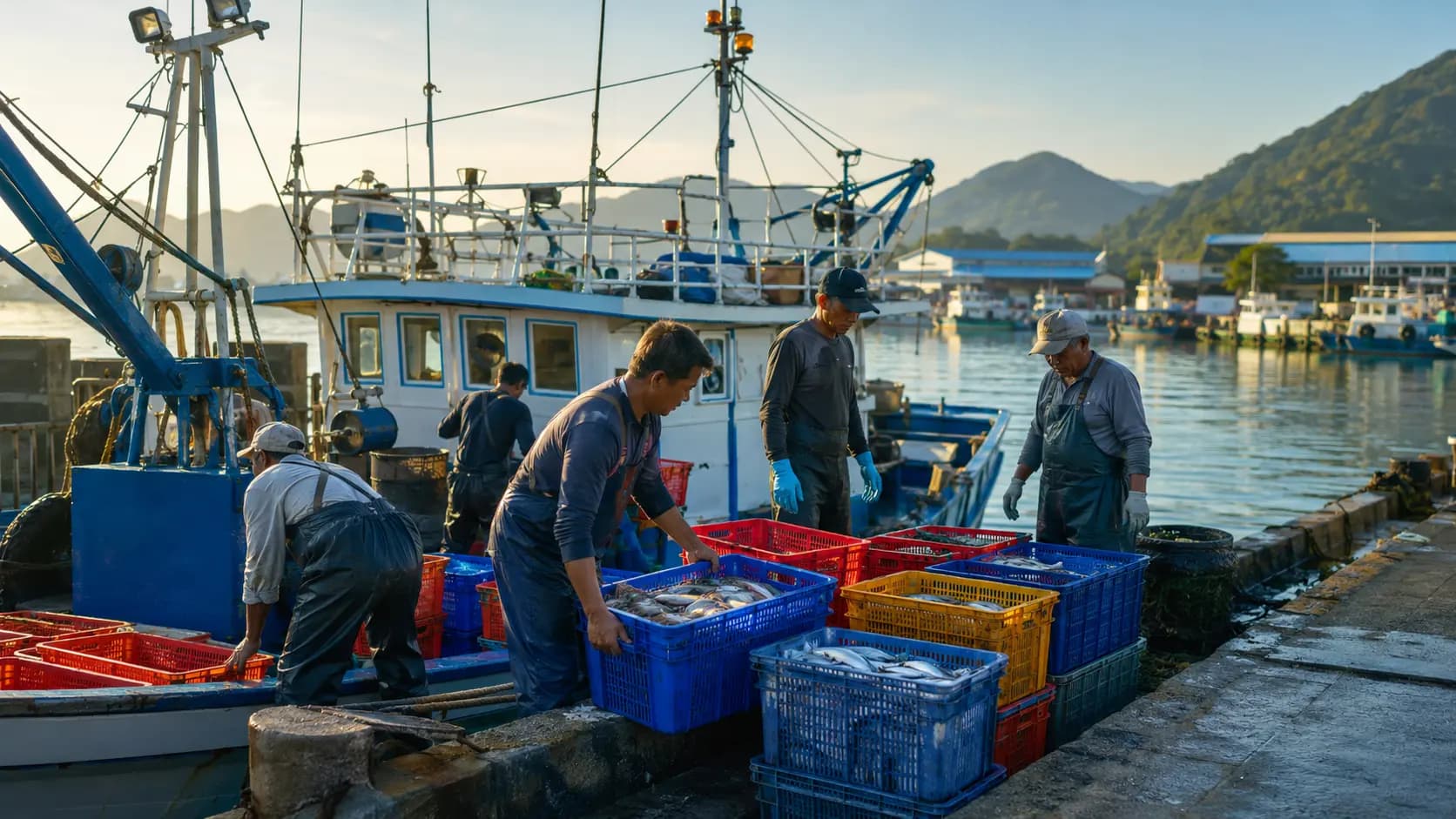
Thailand's marine capture fisheries operate across two main grounds: the Gulf of Thailand (≈304,000 km²), fed by the Chao Phraya, Mae Klong, Tha Chin and Bang Pakong rivers, and the Andaman Sea (≈116,280 km²), with deeper-water and coral-reef ecosystems. Vessels are legally divided into commercial (over 10 GT, offshore) and artisanal (under 10 GT or unpowered, coastal) categories. By quantity, trash fish, anchovy and demersal fish lead the marine catch; by value, squid (≈USD 336 million from 62,594 t) and blue swimming crab (≈USD 243 million) are the two highest-value species. Inland capture fisheries — rivers, canals, reservoirs and ponds — add barb, Nile tilapia and Siamese mud carp as the leading species. Thailand also holds fishing rights in the Indian Ocean as a member of the Indian Ocean Tuna Commission (IOTC, joined 1997) and the Southern Indian Ocean Fisheries Agreement (SIOFA, joined 2017).
Aquaculture — Thailand's Fastest-Growing Supply Source
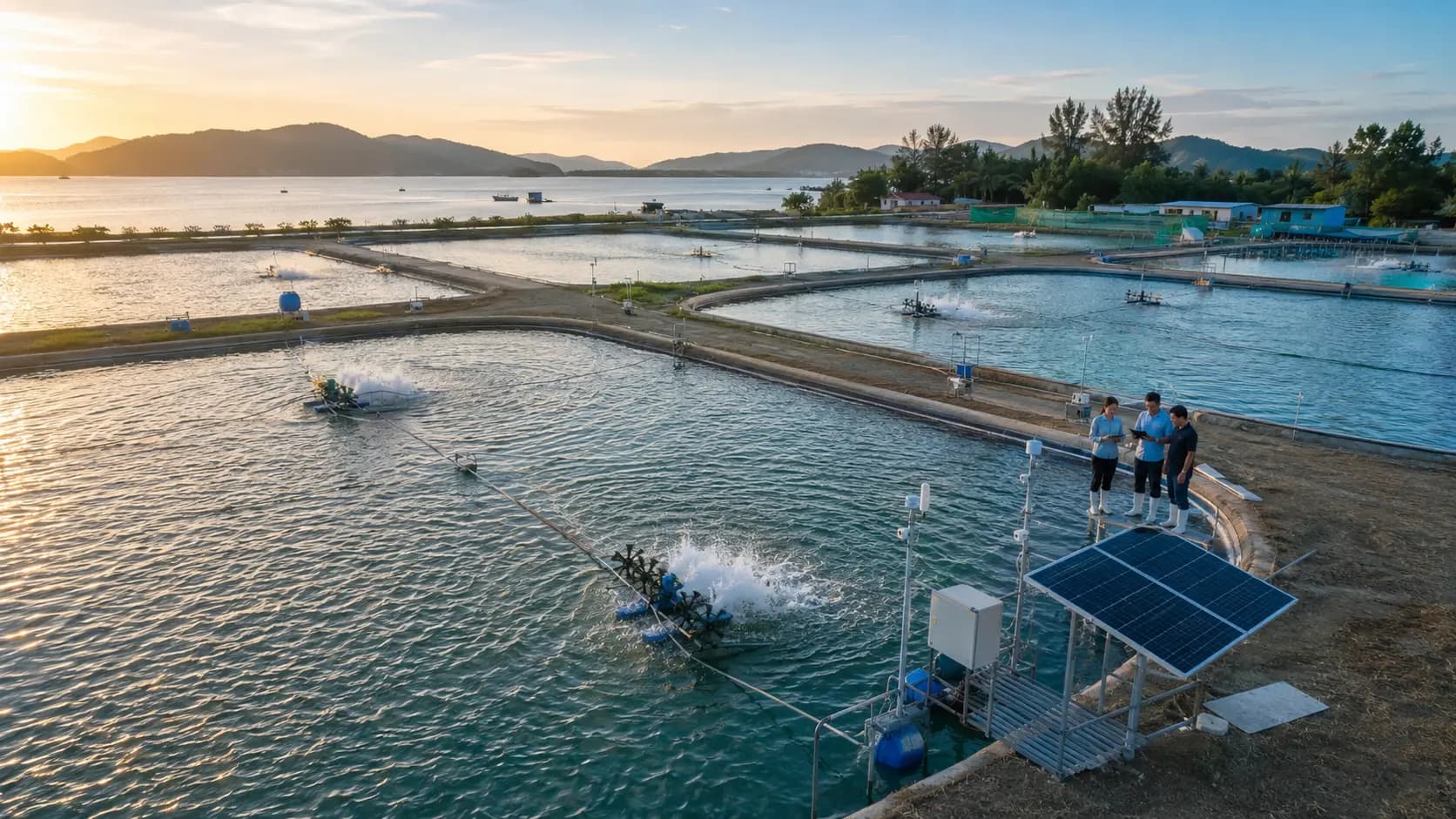
Aquaculture has grown into a critical supplement to declining wild catch, averaging roughly 993,000 tonnes a year from 2019–2023 and consistently generating the highest total value of Thailand's three fishery subsectors (USD 2.80–3.19 billion across the period). Marine shrimp — principally farmed whiteleg shrimp (Litopenaeus vannamei) — is the leading aquaculture product by both volume (392,470 t in 2023) and value (≈USD 1.65 billion), followed by Nile tilapia, giant freshwater prawn, seabass, and catfish. Major integrated players such as Charoen Pokphand Foods (CPF) operate their own shrimp-fry breeding, biosecure hatcheries, and demonstration farms, transferring husbandry technology to independent farmers across Thailand and neighbouring countries.
Processing and Export — From Cold Chain to Container
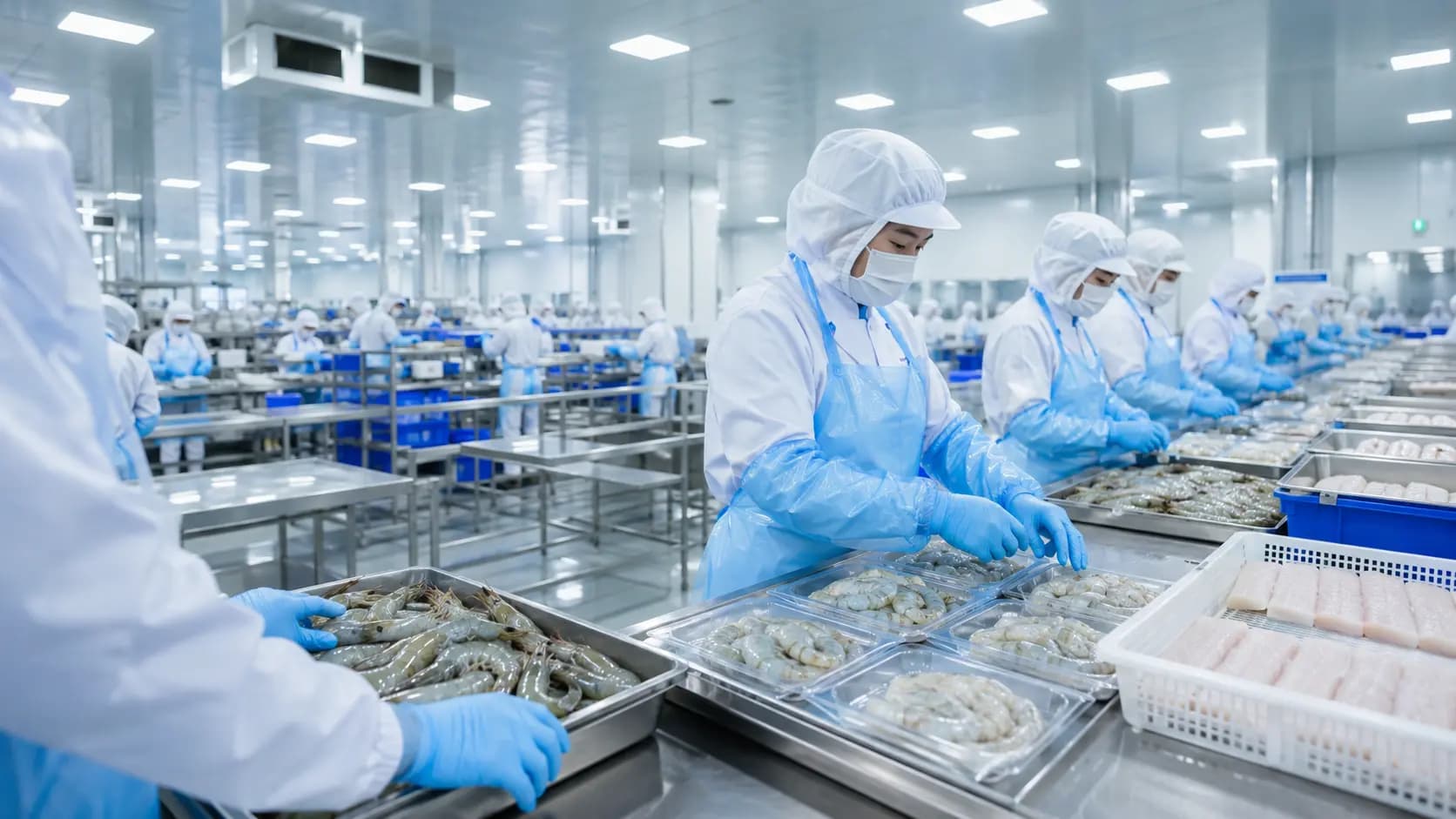
Midstream and downstream, Thailand's fisheries supply chain runs through fish-landing ports, wholesale markets, and processing plants that convert catch and farmed product into canned, frozen, and value-added export goods. Canned tuna is the flagship product — 415,703 t worth roughly USD 1.91 billion in 2023 — produced by processors including Thai Union Group, Sea Value PLC (I.S.A Value and Unicord), and others clustered around Samut Sakhon's deep-water port access and cold-chain infrastructure. Frozen and processed shrimp, canned pet food, canned sardine, and processed cephalopod products round out the export basket. Export and import control procedures administered by the Department of Fisheries are designed to confirm that products are free of IUU-sourced material and meet destination-market food-safety requirements before shipment.
Verified Trade Statistics
Export and import figures for Thailand's three highest-value fishery product groups, each with the exact reporting year, currency, and source citation.
Canned Tuna
HS 1604.14Prepared or preserved tunas, skipjack and bonito (whole or in pieces, but not minced)
- Reporting year
- 2023
- Value
- ≈ USD 1.91 billion
- Volume
- 415,703 t
Scope note: Figures reflect Department of Fisheries Thailand's fishery-product export classification ('Canned tuna'), which may group slightly differently than a strict single HS subheading; shown as reported by the source.
| Country | Value | Volume |
|---|---|---|
| United States | USD 12.34 billion | 217,055 t |
| Japan | USD 11.05 billion | 189,578 t |
| China | USD 6.53 billion | 198,196 t |
| Australia | USD 3.12 billion | 62,172 t |
| Canada | USD 1.96 billion | 35,242 t |
Fresh & Frozen and Processed Shrimp
HS 0306 / 1605.21Frozen/fresh crustaceans (0306) and prepared or preserved shrimps and prawns (1605.21)
- Reporting year
- 2023
- Value
- Fresh & frozen shrimp ≈ USD 690.8 million; Processed shrimp products ≈ USD 578.5 million (combined ≈ USD 1.27 billion)
- Volume
- Fresh & frozen 79,813 t; Processed 53,541 t (combined 133,354 t)
Scope note: Combines Department of Fisheries Thailand's two reported categories, 'Fresh & frozen shrimp' and 'Processed shrimp products,' shown separately below.
| Country | Value | Volume |
|---|---|---|
| United States | USD 12.34 billion | 217,055 t |
| Japan | USD 11.05 billion | 189,578 t |
| China | USD 6.53 billion | 198,196 t |
Fresh & Frozen Tuna (raw material import)
HS 0303Frozen fish (fresh & frozen tuna, as reported by Department of Fisheries Thailand)
- Reporting year
- 2023
- Value
- ≈ USD 1.31 billion
- Volume
- 692,879 t
Scope note: This is an import, not an export — raw-material tuna brought in for Thailand's canning industry, which imports more tuna than it catches domestically.
| Country | Value | Volume |
|---|---|---|
| China | USD 417.1 million | 185,807 t |
| India | USD 353.3 million | 168,584 t |
| Norway | USD 316.0 million | 43,305 t |
| Viet Nam | USD 278.5 million | 109,928 t |
| Myanmar | USD 173.9 million | 248,967 t |
Cold Chain & Export Logistics
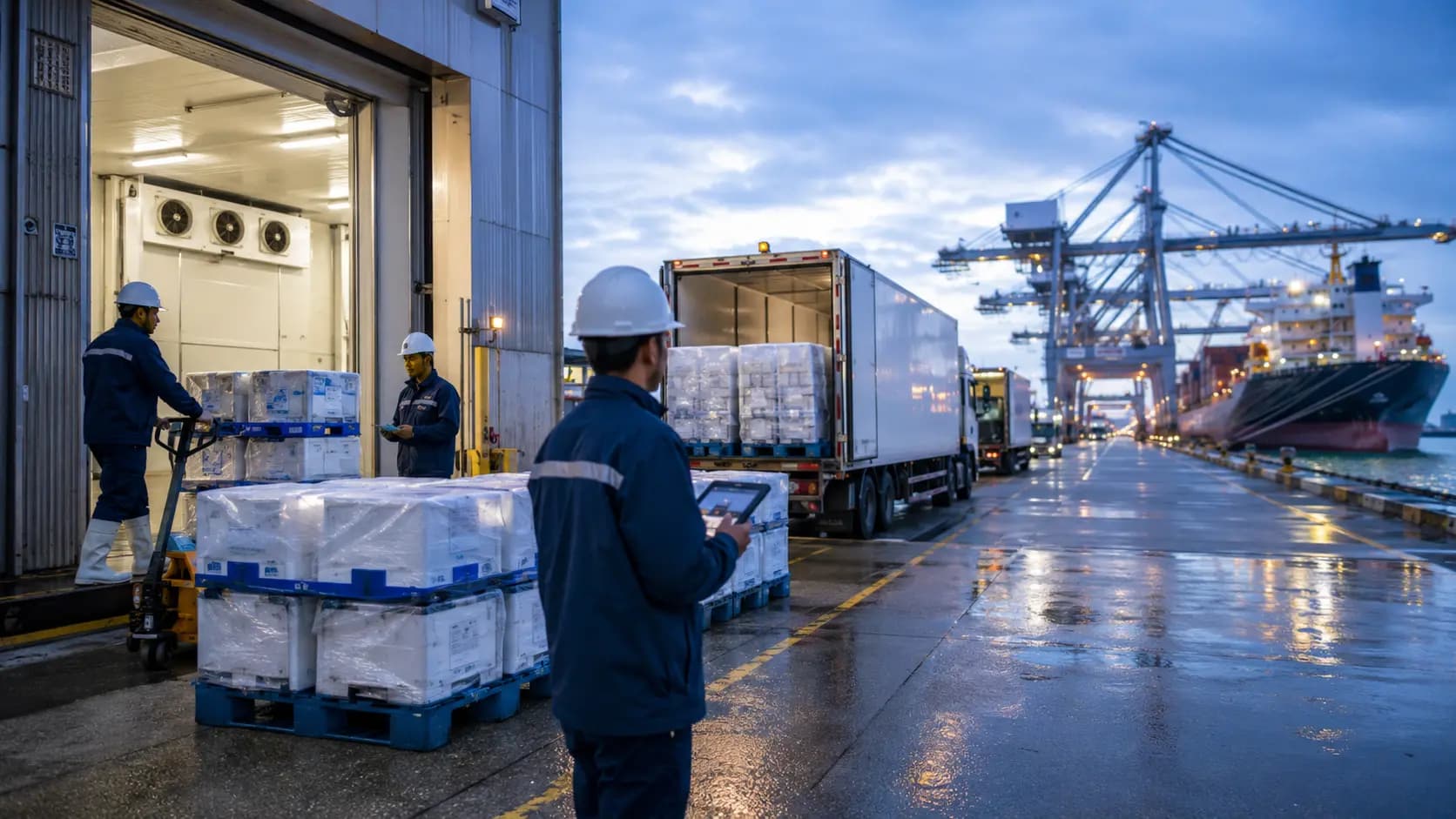
Thailand's seafood export industry depends on an unbroken cold chain from landing site or farm through processing to port — large-scale cold-storage capacity is concentrated around Samut Sakhon (Mahachai), close to Bangkok and Laem Chabang port infrastructure. Thai Royal Frozen Food's own facility, for example, operates 10,000 metric tons of cold-storage capacity on its Mahachai site. Export and import control procedures administered by the Department of Fisheries verify traceability and IUU-free sourcing before shipment.
Regulatory, Legal & IUU Compliance Framework
Seven bodies and legal instruments that together govern Thailand's fisheries and seafood-export sector.
DOF manages and promotes fishery production, aquaculture quality, and compliance with Thai and international standards, and leads monitoring, control and surveillance of fishing activity to prevent, deter and eliminate IUU fishing — coordinating with the Thai Maritime Enforcement Command Center (Thai-MECC), Royal Thai Navy, Marine Department, Marine Police Division, and Department of Labour Protection and Welfare. DOF also publishes Thailand's official fishery production and trade statistics, the primary data source used throughout this page.
Source: SEAFDEC Fisheries Country Profile: Thailand (opens in a new tab) · Official dataset — opened
DMCR conserves, restores and manages marine and coastal resources and promotes awareness of environmental management, supporting fisheries sustainability alongside DOF's production-focused mandate.
Source: SEAFDEC Fisheries Country Profile: Thailand (opens in a new tab) · Official dataset — opened
Enacted to prevent IUU fishing, ensure sustainable use of aquatic resources, and protect small-scale and local fishing communities, the Ordinance requires ecosystem-based, precautionary fisheries management and comprehensive data collection. It underpins Thailand's compliance with international obligations including the FAO Agreement on Port State Measures (PSMA). Related instruments include the Ministerial Regulation on Coastal Sea Zones B.E. 2565 (2022), the Navigation in the Thai Waters Act B.E. 2560 (2017), the Marine and Coastal Resources Management Promotion Act B.E. 2558 (2015), and the Labour Protection in Fishing Work Act B.E. 2562 (2019).
Source: SEAFDEC Fisheries Country Profile: Thailand (opens in a new tab) · Official dataset — opened
ACFS develops Thai Agricultural Standards (TAS) and coordinates food-safety compliance across the agricultural and fishery value chain, supporting exporters in meeting destination-market requirements.
Source: ACFS official site (fetch attempted; page did not return readable content in this pass) (opens in a new tab) · Search-verified
DITP, operating since 1952 under the Ministry of Commerce, runs 58 Thai Trade Centres worldwide and supports Thai exporters — including seafood processors — in market access, trade-lead generation, and international buyer matching.
Source: DITP official site (opens in a new tab) · Search-verified
BOI administers Thailand's investment-incentive framework, including corporate income tax exemptions for eligible activities under its Agriculture and Agro-Industry / food-processing categories, which cover modern food processing, cold-chain, and value-added seafood production. See the Investment Incentives section below for what could and could not be independently confirmed for seafood-specific activities in this pass.
Source: BOI official site (opens in a new tab) · Search-verified
Thai-MECC coordinates with DOF, the Royal Thai Navy, Marine Department and Marine Police Division on monitoring, control and surveillance (MCS) of fishing vessels. Thailand participates in the ASEAN Network for Combating IUU Fishing (AN-IUU) and the Regional Plan of Action to Prevent, Deter and Eliminate IUU Fishing (RPOA-IUU), and has signed the FAO Agreement on Port State Measures (PSMA).
Source: SEAFDEC Fisheries Country Profile: Thailand (opens in a new tab) · Official dataset — opened
Investment Incentives and Government Support
Thailand's Board of Investment (BOI) promotes food processing — including seafood canning, freezing, and value-added product manufacturing — under its Agriculture and Agro-Industry incentive categories, alongside the general refreshed measures BOI announced for 2026–2027. A seafood-specific activity code or tier could not be independently opened and confirmed against the official BOI guide in this research pass (the BOI site's relevant pages returned empty or JS-rendered content on direct fetch); the summary below is Search-verified across multiple independent secondary sources and should be confirmed directly with BOI or a licensed investment adviser before any promotion application.
General framework refreshed for 2026–2027
BOI announced a refreshed set of investment promotion measures effective from the first working day of 2026 through the last working day of 2027, replacing programmes that expired in 2025 — applicable across eligible manufacturing activities including modern food processing.
Technology and innovation-tiered CIT exemptions
The 2026 framework ties corporate income tax (CIT) exemptions to technology and innovation tiers (A1+ through A4), with exemption periods reported up to 13 years in total for the highest tiers — exact eligibility depends on the specific activity and application.
Confirm seafood-specific eligibility directly with BOI
Because this page's research pass could not independently open a seafood-specific BOI activity listing, any investor should verify current activity codes, minimum capital requirements, and CIT/import-duty terms directly at boi.go.th or through the BOI One Start One Stop Investment Center before proceeding.
Confirm current BOI activity codes, capital requirements, and incentive tiers directly at boi.go.th before proceeding with any application.
Standards & Certifications
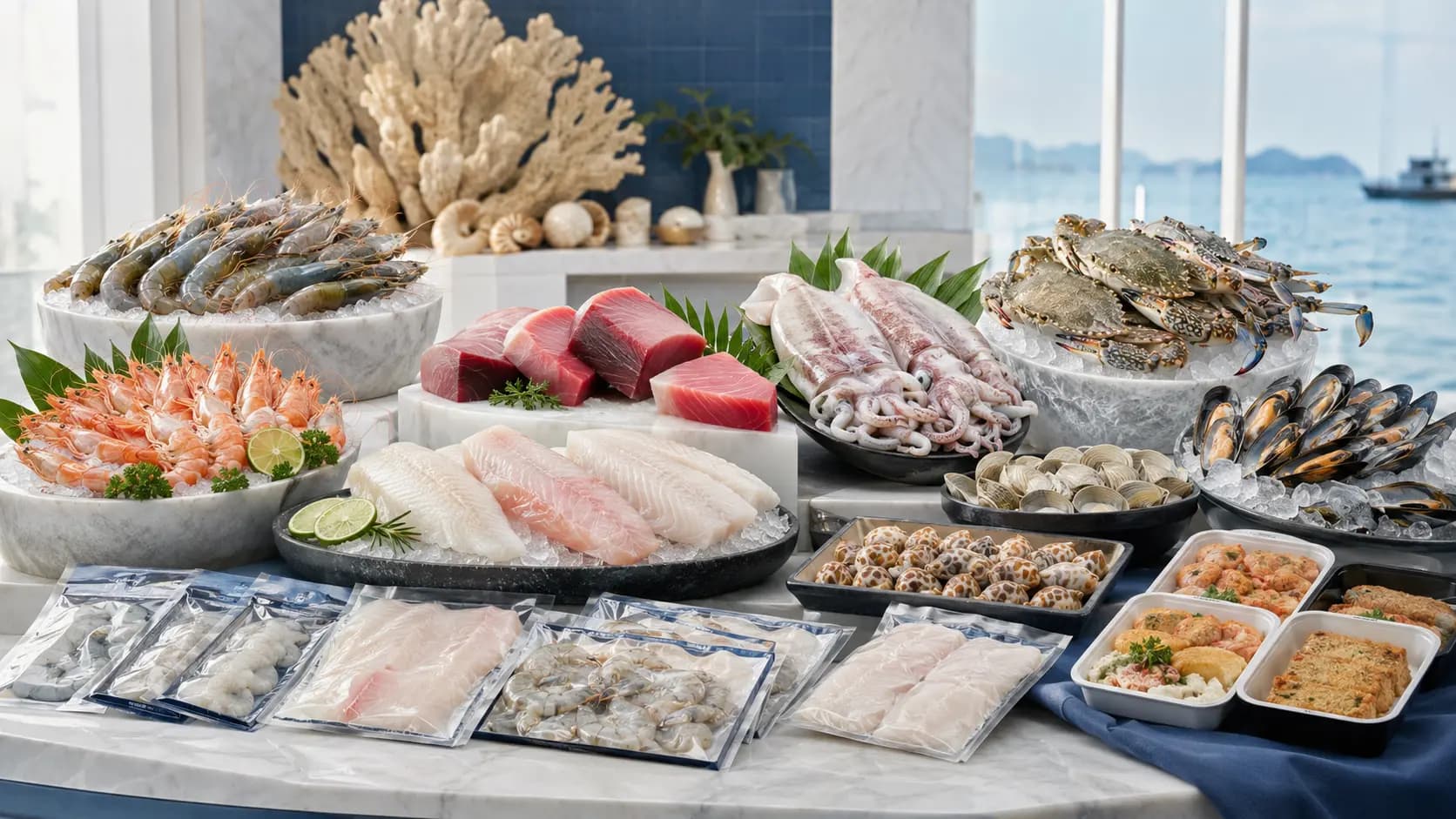
Thai seafood processors widely hold internationally recognised food-safety and sustainability certifications, supporting continuous access to demanding export markets.
HACCP & GMP
Hazard Analysis and Critical Control Points and Good Manufacturing Practice certification are baseline requirements widely held across Thai seafood processing plants, confirmed directly on multiple processors' own certification listings (e.g. Thai Royal Frozen Food).
ISO 22000 & ISO/IEC 17025
Food-safety management systems (ISO 22000) and laboratory-accreditation standards (ISO/IEC 17025) are held by leading exporters for both production and in-house quality-testing laboratories.
BRCGS, ASC & BAP
British Retail Consortium Global Standards (BRCGS), Aquaculture Stewardship Council (ASC) and Best Aquaculture Practices (BAP) certifications support access to European and North American retail and foodservice buyers requiring third-party sustainability and safety audits.
Halal Certification
Halal-certified seafood processing lines position Thai exporters to serve Muslim-majority markets across the Middle East, ASEAN, and beyond — consistent with Thailand's broader Halal-food-industry positioning.

Traceability, Sustainability & IUU Compliance
Following the Royal Ordinance on Fisheries B.E. 2558 (2015), Thailand rebuilt its fisheries governance around vessel monitoring systems (VMS), licensing, port-in/port-out control, and catch documentation designed to prevent illegal, unreported and unregulated (IUU) fishing. Thailand participates in the ASEAN Network for Combating IUU Fishing (AN-IUU), the Regional Plan of Action to Prevent, Deter and Eliminate IUU Fishing (RPOA-IUU), and has signed the FAO Agreement on Port State Measures. At the company level, processors and farms widely pursue third-party sustainability certification — ASC and BAP for aquaculture, and membership in bodies such as the International Seafood Sustainability Foundation (ISSF) for tuna sourcing — alongside labour and ethical-trading policies covering vessel crews and factory workers.
Companies & Supplier Landscape
A representative sample of verified processors, exporters, and integrated aquaculture producers — not an exhaustive industry census.
Processing & Export — Multinational
Thai Union Group PCL
One of the world's largest seafood companies, headquartered in Samut Sakhon, with global tuna, ambient seafood and pet-care brands including Chicken of the Sea and John West.
- Verification:
- Search-verified — official site returned no readable content on direct fetch in this pass (JS-rendered); identity and HQ location cross-matched across independent sources.
Search-verified.
Processing & Export — Tuna
Sea Value PLC
Holding company for I.S.A Value Co., Ltd. and Unicord PLC
Founded 2004 as a holding company for two established tuna processors; Unicord (est. 1980) and I.S.A Value together produce canned, pouch and frozen tuna products under more than 350 brand names for customers worldwide.
- Head office:
- 39/3 Moo 8, Setthakij 1 Road, Tha Sai, Mueang Samut Sakhon, Samut Sakhon 74000, Thailand
- Phone:
- +66 (0) 3442 4437–42
- Email:
- info@seavaluegroup.com
Primary — opened directly, 18 August 2026.
Processing & Export — Shrimp
Thai Royal Frozen Food Co., Ltd.
Family-owned processor established 1980, among the pioneers of farm-raised shrimp processing and export; 12-acre Mahachai (Samut Sakhon) facility with 10,000-metric-ton cold storage capacity and six value-added production lines. Certified GMP, HACCP, ISO 22000, ISO/IEC 17025, ISO 45001, Halal, BRCGS, BAP, ASC and Carbon Footprint for Organization.
- Address:
- 119/99 Moo 1 Vichienchodok Road, Tambon Tachin, Mueang Samut Sakhon, Samut Sakhon 74000, Thailand
- Phone:
- +66 34 423302 (auto 10 lines)
- Email:
- sales@thairoyalfrozen.com
Primary — opened directly, 18 August 2026.
Aquaculture — Integrated Producer
Charoen Pokphand Foods PCL (CPF) — Aquaculture Farming
Integrated agro-industrial and food group operating shrimp-fry and fish-fry breeding (including its own Vannamei whiteleg-shrimp breed), biosecure commercial shrimp and fish farms, and aquaculture feed production, with technology transferred to independent farmers in Thailand, India, Vietnam, China, Malaysia and the Philippines.
- Head office:
- C.P. Tower, 313 Silom Road, Bangrak, Bangkok 10500, Thailand
- Phone:
- +66 (0) 2766 8000
- Email:
- consumercenter@cpf.co.th
Primary — opened directly, 18 August 2026.
Processing & Export
Asian Sea Corporation
Thai seafood processor and exporter verified via direct fetch of its official site during this research pass.
Official website (opens in a new tab)Primary — opened directly.
Trading & Sourcing
Siam Canadian Group
Seafood trading and sourcing company connecting Thai and regional seafood producers with international buyers, verified via direct fetch of its official site during this research pass.
Official website (opens in a new tab)Primary — opened directly.
Associations & Trade Bodies
Verified associations, chambers, federations, business councils and government bodies connected to Seafood in Thailand.
- Government Agency
Thailand Board of Investment
BOI
Thailand's national investment-promotion agency — grants tax and non-tax incentives for promoted activities and coordinates investor support through offices across Asia, Europe, Australia and the US.
- IT & AI
- Textiles
- Food, Beverage & FMCG
- Rubber & Raw Materials
- Energy & Renewable Energy
- Cosmetics
- Seafood
- Gems, Jewellery & Precious Stones
- Packaging, Printing & Labelling
- Furniture, Wood & Interior Products
- Electrical, Electronics & Semiconductors
- Halal Economy
- Education
- Real Estate / Living
- Spa, Wellness & Beauty Services
- Logistics
- Trade Services
- Manufacturing
- Professional & Business Services
- Healthcare
- Government Agency
Department of International Trade Promotion
DITP
Thailand's export-promotion agency — runs Thai Trade Centers worldwide, trade fairs and market-development programs for Thai exporters.
- Government Agency
Department of Fisheries
DOF
Lead national fisheries authority; manages production, aquaculture, IUU-fishing prevention, and publishes Thailand's official fishery statistics.
- Government Agency
National Bureau of Agricultural Commodity and Food Standards
ACFS
Sets and enforces Thai Agricultural Standards (TAS) covering food-safety and quality compliance across agriculture and fisheries.
- Research Institution
Southeast Asian Fisheries Development Center
SEAFDEC
Intergovernmental fisheries research and development body founded in 1967, with Thailand as a founding member and host of its Secretariat (Bangkok) and Training Department (Samut Prakan).
- Industry Association
Thai Frozen Foods Association
TFFA
Represents Thailand's frozen food manufacturing and export industry; originally founded in 1968 as the Thai Aquatic Animal Traders Association.
- Industry Association
Thai Tuna Industry Association
TTIA
Represents Thailand's tuna processing and export industry — one of the world's largest tuna processing hubs.
- Industry Association
Thai Shrimp Association
Represents Thailand's shrimp farming and processing industry. No dedicated official website was located during research; the association maintains an active Facebook presence.
Provinces & Production Clusters
Thailand's seafood industry clusters around one dominant processing hub and two distinct coastal fishing zones.
Samut Sakhon (Mahachai)
Thailand's principal seafood processing and cold-storage hub, roughly an hour south of Bangkok — home to Sea Value's head office and Thai Royal Frozen Food's 12-acre processing and cold-storage facility, among many others.
Gulf of Thailand Coastal Provinces
Trat, Chanthaburi, Rayong, Chon Buri, Chachoengsao, Samut Prakan, Bangkok, Samut Songkhram, Phetchaburi, Prachuap Khiri Khan, Chumphon, Surat Thani, Nakhon Si Thammarat and Songkhla form the Gulf-side coastal fisheries zone recognised in DOF's 2022 coastal-sea-zone regulation.
Andaman Sea Coastal Provinces
Pattani, Narathiwat, Ranong, Phang Nga, Phuket, Krabi, Trang and Satun make up the Andaman-side coastal fisheries zone, with deeper-water and reef-adjacent fishing grounds distinct from the Gulf of Thailand.
Trade Shows & Exhibitions
THAIFEX – Anuga Asia (Seafood)
Asia's largest food and beverage trade show includes a dedicated seafood zone connecting Thai processors and exporters with international buyers. The official event site's live banner confirms the next edition after the 2026 show (whose exhibitor list and post-show report are already published) is dated 25–29 May 2027.
Location: IMPACT Muang Thong Thani, Bangkok
Official event website (official resource, opens in a new tab)Search results and some secondary listings (e.g. event aggregators) still show a 26–30 May 2026 date; the official site itself, opened directly, displays 2026 as already concluded (exhibitor list and post-show report live) with 25–29 May 2027 as the current upcoming edition. The primary source date is used here.
Seafood Expo Asia
A major regional seafood trade event that Thai exporters attend to reach Southeast Asian and international buyers. This event is hosted in Singapore, not Thailand, and is listed here for context on where Thai seafood companies engage internationally rather than as a Thailand-hosted event.
Location: Sands Expo & Convention Centre, Singapore
Official event website (official resource, opens in a new tab)Explore More of Thailand with T3
Agriculture Industry Gateway
Explore Thailand's broader agricultural production and export ecosystem.
Automotive Industry Gateway
Explore Thailand's vehicle manufacturing, parts, and supplier ecosystem.
EV & Future Mobility Gateway
Explore Thailand's battery-electric vehicle and next-generation mobility ecosystem.
Sources, Methodology & Data Coverage
This page draws on official government data, an intergovernmental fisheries dataset, and direct verification of company and association websites. Every figure is labelled with the tier of evidence behind it — figures that could not be verified to a citable source were left out rather than estimated.
Primary dataset: SEAFDEC's Fisheries Country Profile: Thailand
Most production, trade, and vessel statistics on this page come from the Southeast Asian Fisheries Development Center's 2025-updated country profile, which republishes Department of Fisheries Thailand's own 2023/2024 reports with full source citations — opened directly in this research pass.
Company and association verification
Company and association directory entries were verified by opening each organisation's own website directly where possible (Sea Value, Thai Royal Frozen Food, CPF, Thai Frozen Foods Association, Thai Tuna Industry Association, Asian Sea Corporation, Siam Canadian, SEAFDEC). Where a direct fetch failed (Thai Union, ACFS, and the Department of Fisheries' own site all returned unreadable or empty content, likely due to JavaScript-rendered pages), entries are marked Search-verified rather than Primary.
Conflicts disclosed, not resolved by guesswork
Where sources disagreed — most notably on 2024 shrimp production figures — this page uses only the figure confirmed in an official dataset (2023 Department of Fisheries data via SEAFDEC) and marks the unconfirmed, more recent figure as Verification pending rather than averaging or silently picking one.
Research for this page was conducted on 18 August 2026. Regulator and association identities, addresses, and contact details were cross-matched across independent sources before inclusion. BOI incentive details for seafood specifically could not be confirmed against the official BOI guide during this pass (BOI's relevant pages returned empty or JavaScript-rendered content on direct fetch) and are presented at a general, Search-verified level only, with a direct recommendation to confirm with BOI before any application. The known petrolsolutions.com demo/mirror domain pattern (previously identified on the Automotive Industry Gateway page) was checked for and excluded from this page's sources.
Research current as of 18 August 2026 · Local development build, not yet published
Questions about Thailand's seafood sector?
T3 — The True Thailand is an independent knowledge and business-gateway platform, not a government agency, investment adviser, customs broker, or authorised representative of any institution or company listed on this page. Use the directory above to reach the relevant regulator, association, or company directly.
Explore Thailand's Seafood Industry Further
From certified processing facilities to a growing aquaculture technology base, Thailand's seafood sector offers established, export-proven infrastructure for partners and investors.