
T3 EDUCATION & TALENT
Thailand Education: Learning, Skills & International Opportunity
An education destination, innovation hub, and investment opportunity in ASEAN — Thailand connects a nationwide public system with private and international schools, vocational training, research universities and a growing education-services market.
Thailand Education Ecosystem

EDUCATION FROM FOUNDATION TO INDUSTRY
Learning Pathways Across Thailand
Thailand's education ecosystem connects public and private schools, international education, vocational training, universities, research institutions and industry-focused skills development.
Education categories are governed by different authorities and use different reporting periods. Review each figure with its named source before making institutional or investment decisions.
Education in Thailand
How Thailand's Education System Connects Learning, Skills and Industry
Thailand's education system spans public basic education, private and international schools, vocational and technical education, and higher education, each under a distinct regulator within the Ministry of Education and the Ministry of Higher Education, Science, Research and Innovation (MHESI).
Every figure below states its own reference period, unit and source — figures from different years and different populations (e.g. international-school pupils vs. university students) are never combined.
Public education, delivered mainly through the Office of the Basic Education Commission (OBEC), remains the backbone of the system, reaching roughly 6.3 million students through around 29,000 schools.
Alongside it, a private and international education sector regulated by the Office of the Private Education Commission (OPEC) has grown steadily, driven by both expatriate families and a rising number of Thai households choosing bilingual or fully international curricula.
Under Thailand's '4.0' policy framework, education and workforce development are treated as strategic infrastructure for the digital economy: government priorities link vocational and higher education directly to industries such as electronics and semiconductors, digital technology and AI, automotive and EV, and advanced manufacturing, and BOI incentives increasingly favour STEM-focused training providers and research collaboration over generic classroom capacity.
From foundational learning to advanced technical skills, education is part of Thailand's long-term social and economic infrastructure.
Public basic education
~29,000 schools · 6.3M+ students
OBEC operates approximately 29,000 public schools serving more than 6.3 million students across Thailand's 12-year basic education structure (Prathom 1-6, Mathayom 1-6) — a figure reported in current OBEC-focused coverage; confirm the latest count directly with OBEC's own statistics office.
Source: OBEC-sourced reporting (opens in a new tab) · Accessed 22 August 2026
Higher education enrollment
~1.97 million students (2024)
Around 1.97 million students were enrolled across Thai higher-education institutions in 2024, with 154 institutions directly accredited by MHESI as of December 2023, plus 18 additional entities including foreign and specialized higher-education providers.
Source: MHESI-sourced reporting (opens in a new tab) · Accessed 22 August 2026
Licensed international schools
249 schools (OPEC, June 2024)
OPEC's official count recorded 249 licensed international schools as of June 2024 — Thailand's primary regulatory reference point. See the dedicated International Education section for later, non-official figures shown separately.
Source: Office of the Private Education Commission (OPEC) (opens in a new tab) · Accessed 22 August 2026
Vocational (TVET) learners
~1 million students (2019 figure)
OVEC was responsible for close to 1 million vocational students as of 2019 across roughly 429 public and 484 private VET colleges nationwide — the most recent figure this research pass could verify; treat as dated and confirm the current enrollment directly with OVEC.
Source: OVEC-sourced reporting (opens in a new tab) · Accessed 22 August 2026
Opportunity for Foreign Providers & Investors
For foreign education providers and investors, the opportunity sits in several distinct lanes: operating or partnering on a licensed international school; establishing BOI-eligible STEM, vocational or higher-education training capacity; building or distributing EdTech and digital-learning products into Thai schools, universities and corporate training markets; and supporting Thailand's positioning as an ASEAN regional study destination. Each lane has its own licensing, BOI-eligibility and partnership pathway — covered in the Education Investment, Partnership Pathways and Government Education Directory sections below.
What This Page Does Not Claim
This page does not present a single national 'graduates per year' figure because Thailand's graduate, completion, examination-candidate and pass-rate statistics are reported separately by level and by authority, and a consolidated, current, official cross-level figure was not found during this research pass. See the Graduate Talent section and Sources & Methodology for what is and is not shown.
Schools & Learning Pathways
Public, private and international school options across Thailand's 12-year basic education system.
ExploreUniversities & Research
Public and private universities, research institutions and international programmes.
ExploreTVET & Workforce Skills
Certificate and diploma pathways linked to Thailand's industrial clusters.
ExploreTeacher Requirements
Licensing, visas and work-permit orientation for international educators.
ExploreInvestment & Partnerships
BOI-promoted activities and practical partnership structures for education operators.
ExploreEvents & Networks
Conferences, fairs and the government/association directory.
ExploreEducation Structure
Thailand's education system is organised into five broad stages, each with its own regulator, providers and audience. Expand each card for a fuller overview.
Government Education Directory
Thailand's education system is regulated by five core government bodies, each responsible for a distinct level or function. This directory lists their official role, responsibility and website — statutory regulators only; member associations appear separately, later on this page.
Ministry of Education (MOE)
National education policy ministry
Sets overall national education policy and oversees OBEC and OPEC as constituent agencies covering early childhood through upper-secondary education.
Visit official websiteOffice of the Basic Education Commission (OBEC)
Public basic-education administrator
Administers Thailand's public primary and secondary schools nationwide (~29,000 schools), setting the national core curriculum and learning standards.
Visit official websiteOffice of the Private Education Commission (OPEC)
Private and international school regulator
Licenses and regulates all private schools, including Thai-curriculum private schools, bilingual/English-Program schools and licensed international schools.
Visit official websiteMinistry of Higher Education, Science, Research and Innovation (MHESI)
Higher-education and research ministry
Oversees higher education, national research and innovation policy, and directly accredits 154 institutions (plus 18 additional entities) as of December 2023.
Visit official websiteOffice of the Vocational Education Commission (OVEC)
Vocational and technical education administrator
Administers public and oversees private vocational/technical education and training (TVET) colleges nationwide.
Visit official website
Public Education
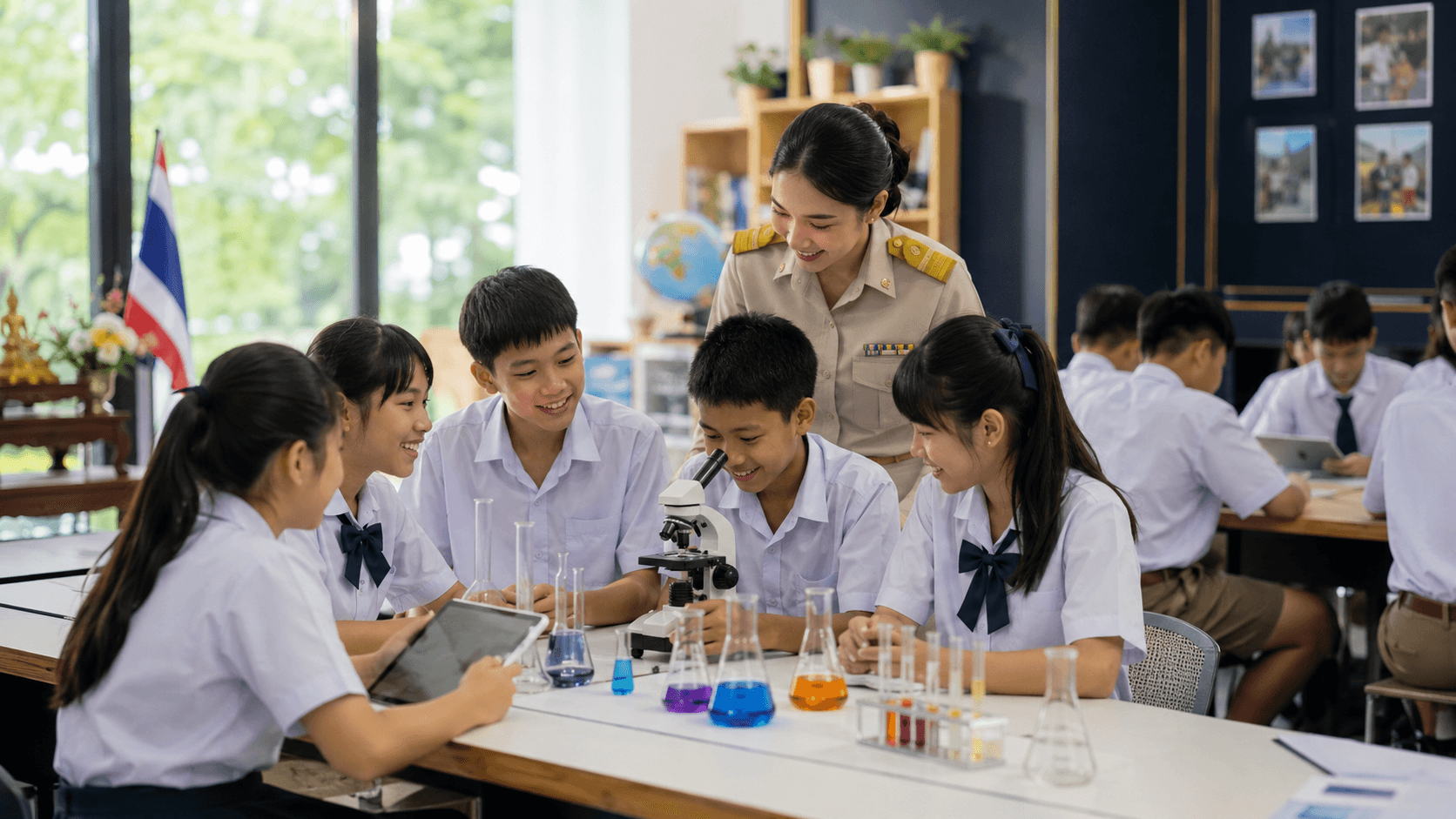
Thailand's public basic-education system is administered by the Office of the Basic Education Commission (OBEC), an agency of the Ministry of Education formed in 2003, which formulates the national core curriculum and learning standards and operates roughly 29,000 schools nationwide serving more than 6.3 million students across a 12-year structure — Prathom 1-6 (primary) and Mathayom 1-6 (lower and upper secondary). Resourcing and outcomes are not uniform across provinces: current policy discussion includes a proposal to consolidate a significant number of small, under-resourced rural schools with nearby larger schools, reflecting real disparities in class sizes, staffing and facilities between urban and rural areas that this page does not gloss over.
Public School System
Alongside the general OBEC network, Thailand operates a small number of distinctive public-school models — university-affiliated demonstration schools and specialised government science schools — that sit outside the standard neighbourhood-school pattern. The examples below are illustrative, not a ranked or exhaustive list; the wider Princess Chulabhorn Science High School (PCSHS) network — 12 regional science high schools established in 1993 under the Ministry of Education, of which Mahidol Wittayanusorn School has served as the model school since 2008 — is described here in prose rather than as individual directory cards, because this pass could not identify one official, campus-independent website representing the whole network distinct from each school's own site.
Showing 5 of 5 entries
Science Schools
Mahidol Wittayanusorn School (MWIT)
Established 1990Thailand's first specialised science and mathematics secondary school, and the designated model school for the 12-school Princess Chulabhorn Science High School network since 2008.
Demonstration Schools
Chulalongkorn University Demonstration School
A university-affiliated demonstration secondary school operated under Chulalongkorn University's Faculty of Education.
Demonstration Schools
Kasetsart University Laboratory School
A university-affiliated laboratory/demonstration school operated under Kasetsart University's Faculty of Education.
Government Excellence Schools
Triam Udom Suksa School
Established 1938Thailand's first co-educational school, originally founded as a preparatory school for Chulalongkorn University and long regarded as one of the country's leading upper-secondary government schools.
Government Excellence Schools
Suankularb Wittayalai School
One of Thailand's oldest government secondary schools, with a long-standing academic reputation.
Directory Scope
This directory illustrates the range of Thai public-school models rather than ranking them — no school is described as 'top,' 'leading' or 'best' without a named, credible methodology, and none was independently verified for this directory during this research pass.

Private & International Schools
Thai private schools (following the national curriculum, sometimes with an English Program/bilingual track) and licensed international schools (following a foreign curriculum such as British, American or IB) are both regulated by the Office of the Private Education Commission (OPEC) but sit in different licensing categories with different curricular obligations. OPEC's official count recorded 249 licensed international schools as of June 2024.
Showing 11 of 11 entries
British Curriculum
Bangkok Patana School
Founded 1957Thailand's oldest British international school, offering the British curriculum from early years through secondary.
British Curriculum
Harrow International School Bangkok
Founded 1998A British-curriculum school founded in 1998, part of the Harrow international schools network.
British Curriculum
Shrewsbury International School Bangkok
Riverside campus opened 2003A British National Curriculum school on the Chao Phraya River offering IGCSE and A Levels to around 1,900 students aged 3-18 from 40 nationalities.
British Curriculum
Wellington College International School Bangkok
Opened August 2018The first Wellington College established in ASEAN, following the standards of its founding school, Wellington College in Berkshire, England.
British Curriculum
St Andrews International School Bangkok
Founded 1997A British-curriculum school, part of the Nord Anglia Education group, operating across Bangkok campuses from Foundation Stage to age 18.
British Curriculum
Regent's International School Bangkok
A day and boarding school for ages 2-18, following the English National Curriculum from EYFS through IGCSE to the IB Diploma Programme in the Sixth Form.
British Curriculum
King's College International School Bangkok
Opened September 2020A King's College School Wimbledon international school on Ratchada-Rama 3 Road, offering IGCSEs and A Levels to students aged 2-18.
IB Curriculum
NIST International School
Founded 1992 · Not-for-profitA not-for-profit IB World School founded in 1992 with support from the United Nations, offering the full IB continuum (PYP, MYP, DP) for ages 3-18.
IB Curriculum
Concordian International School
Founded 2001A Pre-K to Grade 12 IB World School describing itself as Thailand's only fully trilingual international school, with immersion in English, Chinese and Thai.
American Curriculum
International School Bangkok (ISB)
An established American-curriculum international school in Bangkok.
Bilingual Schools
Wells International School
Offers an American and IB curriculum alongside a bilingual English-Thai stream across its Bangkok campuses — a hybrid model within Thailand's international-school market.
Directory Scope
This directory lists a range of well-documented, officially verifiable international and bilingual schools as illustrative examples — it is not a comprehensive or ranked list of Thailand's 249+ licensed international schools, and no school is described as 'top,' 'leading' or 'best' without a named, credible methodology (none was independently verified for this directory during this research pass). No fee schedules are shown because no current, dated fee schedule was independently opened during this research pass — confirm current fees directly with each school for the relevant academic year.
Thailand as an ASEAN Education Hub
Thailand International Schools
Thailand's international-school sector has expanded steadily over the past two decades, driven originally by expatriate demand and increasingly by Thai families choosing a foreign or bilingual curriculum. The market now spans British, American, IB and bilingual providers concentrated in Bangkok, with a growing presence in Chiang Mai, Phuket and the Eastern Economic Corridor provinces.
Official licensed count
249 schools (June 2024)
OPEC's official licensing register — Thailand's primary regulatory data point for international schools.
Source: Office of the Private Education Commission (OPEC) (opens in a new tab) · Accessed 22 August 2026
Later industry-reported count
275 schools · 92,960 pupils (2025)
A later, non-official figure reported in industry coverage — shown separately because it is a different, more recent count using different methodology from OPEC's official register.
Source: Bangkok Post sector reporting (opens in a new tab) · Accessed 22 August 2026
Regional standing (English-medium)
181 schools — 2nd in ASEAN
Per ISC Research data cited in Thai press coverage, Thailand ranks second in ASEAN for English-medium international schools with 181, behind Indonesia's 190 — a different counting methodology from OPEC's licensing register (which includes non-English-medium curricula too) and not to be added to or compared directly against the OPEC or Bangkok Post figures above.
Source: ISC Research, via The Nation Thailand (opens in a new tab) · Accessed 22 August 2026
Major curriculum providers active in Thailand include the British National Curriculum (IGCSE/A Level), the American curriculum, and the International Baccalaureate (PYP/MYP/DP) — see the Private & International Schools directory above for named examples of each. Thailand's combination of cost-competitive tuition relative to Singapore and Hong Kong, an established expatriate community, and improving air and digital connectivity supports its positioning as a regional ASEAN study destination, alongside its role serving the growing segment of Thai families opting into international or bilingual education.
Reading These Figures Together
The three figures above measure different things: OPEC's is Thailand's official regulatory license count; the Bangkok Post figure is a later, non-official industry estimate; and the ISC Research figure is a regional English-medium-school comparison using ISC's own database and definitions. They should be read side by side, not summed or treated as updates of one another.

Universities, Research & International Programs
Thailand's higher-education landscape includes public autonomous universities (self-governing under their own charter acts), other public universities, private universities, and specialized institutions, alongside a growing number of international and joint-degree programs. MHESI directly accredits 154 institutions as of December 2023, plus 18 additional entities including foreign and specialized providers.
Public autonomous universities
Self-governing public universities including Chulalongkorn University and Mahidol University — Thailand's leading research universities per the rankings discussed in the Global Position section.
Public universities
Non-autonomous public universities and Rajabhat/Rajamangala university networks providing broad regional access to higher education across Thailand's provinces.
Private universities
Private higher-education institutions represented collectively by the Association of Private Higher Education Institutions of Thailand (APHEIT), founded 1979.
Specialized institutions & international programs
Institutes focused on specific fields (technology, the arts, public administration) and a growing set of international/joint-degree programs delivered in partnership with foreign universities.
Research Strength — Not a Ranking List
Thailand's public autonomous universities lead the country's documented research output and international collaboration, including a BOI-facilitated agreement with Thailand's Research Universities Network (a group of eight leading research universities) aimed at stimulating private-sector demand-driven R&D, cooperative education and high-skilled workforce recruitment. This section intentionally avoids turning research strength into a ranking list — see Global Position & Rankings for the specific, named rankings this page does cite.
Public & Private University Directory
Showing 10 of 10 entries
Top Public Universities
Chulalongkorn University
Thailand's oldest university and a comprehensive public research university spanning nearly all major academic fields.
Top Public Universities
Mahidol University
A leading public research university known for medicine, health sciences and life sciences, home to Mahidol University International College (MUIC) — Thailand's first public international college, founded 1986.
Top Public Universities
Chiang Mai University
Northern Thailand's leading public research university, offering an extensive slate of English-medium international programmes.
Top Public Universities
Thammasat University
Thailand's second-oldest university, established 1934, historically strong in law, political science and business administration.
Top Public Universities
Kasetsart University
Thailand's first agricultural university, since expanded into science, engineering, life sciences, humanities and social sciences.
Top Public Universities
King Mongkut's University of Technology Thonburi (KMUTT)
A national public engineering and technology university founded in 1960, focused on teaching and applied research.
Private Universities
Bangkok University
A private university offering international bachelor's and master's programmes in creative and business fields.
Private Universities
Assumption University (ABAC)
A private Catholic university, administered by the Brothers of St. Gabriel, established as Assumption Business Administration College in 1972.
Private Universities
Rangsit University
A private university established in 1986 (as Rangsit College), covering music, design, information technology, public health and medicine.
Private Universities
Stamford International University
A private, for-profit international university established in 1995, with a strong business and hospitality orientation.
Directory, Not a Ranking
This directory presents public and private universities alphabetically within each category — it is a directory, not a ranking. See Global Position & Rankings below for the specific, named third-party rankings this page cites (QS World University Rankings and QS World University Rankings by Subject only).

TVET & Industry-Linked Skills
The Office of the Vocational Education Commission (OVEC) oversees Thailand's certificate and diploma-level technical colleges and industrial skills training system, delivered through roughly 429 public and 484 private colleges nationwide. OVEC was responsible for close to 1 million vocational students as of 2019 — the most recent figure this research pass could verify. Vocational education links directly to Thailand's industrial clusters — including automotive, digital technology, hospitality and healthcare support — though the depth of dual-vocational or work-integrated-learning models varies by programme and employer partnership.
Linked industrial clusters
Cross-Sector Note
The links above connect to T3's own verified sector gateway pages for each industry, where TVET-relevant workforce and skills context (where documented) sits alongside that sector's investment and trade information — this page does not duplicate that sector-specific detail here.

Thailand EdTech Ecosystem
Thailand's digital-education landscape spans national programmes (curriculum-level STEM promotion, BOI-linked research-university collaboration, and a growing number of 'smart school' digital-classroom pilots in individual OBEC and private schools) and a distinct, fast-growing private EdTech sector. This page keeps the two clearly separated: national programmes are policy-level initiatives; the companies named below are private products, not government platforms.
Private EdTech products (not government platforms)
SkillLane
An established Thai online-learning platform offering professional and academic courses.
Learn Education / Learn Corporation
A Thai EdTech company that has matured since 2020, incorporating AI-driven personalised learning paths.
Starfish Labz
An EdTech platform focused on supporting a healthier, more supportive learning environment for students and the adults around them.
OpenDurian
An education technology platform using AI to develop educational content based on Thai education data.
Edsy
A deep-tech startup offering an AI-driven English-language practice solution.
SCB 10X — RISA
An AI grading/assessment assistant built on the Thai-aware Typhoon LLM, trialled to reduce grading time for open-ended answers.
EdTech opportunity map
Content
Curriculum-aligned digital content development for schools and self-directed learners.
Platforms & LMS
Learning-management systems and course-delivery platforms serving schools, universities and corporate training.
Assessment
Digital and AI-assisted assessment and grading tools, including automated feedback on open-ended responses.
Simulation
Simulation-based learning tools for technical, vocational and safety-critical training.
Language learning
English and other language-learning tools, an active area of Thai EdTech product development.
Corporate training
Reskilling and upskilling platforms serving employers directly, distinct from K-12 or university-facing products.
Special-needs & accessibility technology
Technology supporting learners with additional needs — a less-developed segment of Thailand's current EdTech market relative to mainstream content and assessment tools.
Graduate Talent & Specialization Fields
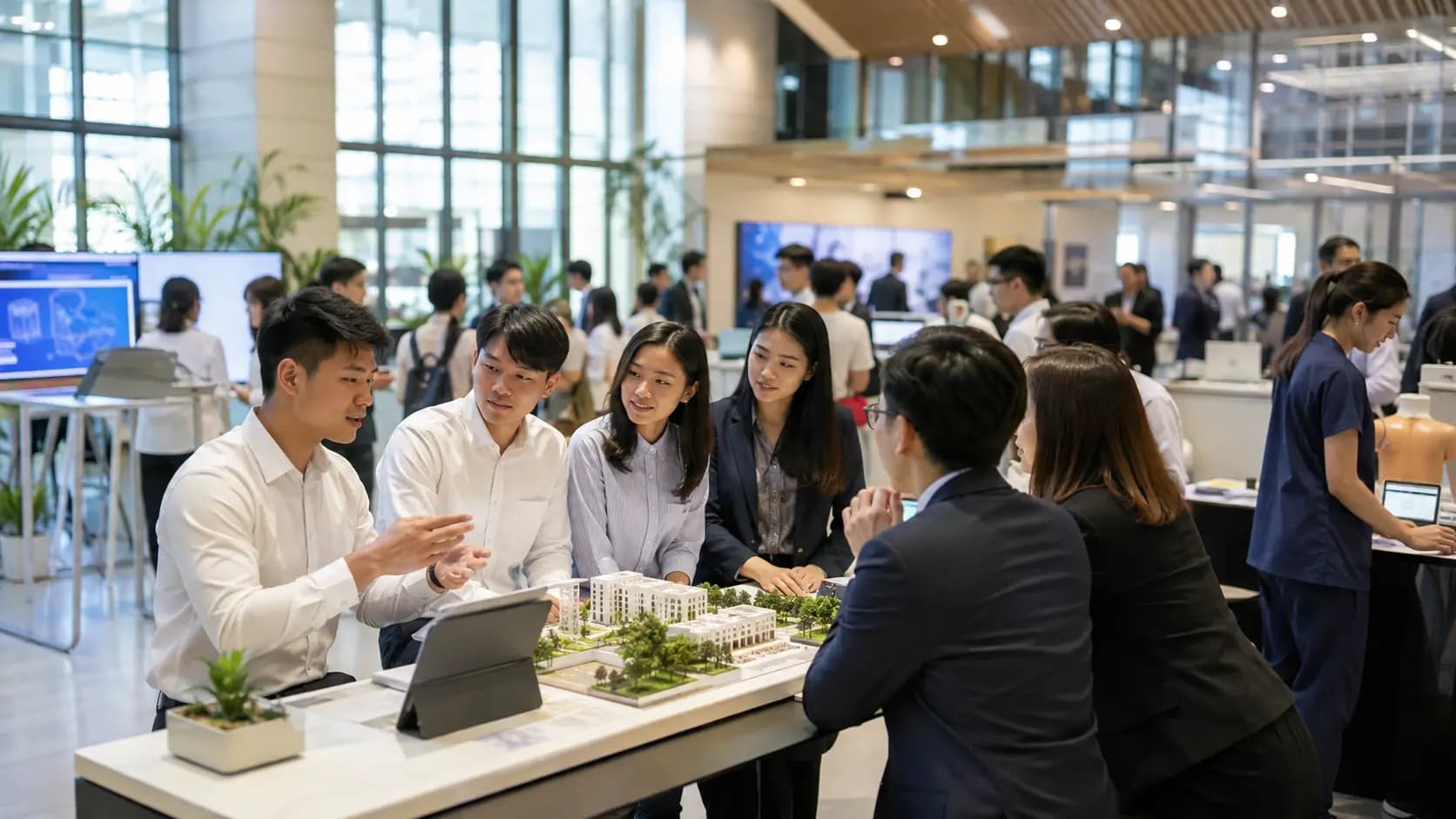
This section deliberately does not present a single national 'graduate output' figure by field: Thailand's higher-education enrollment (~1.97 million students, 2024) is a stock of currently-enrolled students, not an annual graduate count, and a verified, current, field-by-field annual graduate-output breakdown from MHESI was not found during this research pass. Where this page does show a specific, sourced claim about a field of academic strength, it draws on named QS subject rankings rather than an invented graduate count.
Chulalongkorn University — 46 subjects ranked #1 in Thailand
QS World University Rankings by Subject 2026 ranked Chulalongkorn University #1 in Thailand across 46 subjects, with 8 subjects placing in the world's top 100.
Mahidol University — 5 subjects in the world's top 100
QS World University Rankings by Subject 2026 placed Mahidol University in the world's top 100 in five subjects: Music (35th globally), Veterinary Science, Performing Arts, Nursing, and Pharmacy & Pharmacology.
Data Limitation
Named fields relevant to Thailand's industrial base — engineering, computer science/AI, electronics, healthcare/life sciences, agriculture/food, business, tourism/hospitality, creative industries, logistics and automotive/EV — are all represented in Thailand's university system, but this page does not state a specific annual graduate count for any of them because no current, authoritative MHESI dataset breaking down graduates (as opposed to total enrollment) by field was independently confirmed during this research pass. Readers needing this data should consult MHESI's own statistical publications directly.

International Teacher Requirements
Requirements for foreign teachers in Thailand vary by school type, role and the teacher's own qualifications — this is an orientation, not legal advice. Confirm current requirements with the employing institution, the Teachers' Council of Thailand, the Department of Employment and the Immigration Bureau before relying on this summary.
The employing school (itself licensed by OPEC, or operating as a public school under OBEC) is responsible for sponsoring the relevant visa category and coordinating work-permit documentation — requirements differ between international schools, Thai private schools and public schools.
Foreign teachers require an appropriate visa category permitting work (commonly a Non-Immigrant B visa for school employment) before a work permit can be issued — confirm the correct route with the employing school and the Immigration Bureau.
The Department of Employment (Ministry of Labour) issues work permits; since 13 October 2025 the Department has enforced mandatory use of its fully digital e-Work Permit platform, processed through over 40 Foreign Work Permit Service Centers nationwide.
The Teachers' Council of Thailand (Khurusapha/TCT) issues teaching credentials in tiers: foreigners without an education degree typically start with a Temporary Permit (Waiver, 2 years) granted via the school, then may progress to a Provisional (P) License (2 years) and eventually a Basic (B) License (5 years) by completing the TPDI 7 Professional Standards Modules (420 study hours) or an accredited Graduate Diploma, and passing three NIETS board exams.
Applicants typically need to provide certified degree and transcript evidence appropriate to their role and licensing tier — exact requirements depend on the specific license tier being sought.
Foreign academic and background documents may require authentication or legalization (e.g. via the issuing country's foreign ministry or a Thai embassy/consulate) before Thai authorities will accept them — confirm current requirements for your document's country of origin.
Schools — particularly ISAT-member international schools, which maintain their own safeguarding protocols — commonly require criminal-background checks, health screening and safeguarding training in addition to the statutory licensing and visa/work-permit requirements.
Specific roles (e.g. IB-programme teaching, subject specialisms, leadership positions) may carry additional qualification, experience or language requirements set by the individual school rather than by a single national standard.
Not Legal Advice
Not every foreign employee in Thai education follows an identical route — requirements differ meaningfully between international schools, Thai private schools, public schools and non-teaching roles. Confirm current requirements directly with the employing institution, the Teachers' Council of Thailand (ksp.or.th), the Department of Employment (doe.go.th) and the Immigration Bureau before relying on this summary for a real application.

Quality Assurance & Accreditation
Beyond the five core regulators listed in the Government Education Directory above, two further bodies carry specific quality-assurance and licensing functions across the whole system — government licensing, Thai quality assurance and optional international accreditation are three different things, and this page keeps them separate.
Office for National Education Standards and Quality Assessment (ONESQA)
An independent public organisation, established 2000, that develops external-assessment criteria and evaluates/accredits institutions across basic, vocational, higher and non-formal education levels.
Visit official websiteTeachers' Council of Thailand (Khurusapha / TCT)
Issues and regulates teaching licenses, temporary permits and professional-standards credentials for teachers, including foreign teachers.
Visit official websiteAccreditation Scope
International accreditation (e.g. from a foreign accrediting body that some international schools or university programmes hold) applies only to the specific named institution or program holding it — it is not a blanket Thai government endorsement and does not replace the Thai licensing and quality-assurance roles described above and in the Government Education Directory. Confirm any accreditation claim directly with the accrediting body's own current member/institution list.

Education Investment, Incentives & Market Entry
BOI's promoted-activity focus for education has shifted: rather than promoting international schools as such, current BOI materials describe promotion criteria centred on Vocational Training Centers, High-Potential Academies, High-Potential Institutions for Higher Education, and STEM education/training institutes, which must teach or train technical courses in specific approved fields. This page does not imply that an ordinary school automatically receives a tax holiday — eligibility must be confirmed project by project.
STEM education & vocational-training institutes
Under BOI's refreshed promotion package announced 15 January 2026, companies investing in the establishment of education and vocational-training institutes specialising in STEM (science, technology, engineering and mathematics) subjects are eligible for a 5-year corporate income tax exemption, subject to a minimum investment of THB 1 million (excluding land and working capital costs) for institutes developing human resources in Advanced STEM fields.
BOI — current promoted activitiesHigh-Potential Academies & Higher-Education Institutions
BOI's current criteria centre promotion on 'High-Potential Academies' and 'High-Potential Institutions for Higher Education' that teach or train technical courses in specific BOI-approved fields (including design training centres) — a narrower, activity-specific category rather than education-sector-wide promotion.
BOI Investment Promotion GuideResearch-university collaboration (BOI–RUN)
BOI has an agreement with Thailand's Research Universities Network — eight leading research universities — aimed at stimulating private-sector demand-driven R&D, cooperative-education programmes and high-skilled workforce recruitment.
BOI — current promoted activitiesSMART Visa for education, science and key talent
BOI's SMART Visa programme allows qualifying foreign investors, their families, and key talent in business, science and education to reside in Thailand for up to 4 years without needing a separate work permit — a facilitation measure distinct from a tax incentive.
BOI — SMART VisaEligibility Must Be Confirmed Project by Project
Eligibility must be confirmed project by project. BOI's education-related promoted-activity criteria, incentive groups and non-tax privileges (including any foreign-expert facilitation, land rights or foreign-ownership relaxation) apply only to the specific approved activity, are activity-based rather than company-based, and require a Thai-workforce-development plan as part of the application — do not assume an ordinary school, tutoring centre or general higher-education programme qualifies without direct confirmation against BOI's current Investment Promotion Guide and activity-list documentation.
Why investors choose Thailand
ASEAN location
Central regional access to ASEAN's combined population and growing intra-regional student and talent mobility.
Growing middle class
Rising Thai household demand for bilingual and international-curriculum education, alongside expatriate demand.
International demand
An established base of international schools, universities and training providers already serving a multinational student and corporate-training population.
Government support
BOI incentives, SMART Visa facilitation, and Thailand 4.0 policy alignment linking education directly to priority industries.
Legal & compliance framework
- Private-school and higher-education licensing — operating a private school requires OPEC licensing; operating a higher-education institution requires MHESI accreditation, each with its own application and compliance requirements.
- Foreign Business Act (FBA) implications — education-services provision by foreign-majority entities may fall within the FBA's restricted-activity framework depending on the specific activity; confirm current classification with the Department of Business Development.
- Land/building — school and campus facilities are subject to standard Thai land-use, zoning and building-permission requirements (see T3's Construction Thailand chapter for the general regulatory framework).
- Employment — teaching and non-teaching staff employment is subject to standard Thai labour law plus the sector-specific teacher-licensing requirements described in the Teacher Requirements section.
- Child safeguarding — schools, particularly those serving minors, are expected to maintain safeguarding policies; ISAT member schools reference safeguarding standards on ISAT's own site.
- Personal-data obligations — schools and education operators handling student and staff personal data are subject to Thailand's Personal Data Protection Act (PDPA) requirements.
Partnership Pathways
Foreign education operators, universities and EdTech providers typically enter the Thai market through one of the structures below. None of these structures bypasses Thailand's licensing or foreign-ownership rules — they are ways of structuring compliant participation, not workarounds.
International school operation
Operating a licensed international school under OPEC, typically via a Thai-registered entity meeting OPEC's licensing requirements.
University joint programs
Joint academic programmes between a Thai and foreign university, delivered under Thai institutional accreditation.
Dual degrees
Structured dual-degree pathways allowing students to earn credentials from both a Thai and a partner foreign institution.
Articulation agreements
Credit-transfer and pathway agreements between institutions, commonly used for students progressing from Thai TVET or undergraduate programmes to foreign universities.
Research partnerships
Collaborative research arrangements, including BOI-facilitated links with Thailand's Research Universities Network.
Corporate academies
Employer-run training academies addressing specific workforce skills gaps, often linked to a named industrial sector.
TVET partnerships
Employer and industry partnerships with vocational colleges, including work-integrated learning models where officially documented.
Teacher development
Professional-development partnerships supporting Thai and international teachers, including Teachers' Council-recognised training providers.
EdTech distribution
Distribution and licensing partnerships bringing foreign EdTech products into Thai schools, universities or corporate-training markets.
Campus & service partnerships
Facilities, catering, technology and other service partnerships supporting school and university campus operations.
Global Position & Rankings
Rankings are shown sparingly and only where this research pass found a named methodology, publisher, edition/year and exact band or rank. No unofficial ranking or listicle website is used as a source anywhere on this page. A subject-level ranking is never converted into a university-wide claim, and PISA — an OECD assessment of 15-year-old students' learning outcomes — is never presented as a university ranking.
QS World University Rankings · 2026 edition
Chulalongkorn University
Overall global ranking
221st globally; Thailand's No. 1 university for the 17th consecutive year; among the top 10 in ASEAN
Source: Chulalongkorn University official news · Accessed 22 August 2026
QS World University Rankings by Subject · 2026 edition
Chulalongkorn University
Subject rankings (60 subjects evaluated)
Ranked No. 1 in Thailand in 46 of 60 evaluated subjects, with 8 subjects in the world's top 100
Source: Chulalongkorn University official news · Accessed 22 August 2026
QS World University Rankings by Subject · 2026 edition
Mahidol University
Subject rankings
World top 100 in 5 subjects: Music (35th globally), Veterinary Science, Performing Arts, Nursing, and Pharmacy & Pharmacology
Source: Mahidol University official news · Accessed 22 August 2026
Ranking Methodology Caution
Rankings use different methodologies, weightings and subject definitions between publishers and editions, and can change year to year. This page does not compare rankings across different publishers as if they used the same methodology, and does not restate a subject-level result as a claim about the whole university's overall standing.
PISA — a learning-outcomes assessment, not a university ranking
The OECD's Programme for International Student Assessment (PISA) measures learning outcomes among 15-year-old students, not universities. In PISA 2022 (the most recent published cycle), Thai students scored 394 in mathematics (OECD average: 472), 379 in reading (OECD average: 476) and 409 in science (OECD average: 485). Average performance declined across all three subjects compared to 2018, continuing a downward trend since 2012 (roughly a 30-point decline in mathematics and science, and a 60-point decline in reading, over 2012-2022). Only about 35% of Thai students reached PISA reading Level 2 or higher, against an OECD average of 74%.
Source: OECD, PISA 2022 Results — Country Notes: Thailand · Accessed 22 August 2026

Thailand as an Education Destination
Thailand draws international students through a combination of English-medium university programmes, comparatively affordable tuition and living costs relative to regional peers, and Bangkok's position as a major ASEAN transport and logistics hub. The market spans the ASEAN regional student base, degree-seeking students from further afield, and shorter exchange, language and training programmes.
Medical & Health Sciences
English-medium programmes at institutions such as Mahidol University, a leading centre for medical and health-science education and research in the region.
Engineering & Technology
English-medium engineering programmes at institutions including KMUTT, Chulalongkorn and Chiang Mai University, linked to Thailand's industrial and digital-economy priorities.
Hospitality & Tourism Management
Hospitality-focused programmes including Stamford International University and Rangsit University's Stenden Rangsit partnership, reflecting Thailand's global tourism and hospitality industry.
Digital Technology & Computer Science
Growing English-medium digital technology and computer science offerings, including Bangkok University's computer engineering programme, aligned with Thailand 4.0 priorities.
Scholarships
For Academic Year 2026, MHESI's Thailand Scholarship Program — delivered in cooperation with Thai higher-education institutions — offered 211 academic programmes, including at least 174 scholarship awards for Master's and Doctoral study plus exchange and training programmes, open to international applicants. Specific scholarship availability varies by year, field, institution and nationality; prospective students should confirm current offerings directly with MHESI/OPS and with each university's international admissions office rather than relying on any fixed list.

International Students & Education-Services Trade
Beyond the individual-student opportunity described above, Thailand's international education-services activity also has a trade-policy dimension spanning international-school enrollment, transnational education partnerships, and study-abroad services. These are distinct populations and markets, not a single 'international students' figure — this page does not merge them.
- International-school enrollment — OPEC's official count recorded 249 licensed international schools as of June 2024, serving a mix of expatriate and increasingly Thai families; this is a K-12 population, separate from university-level international students.
- International/joint university programmes — a growing number of Thai universities offer English-medium and joint/dual-degree programmes with foreign partner institutions, discussed in the Universities section.
- Study-abroad and outbound services — Thailand hosts an active study-abroad and international-education-fair market, including the OCSC International Education Expo, connecting Thai students to foreign universities (see the Events section).
- Thailand's regional accessibility — Bangkok's status as a major regional aviation and logistics hub supports international education-services activity, though this page does not cite a specific inbound-international-student total because no current, authoritative figure was independently confirmed during this research pass.
Trade-Framework Note
GATS, ASEAN, RCEP and Thailand's bilateral trade agreements include services-sector commitments that can be relevant to cross-border education services, but these are framework-level provisions. They do not automatically grant a school license, professional recognition, a visa, or unrestricted market access — the specific schedule, reservation and current implementing regulation must be verified for any real transaction before relying on a services-commitment claim.
Investment, Employment & Professional Association Directory
Showing 5 of 5 entries
Investment & Employment
Thailand Board of Investment (BOI)
Administers investment promotion for eligible education, training and R&D activities.
Investment & Employment
Department of Employment (DOE)
Issues work permits for foreign employees, including school and university staff.
Investment & Employment
Immigration Bureau
Manages visa issuance and extensions relevant to foreign education-sector employees and students.
Professional Associations
Council of University Presidents of Thailand (CUPT)
A coordinating body of Thai state-university presidents, established 1972, overseeing the centralized university-admission system.
Professional Associations
Association of Private Higher Education Institutions of Thailand (APHEIT)
Represents Thailand's private higher-education institutions, established 1979.
Associations & Trade Bodies
Verified associations, chambers, federations, business councils and government bodies connected to Education in Thailand.
- Government Agency
Thailand Board of Investment
BOI
Thailand's national investment-promotion agency — grants tax and non-tax incentives for promoted activities and coordinates investor support through offices across Asia, Europe, Australia and the US.
- IT & AI
- Textiles
- Food, Beverage & FMCG
- Rubber & Raw Materials
- Energy & Renewable Energy
- Cosmetics
- Seafood
- Gems, Jewellery & Precious Stones
- Packaging, Printing & Labelling
- Furniture, Wood & Interior Products
- Electrical, Electronics & Semiconductors
- Halal Economy
- Education
- Real Estate / Living
- Spa, Wellness & Beauty Services
- Logistics
- Trade Services
- Manufacturing
- Professional & Business Services
- Healthcare
- Government Agency
Department of Employment
DOE
Issues work permits for foreign employees, including school and university staff.
- Government Agency
Immigration Bureau
Manages visa issuance and extensions for foreign residents, education-sector employees, students, retirees and long-stay visa holders.
- Industry Association
International Schools Association of Thailand
ISAT
Represents Thailand's international education sector, covering 200+ member schools.
- Industry Association
Council of University Presidents of Thailand
CUPT
A coordinating body of Thai state-university presidents, established 1972, overseeing the centralized university-admission system (TCAS).
- Industry Association
Association of Private Higher Education Institutions of Thailand
APHEIT
Represents Thailand's private higher-education institutions, established 1979.
Education Shows, Fairs & Conferences
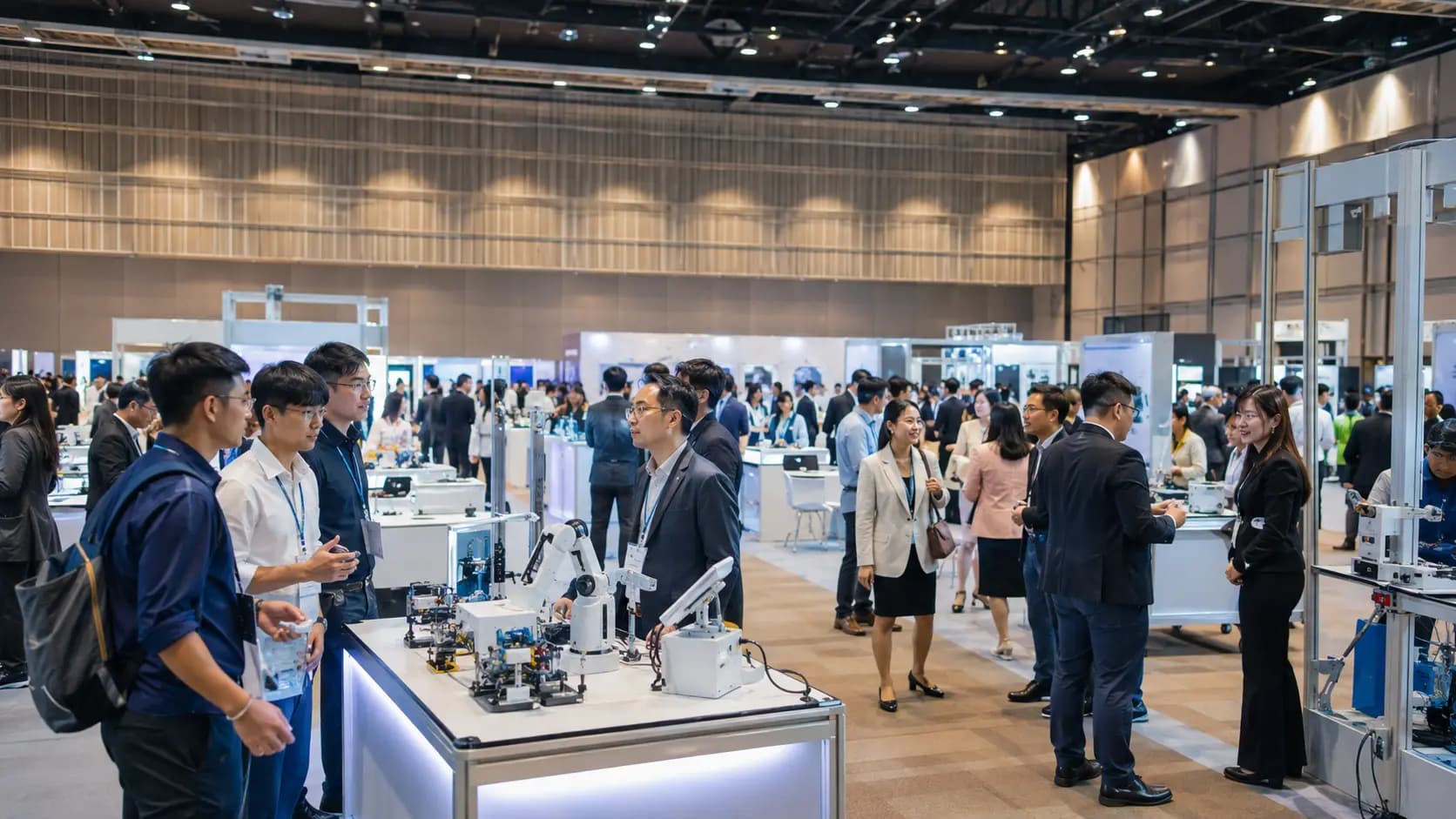
Thailand hosts several education-focused fairs and academic/teacher conferences. Confirmed upcoming events with strong current sourcing are shown below, alongside two academic conferences already held in 2026 shown as recently concluded. Note: Bett Asia (a major education-technology exhibition sometimes associated with the region) relocated to Kuala Lumpur, Malaysia for its 2026 edition, and WorldDidac Asia relocated to Hangzhou, China for 2026 — neither is a current Thailand event and both are excluded here rather than mis-listed.
OCSC International Education Expo 2026
Described by its organiser as Thailand's largest international education fair, connecting Thai students with foreign universities, colleges, schools and language programmes across 30+ countries.
- Venue:
- Paragon Hall, Siam Paragon, Bangkok
- Organiser:
- OCSC EXPO
- Focus:
- Study abroad, international university/college recruitment, scholarships
Accessed 22 August 2026
Thailand Festival of Education 2026
Now in its fourth year, a professional-learning event for international educators — teachers, school leaders and education innovators — founded by Wellington College (UK) in 2010 and operated regionally by EducationScape. The 2026 edition features keynote speakers Doug Lemov, Hannah Miller and Chloe Combi, with 600+ attendees, 50+ sessions and 75+ speakers expected.
- Venue:
- Wellington College International School Bangkok
- Organiser:
- EducationScape (founded by Wellington College, UK)
- Focus:
- Teacher professional development, school leadership, education innovation
Accessed 22 August 2026
6th International Education Conference (IECONF 2026)
An academic conference for educators, researchers, policymakers and practitioners to present research, publish in SCOPUS-indexed journals and discuss educational innovation.
- Venue:
- Bangkok
- Organiser:
- IECONF
- Focus:
- Education research, teacher education, e-learning, education policy
Accessed 22 August 2026
21st Education and Development Conference (EDC2026)
A forum and networking event for academic, professional and government stakeholders in education, teaching and learning.
- Venue:
- Bangkok
- Organiser:
- Tomorrow People Organization
- Focus:
- Education and development, teaching and learning research
Accessed 22 August 2026
Asia-Pacific Regional Forum on Teachers
A forum convening policymakers, teacher representatives, development partners and experts from across the Asia-Pacific region.
- Venue:
- Bangkok
- Organiser:
- Regional education/teacher-policy partners
- Focus:
- Teacher policy, workforce development
Accessed 22 August 2026
Event Date Status
This page shows exact dates only where confirmed on an organiser's current official page, and never guesses a future edition from an annual pattern. Additional recurring Thailand-based school fairs, career fairs and skills competitions exist but were not independently confirmed against a current official date during this research pass.
Sources & Methodology

Every statistic, regulatory description, ranking, event date and organization fact on this page is cited to a specific source with an access date. Sources are grouped below by type; each row states what it supports and any limitation readers should know about. No unofficial ranking or 'top school/university' listicle website was used as a factual source.
| Source | Supports | Limitation |
|---|---|---|
| Office of the Basic Education Commission (OBEC) | OBEC's role and basic-education structure; school/enrollment figures | School/enrollment figures were cross-verified via secondary coverage rather than an OBEC statistical publication opened directly in this pass — confirm the current count with OBEC's own statistics office. |
| Office of the Vocational Education Commission (OVEC) | OVEC's role; vocational enrollment and college-count figures | The ~1 million student figure and college counts found this pass date to 2019-era sources — confirm the current figure directly with OVEC. |
| Source | Supports | Limitation |
|---|---|---|
| Mahidol Wittayanusorn School (MWIT) | Founding year, science/mathematics specialisation, role as PCSHS model school | Opened directly during this research pass. |
| Chulalongkorn University Demonstration School | Existence and university-affiliation of the demonstration school | Referenced via search results; site structure limited full independent verification of current details in this pass. |
| Kasetsart University Laboratory School | Existence and university-affiliation of the laboratory school | Referenced via search results in this pass. |
| Triam Udom Suksa School | Founding year (1938) and status as a leading government excellence school | Founding-year fact cross-verified via Wikipedia rather than the school's own historical page in this pass. |
| Suankularb Wittayalai School | Existence and standing as a historic government excellence school | Referenced via search results in this pass. |
| Source | Supports | Limitation |
|---|---|---|
| Office of the Private Education Commission (OPEC) | International-school licensing and the 249-school (June 2024) official count | OPEC's official site was referenced via search results, not independently opened for a live statistics page in this pass. |
| Individual school official sites (Bangkok Patana, Harrow Bangkok, Shrewsbury, Wellington College Bangkok, Regent's, King's College Bangkok, NIST, Concordian, ISB, Wells) | Named school directory entries — founding year, curriculum type | Founding-year and curriculum facts are cross-verified via search-result summaries and each school's own site rather than opened in full detail in every case; St Andrews International School Bangkok's official presence was identified via its Nord Anglia Education group page rather than a standalone school domain. |
| International Schools Association of Thailand (ISAT) | ISAT's role and membership scope; safeguarding standards reference | Opened directly during this research pass; ISAT's own 2025 school-count/enrollment figures were displayed as images on its homepage and could not be extracted as text — the Bangkok Post-reported figures (275 schools, 92,960 pupils) are used instead, clearly labelled as a different, later source than OPEC's official count. |
| ISC Research, via The Nation Thailand | Regional comparison of English-medium international-school counts (Thailand 181, Indonesia 190) | Cited via a Thai press summary of ISC Research data rather than ISC Research's own report opened directly in this pass; uses a different counting methodology from OPEC's official register. |
| Source | Supports | Limitation |
|---|---|---|
| Ministry of Higher Education, Science, Research and Innovation (MHESI) | Higher-education enrollment (~1.97M, 2024) and accredited-institution count (154, Dec 2023) | Figures cross-verified via search-result summaries; a field-by-field annual graduate-output breakdown was not found and is not shown on this page. |
| University directory official sites (Chulalongkorn, Mahidol, Chiang Mai, Thammasat, Kasetsart, KMUTT, Bangkok University, Assumption University, Rangsit University, Stamford International University) | Public/private university directory — location, specialisation, international programmes, founding facts | Programme counts (e.g. Chiang Mai's 80+ international programmes, Kasetsart's 24 international undergraduate programmes) are as reported in search-result summaries of each university's own materials, not independently recounted from a primary programme catalogue in this pass. |
| Council of University Presidents of Thailand (CUPT) | CUPT's role and founding year | Referenced via search results, not independently opened in this pass. |
| Association of Private Higher Education Institutions of Thailand (APHEIT) | APHEIT's role and founding year | Referenced via search results, not independently opened in this pass. |
| Source | Supports | Limitation |
|---|---|---|
| Teachers' Council of Thailand (Khurusapha) — license search | Teaching-license tiers, TPDI modules, NIETS exam requirement | Requirements summarised from current 2026 third-party guides referencing Khurusapha's own process — confirm directly with the Teachers' Council before relying on this summary. |
| Department of Employment — e-Work Permit | Mandatory digital work-permit platform (effective 13 October 2025) | Referenced via search results; manual-submission transition deadlines are subject to change — confirm current status directly. |
| Source | Supports | Limitation |
|---|---|---|
| ONESQA — official site | ONESQA's founding year (2000) and cross-level quality-assessment role | Referenced via search results, not independently opened in this pass. |
| Source | Supports | Limitation |
|---|---|---|
| Thailand Board of Investment (BOI) — official site | General BOI promotion framework for education-related activities | Confirm specific activity eligibility directly — not independently re-verified for every activity cited on this page. |
| BOI Investment Promotion Guide 2025 (PDF) | Incentive-tier structure referenced for education-adjacent activities | Referenced via search results, not independently opened in this research pass. |
| BOI 15 January 2026 promotion package coverage (Alvarez & Marsal, AIM Bangkok) | Refreshed 2026-2027 BOI measures, STEM institute CIT exemption and THB 1 million minimum-investment detail | Third-party advisory-firm summaries of the BOI package, not the BOI's own primary announcement text, opened directly in this pass. |
| Source | Supports | Limitation |
|---|---|---|
| Chulalongkorn University — official rankings news | QS World University Rankings 2026 and QS Subject Rankings 2026 results for Chulalongkorn | University's own reporting of third-party ranking results — cross-check against QS's own published tables for exact figures. |
| Mahidol University — official rankings news | QS Subject Rankings 2026 results for Mahidol | University's own reporting of third-party ranking results. |
| OECD — PISA 2022 Results, Country Notes: Thailand | PISA 2022 mathematics/reading/science scores and proficiency-level data | PISA 2022 is the most recent published cycle at the time of this research pass; PISA 2025 results were not yet published. |
| Source | Supports | Limitation |
|---|---|---|
| MHESI Thailand Scholarship Program (via ops.go.th) | Academic Year 2026 scholarship-programme scale (211 academic programmes, 174+ Master's/Doctoral awards) | Programme counts are specific to the Academic Year 2026 cycle and change annually — confirm current-year availability directly with MHESI/OPS. |
| Source | Supports | Limitation |
|---|---|---|
| OCSC International Education Expo — official site | OCSC Expo 2026 dates, venue, scope | Organiser's own site; 'largest international education fair' is the organiser's own claim, not an independently verified ranking. |
| Thailand Festival of Education — official site | 2026 event date (7 November), venue, organiser, keynote speakers, scale | Opened directly during this research pass; attendee/session/speaker counts are the organiser's own stated figures. |
| IECONF — official site | IECONF 2026 dates, venue, scope | Opened directly during this research pass. |
Sources last reviewed: 22 August 2026

An Education Destination, Innovation Hub & Investment Opportunity in ASEAN
From public schools and licensed international schools to vocational training and research universities, Thailand's education ecosystem offers real opportunity for operators, investors and talent — with regulatory and licensing due diligence as essential as market understanding. T3 connects education operators, universities, investors and talent partners to verified government, professional and industry resources across Thailand's education ecosystem.